Advertisements
Advertisements
Question
Go to your college library and collect and read the poems written by Sarojini Naidu.
Advertisements
Solution
The students can read the following poems by Sarojini Naidu:
- A Love Song from the North
- A Rajput Love Song
- Alabaster
- An Indian Love Song
- Autumn Song
Notes
[Note: The above activity students will do themselves]
APPEARS IN
RELATED QUESTIONS
Working in pairs, go through the table below that gives you information about the top women tennis players since 1975. Write a short article for your school magazine comparing and contrasting the players in terms of their duration at the top. Mention some qualities that you think may be responsible for their brief or long stay at the top spot.
Top-Ranked Women Players
I. The roll of honour of women who enjoyed life at the summit since everybody’s favourite player, Chris Evert, took her place in 1975.
| Name | Ranked on | Weeks as No. 1 |
| Maria Sharapova (Russia) | 22 August 2005 | 1 |
| Lindsay Davenport (U.S.) |
October 2004 |
82 |
| Amelie Mauresmo (France) | 13 September 2004 | 5 |
|
Justine Henin-Hardenne (Belgium) |
20 October 2003 | 45 |
| Kim Clijsters (Belgium) | 11 August 2003 | 12 |
| Serena Williams (U.S.) | 8 July 2002 | 57 |
| Venus Williams (U.S.) | 25 February 2002 | 11 |
| Jennifer Capriati (U.S.) | 15 October 2001 | 17 |
| Lindsay Davenport (U.S.) | 12 October 1998 | 82 |
| Martina Hingis (Switzerland) | 31 March 1997 | 209 |
| Arantxa Sanchez-Vicario (Spain) | 6 February 1995 | 12 |
| Monica Seles (U.S.) | 11 March 1991 | 178 |
| Steffi Graf (Germany) | 17 August 1987 | 377 |
| Tracy Austin (U.S.) | 7 April 1980 | 22 |
| Martina Navratilova (U.S.) | 10 July 1978 | 331 |
| Chris Evert (U.S.) | 3 November 1975 | 362 |
Write an e-mail to the Principal of a neighbouring school requesting him/her to send a team of three members to participate in the Quiz Competition.
Fill in the blank with the suitable word.
He agreed to carry _____________ the manager’s orders.
Can we say that the poet has succeeded in conveying his point? How?
Can it be argued that this is an anti- war poem?
How is he affected by the experience of seeing the daffodils?
Who are ‘they’ referred to in the third line of the last stanza? When had the poet come across them?
What is the symbolic significance of the sun, sky and wind in the first stanza?
But a caged BIRD stands on the grave of dreams
His shadow shouts on a nightmare scream
His wings are clipped and his feet are tied
So he opens his throat to sing.
Read the above lines and answer the question that follow.
What does the line “and his shadow shouts on a nightmare scream” mean?
Explain the difference between welcome scene and departure scene from the poem “The Patriot” by Robert Browning.
It was roses, roses, all the way,
With myrtle mixed in my path like mad;
The house-roofs seemed to heave and sway,
The church-spires flamed, such flags they had,
A year ago on this very day.
Read the above lines and answer the question that follow.
When was the patriot welcomed?
What message is conveyed in the poem?
Who won the race and how? Explain in about 50 words.
What event is referred to in the poem?
Who won the race as described in the end.
How does Seattle justify his religion as opposed to what the white men had said about it?
The programme ran________six hours.
Read the following passage carefully and answer the questions that follow:
For some time Mother had greatly envied us our swimming, both in the daytime and at night, but as she pointed out when we suggested she join us, she was far too old for that sort of thing. Eventually, however, under constant pressure from us, Mother paid a visit into town and returned to the villa coyly bearing a mysterious parcel. Opening this she astonished us all by holding up an extraordinary shapeless garment of black cloth, covered from top to bottom with hundreds of frills and pleats and tucks.
‘Well, what do you think of it?’ Mother asked.
We stared at the odd garment and wondered what it was for.
‘What is it?’ asked Larry at length.
‘It’s a bathing-costume, of course,’ said Mother. “What on earth did you think it was?’ ‘It looks to me like a badly-skinned whale,’ said Larry, peering at it closely.
You can’t possibly wear that, Mother,’ said Margo, horrified, Shy, it looks as though it was made in nineteen-twenty.’
‘What are all those frills and things for?’ asked Larry with interest.
‘Decoration, of course,’ said Mother indignantly.
‘What a jolly idea! Don’t forget to shake the fish out of them when you come out of the water.’
‘Well, I like it, anyway,’ Mother said firmly, wrapping the monstrosity up again, ‘and I’m going to wear it.’
‘You’ll have to be careful you don’t get waterlogged, with all that cloth around you,’ said Leslie seriously.
‘Mother, it’s awful; you can’t wear it,’ said Margo. ‘Why on earth didn’t you get something more up to date?’
‘ When you get to my age, dear, you can’t go around in a two-piece bathing suit… you don’t have the figure for it.’
‘I’d love to know what sort of figure that was designed for,’ remarked Larry.
‘You really are hopeless, Mother,’ said Margo despairingly.
‘But I like it… and I’m not asking you to wear it,’ Mother pointed out angrily.
‘That’s right, you do what you want to do,’ agreed Larry; ‘don’t be put off. It’ll probably suit you very well if you can grow another three or four legs to go with it.’
Mother snorted indignantly and swept upstairs to try on her costume. Presently she called to us to come and see the effect, and we all trooped up to the bedroom. Roger the dog, was the first to enter, and on being greeted by this strange apparition clad in its voluminous black costume rippling with frills, he retreated hurriedly through the door, backward, barking ferociously. It was some time before we could persuade him that it really was Mother, and even then he kept giving her vaguely uncertain looks from the corner of his eye. However, in spite of all opposition, Mother stuck to her tent-like bathing- suit, and in the end we gave up.
In order to celebrate her first entry into the sea we decided to have a moonlight picnic down at the bay, and sent an invitation to Theodore, who was the only stranger that Mother would tolerate on such a great occasion. The day for the great immersion arrived, food and wine were prepared, the boat was cleaned out and filled with cushions and everything was ready when Theodore turned up.
One word answers or short phrases will be accepted.
- peering
- ferociously
- immersion
(b) Answer the following questions briefly in your own words.
- Why did mother not join the swimming in the beginning?
- Briefly describe her swimming costume.
- What did Larry think it was?
- Which sentence tells you that Margo thought it was old fashioned?
- What was Leslie’s concern?
- Why did mother think it was suitable?
(c)
(i) In not more than 60 words describe what happened after mother went upstairs to try on her costume.
(ii) Give a title to your summary in 3 (c) (i). Give a reason to justify your choice.
Fill in the blank with an appropriate word:
Air pollution is responsible for the spread ……… bronchitis.
Referring closely to specific instances in the play 'Arms and the Man', discuss how Shaw presents class distinctions and social snobbery.
Write a composition (350–400 words) on the following:
You had booked a ticket on an early morning train. However, you woke up late and missed it. You then decided to run to catch a bus to the next station, where you hoped to catch up with the train. Narrate the entire event, including how you felt, the effort you made, and how you finally caught the train. What did you learn from this stressful experience?
Fill in the blank with an appropriate word:
He found the key just _______ the front door.
The following words used in the text as ship terminology are also commonly used in another sense. In what contexts would you use the other meaning?
| Knot | stern | boom | hatch | anchor |
Give reasons for the following.
The boy king changed his name from Tutankhaten to Tutankhamun.
Some of the leaves and flowers mentioned in the passage for adorning the dead are willow, olive, celery, lotus, cornflower. Which of these are common in our country?
Look for some more poems in the rain and see how this one is different from them.
You are the class representative and you have been asked by the Principal to conduct an interview of a cop. Frame 8-10 questions with the help of the following points, give introduction and conclusion.
- reasons for joining the department
- special training
- developing the skill to identify and locate criminals
- dealing with criminals
- achievements and awards.
Find various career opportunities in Small-scale Industries like Handloom, Art and Craft, Block Printing, etc.
Rewrite the following incomplete sentences carefully, so that the reader does not have to guess what is left out.
1. more and more books
2. too difficult
3. got up late, missed the bus
4. solved the mystery
Your teacher will speak the word given below. Write against two new words that rhyme with it.
wax ______ ______
Multiple Choice Question:
The poet had a quarrel with her ______
Multiple Choice Question:
Explain The afternoon turned black.
Use the phrase in a sentence of your own, after finding out its meaning.
on board
What is beauty? Where can, in the poet’s opinion, beauty be seen, heard, and experienced?
The word ‘round’ usually means a kind of shape. What is its meaning in the story?
Re-word the line from the story:
“We cannot bandage the children’s mouths, so they really have to exercise their will-power.”
Find words in the story, which show things striking violently against each other.
The crow and the myna c_ll____in mid-air.
Look at your hands carefully. Now, write down for each finger one action for which that finger is particularly important. For example, the second (or index) finger helps to hold the knife down firmly when cutting.
Notice the use of ‘there’ in the following sentences.
-
There was a big crowd at the fair.
-
There were many things I’d have liked to buy.
Now rewrite the following sentences using ‘there’ in the beginning. Look at the following examples.
-
I can do nothing to help you.
-
There is nothing I can do to help you.
-
A man at the door is asking to see you.
-
There is a man at the door asking to see you.
1. This park has beautiful roses.
2. Your story has no fun in it.
3. We have no secrets between us.
4. My village has two primary schools.
5. This problem can be solved in two ways.
Discuss with your partner and choose the correct alternative.
A democratic country is governed by, its - __________________.
Rewrite the given statements in their order of occurrence.
The most difficult task of maintaining the hold on Tiger Hill was achieved in this way:
- 8 Sikh was ordered to attack and capture Helmet and India Gate.
- Bodies of the Pakistani soldiers were collected and buried appropriately.
- During the ferocious artillery duels, the Grenadiers hung on their precarious perch with grit and determination.
- Sikh fought back successfully two counterattacks with forty to fifty personnel.
- An ad-hoc column of 8 Sikh climbed the steep rock and captured India Gate.
- In spite of heavy casualties, 8 Sikh captured Helmet on 5 July.
Guess the meaning of the above proverbs and write them down along with a sentence of your own.
Form pairs and make a 'pair presentation' of any one of the two stories. To do so, each person presents only one sentence at a time, and the next one is immediately presented by the partner. Thus, each person in the pair presents alternate sentences without breaking the flow of the narration.
What is your favourite source of light? Write its autobiography. (10 - 15 lines)
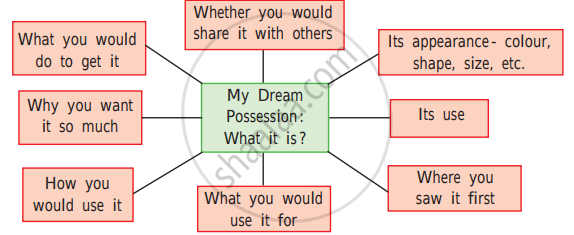
Is there something that you would like to own more than anything else? Describe your dream possession with the help of the following points. You may add your own points, too.
Write what you think about the following thoughts and actions of Mathilde :
Mathilde told her friend about the lost necklace.
Prepare a formal invitation for a function you have arranged at home. It should clearly state the following points:
- Who is inviting people to the function.
- What the program is.
- The date and time.
- The venue. (The place where
- A polite request to attend the function. the function will take place.)
Use the details given in the story and your imagination and prepare a timetable for the trip to the moon.
Use the internet, your school library, or other sources for the following activity.
Try to find other nature poems.
Hold a discussion in the classroom about the differences between printed newspapers, radio news bulletins, TV news bulletins. Discuss the merits, demerits, and popularity of each.
Write 3 to 5 sentences about the following character.
The Bachelor
There are many legends about the ‘nine gems’ in Akbar’s Court. These are popular tales and they may not have a historical basis. Can you name some of the nine gems and the stories associated with them?
Write about your own daydream in short.
Your class has to stage a Puppet Show in the Assembly Open Forum on the topic ‘Child Labour’. Divide yourselves into groups and discuss the requirements for the presentation like a storyline, characters, dialogues, choice of puppets, and music for the interlude. Now complete the dialogues given below.
| Ramesh | Let us present a Puppet Show on CHILD LABOUR for our Assembly Open Forum. |
| Mohammed | That is a very good idea! Let us start planning right away. |
| Geetha | _______________________________________________________? |
| Leema | I suggest we begin with the storyline first. |
| Mani | How ___________________________________________________ ? |
| Ramesh | We can have around five characters. |
| Mohammed | What __________________________________________________ ? |
| Meena | We can focus on the problems of poverty and illiteracy as the major reasons for child labour. |
| Ramesh | Can _________________________________________________? |
| Leema | I am good at making stick puppets. I will make them myself. But I require some help. |
| Mani | I ________________________ . Tell me, ______________________. |
| Leema | Thank you, Mani. Let us stay back after the meeting and discuss. |
| Ramesh | Have ___________________________ ? |
| Meena | I think we should have some music for the interlude. |
| Geetha | That would make it really interesting. I will get my music group to start working on the tunes for our puppet show. |
Look at the image of the familiar advertisement given below. Identify the product and try to frame your own slogan for them.

You are the receptionist of your school. Your Head master instructs you to send a message to all the parents of class ten to attend a PTA (Parent-Teacher Association) meet which is to be held on 22.12.2019
|
______________________________ ______________________________ ______________________________ ______________________________ |
Create a pamphlet for the following.
Make a pamphlet on the latest gadgets (Mention the variety of models, uses, needs, and availability).
If you are asked to choose from any one of these toys which one do you choose? Give reasons. (plastic toys, wooden toys, clay toys, metallic toys)
What are the themes of the singers’ songs?
Punctuate the following sentence.
when I went fishing I caught an old shoe a plastic bag and a bad cold.
Make sentences using any two new words which you have learnt in the lesson.
How did the grandmother spend the last few hours of her life?
What was Sletherby’s response to Bertie’s request?
Explain the following phrase selected from the story in your own word and work with a partner to make sentence using these phrase:
on approval
Bring out the people’s reaction to the noises from the surgery.
Study the pie-chart carefully and answer the questions that follow.
Percentage of people who speak each language as their first language.

- Which language is spoken by most people?
- What are the Indian languages that rank among the top five spoken languages?
- Which are the languages that are spoken by less than three percent of people?
- With the help of the questions and answers, draw your own conclusions from the pie chart. Then, write a paragraph on the popular spoken languages.
Why did the photographer feel happy after taking the photograph?
What kind of relationship existed between Miss Meadows and the Science Mistress?
Urban living brings with it a possibility of various communicable diseases.
Now write an article of about 150 words for a leading newspaper on the various ways of maintaining personal hygiene and sanitation in order to ensure a healthy living. Make use of the hints given below
Hints:
a) Introduction – ‘Cleanliness is next to Godliness’ – brief explanation
b) Personal hygiene
(i) Frequent washing of hands and regular bathing
(ii) Brushing of teeth, trimming of nails and hair
(iii)Wearing clean clothes
c) Keeping diseases at bay
(i) Avoid street food
(ii) Keep food containers covered
(iii)Drink boiled water
(iv) Wash fruits and vegetables in flowing water
d) Keeping living areas, surroundings and the environment clean
(i) Disposal of domestic organic waste on a daily basis and hazardous waste in designated places
(ii) Regular sweeping, mopping and dusting
(iii)Disinfection of toilets and bathing areas
(iv) Avoid littering of public places
(v) Avoid spitting, urinating and defecating in public places
e) Conclusion – hygiene – a collective exercise – everyone’s involvement and practice, a must – ensure community health and happiness – celebrate life
Write the contraction for the following phrase.
have not - ______
Write the full form for the following.
who's - ______
Study the picture given below. Write a story or a description or an account of what it suggests to you. Your composition may be about the subject of the picture, or you may take suggestions from it; however, there must be a clear connection between the picture and your composition.

When Luz Long said, 'something must be eating you' he meant that Jesse Owens must be ______.
What might success mean to the following people? Think about it and write.
A person who has applied for a job
In your opinion what things will help to make the world a better place? Discuss with your friends and write down at least three of the things.
Write a letter to your father asking permission to go on an educational tour.
Write a review of a film that you watched recently, using the points given below. The reveiw is to be published in your school newsletter and should not exceed 300 words.
Name of the film and director - lead actors and their performances - plot - setting - description of a scene that you particularly liked - rating and recommendation.
Write a composition (300-350 words) of the following:
‘Peer pressure is a force for good.' Express your views either for or against this statement.
