Advertisements
Chapters
1: Reproduction in Organisms
2: Sexual Reproduction in Flowering Plants
3: Human Reproduction
4: Reproductive Health
UNIT 2 : GENETICS AND EVOLUTION
▶ 5: Principles of Inheritance and Variation
6: Molecular Basis of Inheritance
7: Origin of Life
8: Evidences and Theories of Biological Evolution
9: Human Evolution
UNIT 3 : BIOLOGY AND HUMAN WELFARE
10: Human Health and Diseases
11: Strategies for Enhancement in Food Production
12: Microbes in Human Welfare
UNIT 4 : BIOTECHNOLOGY AND ITS APPLICATIONS
13: Principles and Processes of Biotechnology
14: Biotechnology and Its Applications
UNIT 5 : ECOLOGY AND ENVIRONMENT
15: Organisms and Populations
16: Ecosystem
17: Biodiversity and Its Conservation
18: Environmental Issues
![Nootan solutions for बायोलॉजी [इंग्रजी] इयत्ता १२ आईएससी chapter 5 - Principles of Inheritance and Variation - Shaalaa.com](/images/biology-english-class-12-isc_6:5d0f76efd5b64b75a3ef882e75824c08.png "Nootan solutions for बायोलॉजी [इंग्रजी] इयत्ता १२ आईएससी chapter 5 - Principles of Inheritance and Variation")
Advertisements
Solutions for Chapter 5: Principles of Inheritance and Variation
Below listed, you can find solutions for Chapter 5 of CISCE Nootan for बायोलॉजी [इंग्रजी] इयत्ता १२ आईएससी.
Nootan solutions for बायोलॉजी [इंग्रजी] इयत्ता १२ आईएससी 5 Principles of Inheritance and Variation Test Your Progress [Pages 196 - 207]
OBJECTIVE TYPE QUESTIONS Choose the correct answer from the alternatives given.
One pure strain of pea plants developed by Mendel had yellow seeds and another strain had green seeds. All the offsprings from crosses between these two parental strains of plants had yellow seeds. In these plants, the allele for yellow seed colour is ______.
recessive to the allele for green colour
dominant over the allele for green colour
epistatic over other alleles
expressed only in gametes
An organism with two copies of the same allele is ______.
homozygous for that trait
heterozygous for that trait
homologous for the allele
heterologous for the allele
In Mendel’s crosses beginning with two pure strains of pea plants, one with yellow seeds (Y/Y) and the other with green seeds (y/y), the test cross was done between F2 offspring with yellow seeds and a pure strain of plants with the genotype:
Y/Y
y/y
Y/y
YY/yy
In all the Mendel’s experiments, the two alleles causing a trait were:
dominant-recessive
codominant
incompletely dominant
corecessive
When Mendel crossed a pure white flowered strain of pea with a pure red flowered strain, the first generation hybrids had:
only red flowers
only white flowers
pink flowers
three red and one white flowers
Mendelian recombinations are due to ______.
mutation
linkage
modifications
independent assortment of characters
A test cross distinguishes between:
two homozygous forms
two heterozygous forms
a homozygous dominant and the heterozygous form
a homozygous recessive and a heterozygous form
If individuals of genotype Aa Bb Cc are intercrossed, how many different phenotypes can appear in their offspring?
3
6
8
16
If individuals of genotype Aa Bb Cc are intercrossed, how many different genotypes can occur in their progeny?
6
9
15
27
Mendel did not deal with:
segregation
linkage
incomplete dominance
both linkage and incomplete dominance
Alleles are ______.
self-fertilizing, true-breeding homozygotes
different molecular forms of a chromosome
different molecular forms of a gene
none of the above
A heterozygote has a ______ for the trait being studied.
haploid condition, in genetic terms
pair of non-identical alleles
pair of identical alleles
both haploid condition, in genetic terms and pair of identical alleles
The observable traits of an organism are its ______.
phenotype
pedigree
genotype
sociobiology
F1 offspring of the monohybrid cross AA × aa are ______.
all AA
all Aa
all aa
1/2 AA and 1/2 aa
Second-generation offspring from a cross are the ______.
F1 generation
F2 generation
hybrid generation
none of these
Assuming complete dominance will occur, the offspring of the cross AA × Aa will show a phenotypic ratio of ______.
3 : 1
1 : 2 : 1
9 : 3 : 3 : 1
9 : 1
Crosses between F1 individuals resulting from the cross AABB × aabb lead to F2 phenotypic ratio close to ______.
1 : 1 : 1 : 1
3 : 1
9 : 3 : 3 : 1
1 : 2 : 1
Consider a cross in which a trait is inherited by complete dominance. What percentage of the F2 from the mating of homozygous dominant and homozygous recessive individuals will possess the heterozygous genotype?
75 per cent
50 per cent
25 per cent
0 per cent
Consider a cross in which a trait is inherited by incomplete dominance. What percentage of the F2 from the mating of homozygous dominant and homozygous recessive individuals will possess the dominant phenotype?
0 per cent
25 per cent
50 per cent
75 per cent
An independent assortment of traits from different parents occurs as a result of events during ______ of meiosis.
anaphase I
metaphase II
prophase II
prophase I
A test cross involves crossing an individual of unknown genotype with an individual of known genotype that usually is ______ for the trait in question.
homozygous dominant
homozygous recessive
heterozygous
incompletely dominant
Which of the following explains how progeny can possess the combinations of traits that none of the parents possessed?
Law of segregation
Chromosome theory
Law of independent assortment
Polygenic inheritance
A 1 : 1 phenotypic ratio in a test cross indicated that ______.
alleles are codominant
dominant phenotype parent was heterozygous
dominant phenotype parent was homozygous
both parents were heterozygotes
Discovery of Mendel’s law of segregation required the use of ______.
dihybrid parental and F1 crosses
plants showing incomplete dominance
test crosses
parental crosses with true-breeding plants followed by crosses with F1 heterozygous plants
According to the theory of pangenesis:
particulate heritable factors separate in the formation of gametes
changes to an organism’s body can be passed to the next generation
sperm contains a miniature human being called the homunculus
characteristics of the offspring are a blending of parental traits
Two genes will probably assort independently if:
they are both located on the X chromosome
they are on homologous chromosomes
they are very far apart on the same chromosome
they are very close together on the same chromosome
Which characteristic of pea plants was not important in their selection as Mendel’s research organism?
Most other scientists of the time were also using peas, so a lot was known about them
Peas are easy to cultivate, and have a short generation time
Pea plants are self-pollinating but can be cross-fertilized easily
Many true-breeding varieties were available
In a mendelian monohybrid cross, which generation is always completely heterozygous?
F1 generation
F2 generation
F3 generation
P generation
In a mendelian monohybrid cross, which generation is always completely homozygous?
F1 generation
F2 generation
F3 generation
P generation
What aspect of Mendel’s background gave him the necessary tools to discover the laws of inheritance?
He was a monk
He was a teacher
He had studied mathematics and probability
He corresponded with Charles Darwin
If a pea plant shows a recessive phenotype:
it can be either TT or Tt
it can be either Tt or tt
it can be only TT
it can be only tt
The symbol ‘F’ in the results of a test cross stands for ______.
dominant
recessive
first trait to show up
filial
The F2 offspring of a monohybrid cross would show the genotype:
AA and Aa
Aa and aa
AA, Aa and aa
Aa only
The F1 offspring of a monohybrid cross would show the genotype:
AA and Aa
Aa and aa
AA, Aa and aa
Aa only
In which kind of cross would you expect to find a ratio of 3 : 1 among the F2 offspring?
Monohybrid cross
Dihybrid cross
Test cross
None of these
Back cross
A reciprocal cross would be:
between a homozygous recessive individual and a homozygous dominant one with respect to one pair of traits
between a homozygous recessive individual and a homozygous dominant one with respect to two pairs of traits
between a homozygous recessive male and a homozygous dominant female, and a separate cross between a homozygous dominant male and a homozygous recessive female
self-fertilization of an F1 plant
If you had two guinea pigs of opposite sex, both homozygous, one black and one brown, but you didn't know which was the dominant characteristic, how would you find out the dominant colour?
Mate them together and see what colour the offspring are,that will be the dominant colour
Mate them together and see what colour the offspring are,the other will be the dominant colour
Mate them together, then mate their offspring to see what colour the grandchildren are,that will be the dominant colour
Mate them together, then mate their offspring to see what colour the grandchildren are,the other colour will be the dominant colour
The offspring of a monohybrid test cross would show the genotype:
AA and Aa
Aa and aa
AA, Aa, and aa
AA only
If an individual with a dominant phenotype is crossed with an individual with a recessive phenotype, 4 of their 9 offspring show the recessive phenotype. What is the genotype of the first parent?
AA
Aa
aa
Answer cannot be determined from this information
Which of these could be a normal gamete?
GgRr
GRr
Gr
GgR
In peas, yellow seed (Y) is dominant over green seed (y). In this F2 generation of a monohybrid cross that begins when a dominant homozygote is crossed with a recessive homozygote, you would expect:
plants that produce three yellow seeds to every green seed
plants with one yellow seed for every green seed
only plants with the genotype Yy
only plants that produce yellow seeds
In humans, pointed eyebrows (B) are dominant over smooth eyebrows (b). Seema’s father has pointed eyebrows, but she and her mother have smooth. What is the genotype of the father?
BB
Bb
bb
BbBb
In tomatoes, red fruit (R) is dominant over yellow fruit (r) and tallness (T) is dominant over dwarfness (t). A plant that is RrTT is crossed with a plant that is rrTt. What are the chances of an offspring being heterozygous for both traits?
None
1/2
1/4
9/16
In the cross RrTt × rrt:
all the offspring will be tall with red fruit
75% (3/4) will be tall with red fruit
50% (1/2) Will be tall with red fruit
25% (1/4) will be tall with red fruit
When alleles move into different gametes, this demonstrates:
dominance
segregation
crossing over
independent assortment
What was the most significant conclusion that Mendel drew from his experiments?
There is considerable genetic variation in garden pea.
Traits are inherited in discrete units one from each parent.
Genes are composed of DNA.
Recessive genes occur as frequently as dominant ones.
Which of the following is an example of codominance?
Pink flowers of snapdragon
The ABO blood groups in humans
Sex-linkage in humans
None of the above
A boy has the blood group AB. What is true of the inheritance of this blood group in his case?
His parents should be one with O group and the other with B group
His parents should be one with O group and the other with A group
Both his parents should be with B group
His father should be A group and mother with B group
A girl has the blood group A. What is true of the inheritance of this blood group in her case?
Her mother should be homozygous O
Her both parents should be with O group blood
Her father could be heterozygous A
Both her parents could be heterozygous A
Reciprocal cross is made to determine it:
the trait is inherited as dominant
the trait is inherited as recessive
sex has any role in dominance recessive relationship
the trait shows codominance
A boy has the blood group O. What is true of the inheritance of this blood group in his case?
His mother should be with AB blood group
Both his parents could be heterozygous A group
His father could be homozygous B group
His mother could be homozygous A group
Who is called ‘father of genetics’?
Hugo de Vries
Carl Correns
Gregor J. Mendel
Erich Von Tschermak
Hereditary unit is ______.
chromosome
genotype
golgi bodies
gene
Person having genotype IA IB would show the blood group as AB. This is because of ______.
Co-dominance
Pleiotropy
Segregation
Incomplete dominance
In a dihybrid cross, if you get 9:3:3:1 ratio it denotes that ______.
The allels of two genes are segregating independently
It is a case of multiple allelism
It is a multigenic inheritance
The allels of two genes are interacting with each other
To analyse the genotype of an organism, it is made to:
self cross
cross with dominant parent
cross with recessive parent
cross with another species
Occasionally, a single gene may express more than one effect. The phenomenon is called ______.
pleiotropy
mosaicism
polygeny
multiple allelism
independent assortment
Mendel’s Law of independent assortment holds good for genes situated on the ______.
non-homologous chromosomes
homologous chromosomes
extra nuclear genetic element
same chromosome
Mendel proposed that the factor controlling any character is discrete and independent. His proposition was based on the ______.
observations that the offspring of a cross made between the plants having two contrasting characters shows only one character without any blending
self-pollination of F1 offsprings
cross pollination of F1 generation with recessive parent
results of F3 generation of a cross
A woman with blood group ‘O’ marries a man with blood group ‘AB’. The blood group of their son would be:
‘A’
‘B’
‘A’ or ‘B’
‘O’
In which kind of cross would you expect to find a ratio of 3 : 1 among the F2 offspring?
Monohybrid cross
Dihybrid cross
Test cross
None of these
Back cross
In mendelian monohybrid cross, which generation is always heterozygous?
First filial generation
Second filial generation
Third filial generation
Parent generation
When F1 individual is crossed with its either of the two parents, the cross is known as ______.
test cross
back cross
reciprocal cross
monohybrid cross
Which blood group is called universal donor?
A
O
B
AB
Crossing over takes place during:
prophase of meiosis I
anaphase of meiosis I
prophase of meiosis II
anaphase of meiosis II
The probability of a cross-over occurring between two gene loci is proportional to ______.
the activity of the two loci
the distance between the two loci
how far the loci are from the centromere
how tightly the chromosomes are packed in the nucleus
Which of the following is sex-linked?
Phenylketonuria
Haemophilia
Diabetes malletus
Thalassaemia
The knowledge of cross-over percentage is of importance to scientists as it ______.
proves that genes are the DNA in chromosomes
makes possible the mapping of chromosomes
enables certain gene frequencies to increase in a population
neutralizes the effect of linkage
If there is complete linkage in the F2 generation:
there will be only parental combination
new combination will be more than parental combinations
parental combinations will be equal to the new combinations
new combinations would be lesser than the parent ones
Crossing over occurs between:
sister chromatids
non-sister chromatids
centromeres
none of these
The pattern of inheritance of white eye colour in Drosophila shows that the gene is ______.
located at the X-chromosomes
located on the Y-chromosomes
located on an autosome
sex-linked
A haemophilic man marries a normal homozygous woman. What is the probability that their son will be haemophilic?
100%
75%
50%
0%
What is probability of the offspring daughter will be haeimophilic if a haemophilic man marries a normal homozygous woman?
0%
50%
75%
100%
______ segregate during ______.
genes on one chromosome; mitosis
homologues; meiosis
gene on one chromosome; meiosis
homologues; mitosis
The probability of a cross-over occurring between two genes on the same chromosome is ______.
unrelated to the distance between them
increased if they are closer together on the chromosome
increased if they are farther apart on the chromosome
impossible
Non-disjunction can be caused by ______.
multiple independent assortments
failure of chromosomes to separate during meiosis
segregation in meiosis
crossing over in mitosis
Crossing over most commonly occurs during ______.
telophase II
prophase II
anaphase I
prophase I
A gamete affected by non-disjunction would have ______.
the potential for a genetic disorder
one extra or one missing chromosome
a change from the normal chromosome number
all of the above
Which of the following events contributes to phenotypic variation in a population?
Changes in chromosome structure and number
Independent assortment
Crossing over
All of the above
The chromosome theory was proposed by ______.
Theodor Boveri
Thomas Hunt Morgan
W. S. Sutton
Sutton and Boveri
How many linkage groups would be revealed by careful analysis of human genetics?
23
4
3
1
Determine the order of genes along a chromosome based on the following recombination frequencies : A-B, 8 map units; A-C, 28 map units; A-D, 25 map units; B-C, 20 map units; B-D, 33 map units:
A-C-D-B
C-D-B-A
D-A-B-C
B-A-C-D
The chromosome theory of inheritance:
preceded Mendel’s research by a century
was proposed by Mendel
was proposed by Boveri and Sutton and explained why Mendel’s laws are true
all of the above
In chromosome mapping, one map unit represents:
the distance between one gene and the next on a chromosome
1% crossing over between two sites on a chromosome
1% of the length of the chromosome
10% crossing over between two sites on a chromosome
A human male has ______ chromosomes with ______ sex chromosomes.
46, XY
48, XY
46, XX
48, XX
White eyes in male fruit fly is determined by a ______.
dominant gene on X
recessive gene on Y
dominant gene on Y
recessive gene on X
A boy suffers from haemophilia. What is true of the inheritance of this case?
His mother could be normal (homozygous)
His mother could be a carrier of this disorder
He has inherited this disease from his father
His maternal grandfather was normal
How many genes are received in children from father?
25%
50%
75%
25-50%
Down’s syndrome is caused due to ______.
monosomy of 21st chromosome
trisomy of 21st chromosome
an extra Y-chromosome in male
an extra X-chromosome in female
White eyes in male fruit fly is determined by a ______.
dominant gene on X
recessive gene on Y
dominant gene on Y
recessive gene on X
The genotype of a person with Turner’s syndrome will be:
44 + XXY
44 + XYY
44 + XO
44 + XXYY
‘Mongoloid idiocy’ occurs due to ______.
monosomy of sex chromosomes
monosomy of 21st pair of autosomes
trisomy of sex chromosomes
trisomy of 21st pair of autosomes
The unit of inheritance is ______.
gene
phenotype
chromosome
genotype
If a genetic disease is transferred from a phenotypically normal but carrier female to only some of the male progeny, the disease is ______.
Sex-linked recessive
Autosomal dominant
Sex-linked dominant
Autosomal recessive
ZZ/ZW type of sex determination is seen in ______.
Peacock
Cockroach
Platypus
Snails
apple snail
human
Which of the following will not result in variations among siblings?
Linkage
Mutation
Independent assortment of genes
Crossing over
All genes located on the same chromosome ______.
Form one linkage group
Will not from any linkage groups
Form interactive groups that affect the phenotype
Form different groups depending upon their relative distance
Which one of the following symbols represents a Turner’s syndrome?
AA XO
AA XYY
AA XXY
AA XXX
The condition in which there are more than two complete sets of chromosomes is called ______.
aneuploidy
polyploidy
deletion
duplication
Deletions occur most often in chromosomal fragments ______.
of polytene chromosomes
without centromeres
with centromeres
with inversions
Which of the fol lowing chromosomal changes is usually the most damaging when in the homozygous condition?
Deletion
Duplication
Translocation
Inversion
An inversion, when present in just one of the chromosomes, suppresses:
mutations
cross overs
duplications
translocations
When a mutation is limited to the substitution of one nucleotide pair for another, it is called a ______.
point mutation
base inversion
translocation
sugar-phosphate deletion
Mutations can be artificially induced by ______.
X-rays
infra-red rays
visible light
radio waves
When a purine is replaced by a pyrimidine in base-pair substitution process the phenomenon is termed as ______.
transition
transversion
frameshift mutation
tautomerisation
Frame shift mutations occur following:
tautomeric shifts
base substitutions
dimer formation
insertion/deletion of single base
Variations during mutations of meiotic recombinations are ______.
random and directionless
random and directional
random and small
random, small, and directional
small and directional
Sudden change in genetic character is known as ______.
mutation
mitotic division
meiotic division
recombination
In the given pedigree chart, the trait shown is:

Autosomal dominant
Autosomal recessive
X-linked
Y-linked
Fill in the blanks with appropriate words.
Mendel studied a total of ______ traits in peas, each trait occurring in ______ different forms.
We can find out whether an organism is homozygous or heterozygous for a trait by carrying out a ______.
When Mendel cross-pollinated plants of two pure bred strains, all the offspring were ______ in their phenotypes.
Genes that exist in more than two forms are called ______.
Translocations and duplications usually have little effect on a cell’s function, since they do not result in a loss of genes. They do, however, cause problems during ______.
Any sudden heritable change in an organism is known as ______.
When a pure strain of tall plants with round peas is crossed with a pure strain of short plants with wrinkled peas, an F1 generation is produced. When these F1 plants self-pollinate, ______ proportion of the F2 generation is short with wrinkled peas.
When gametes are formed, each gamete has only ______ allele of the pair.
F2 phenotypic ratio 1 : 2 : 1 is obtained in ______ dominance.
A cross when only one pair of alleles is used for hybridization, is called ______ cross.
The more chromosomes an organism has, the more genetic variability it gets from ______.
In Drosophila, the male sex chromosomes are ______ and the female sex chromosomes are ______.
Genes located in the same chromosomes are said to be ______ in inheritance.
The normal human karyotype has ______ sex chromosomes and ______ autosomes.
In higher eukaryotes, traits coded for in extranuclear DNA are inherited solely from the ______ parent.
Independent assortment recombines genes from ______ chromosomes, and crossing over recombines genes from ______ chromosomes.
The genes responsible for sex-linked characters are located in ______.
Failure of two homologous chromosomes to go to separate cells during meiosis leading to unequal number of chromosomes in the daughter cells is known as ______.
The chromosomal theory of heredity was first proposed by ______.
Linked genes do not obey the law of ______.
Down’s syndrome is also known as ______.
The factor that causes most mutations in nature is ______.
The more chromosomes an organism has, the more genetic variability it gets from ______.
State whether the following statement is true or false.
A phenotype is either the product of gene or of environmental influences.
State whether the following statement is true or false.
Barring mutation, a pure line is expected to breed true to type.
State whether the following statement is true or false.
The F2 generation is conventionally produced by random union of the F1 gametes.
State whether the following statement is true or false.
Mendel did not deal with linkage and incomplete dominance.
State whether the following statement is true or false.
A cross between F1 hybrid and its homozygous recessive plant is called test cross.
State whether the following statement is true or false.
Where F1 phenotype is intermediate between dominant and recessive characters is known as incomplete dominance.
State whether the following statement is true or false.
Alternative forms of the same gene is called allele.
State whether the following statement is true or false.
The plants are considered to be true breeding when all the plants of the parental generation resemble each other.
State whether the following statement is true or false.
The term ‘gene’ is equivalent to ‘Mendelian factor’.
State whether the following statement is true or false.
A gene that expresses phenotypically only in homozygous condition is called recessive.
State whether the following statement is true or false.
In chickens, the female is the homogametic sex.
State whether the following statement is true or false.
No genes are common to both the X and Y-chromosomes.
State whether the following statement is true or false.
Sex-linked recessive traits in mammalian populations are always expected to be more frequent in males than in females.
State whether the following statement is true or false.
In Drosophila, the Y-chromosome does not determine ‘maleness’, but is necessary for fertility.
State whether the following statement is true or false.
The number of linkage groups is greater in Drosophila than in human beings.
State whether the following statement is true or false.
Sex-linked traits may be defined as those traits that affect the sex organs.
State whether the following statement is true or false.
Each chiasma is equivalent to 1% crossing over.
State whether the following statement is true or false.
The limit of recombination is 50%.
State whether the following statement is true or false.
In Drosophila, crossing over occurs only in females.
State whether the following statement is true or false.
Abrupt hereditary changes (first described by Hugo de Vries) are called mutations.
State whether the following statement is true or false.
X-rays increase the rate of mutation.
VERY SHORT ANSWER TYPE QUESTIONS
What is point mutation?
In what condition law of independent assortment does not hold good?
Name the plant over which Mendel conducted his hybridization experiments.
What was the total number of true breeding varieties of garden pea which Mendel had taken for his experiments?
Which genetic term is used to describe the actual appearance of an organism?
Under what conditions does Mendel’s law of independent assortment apply?
Who coined the term ‘Genetics’ and in which year?
In which branch of biology the facts and laws of heredity are studied?
Name the three eminent biologists who rediscovered the mendelian principles.
Define Mendel’s law of segregation.
Write the dihybrid ratio.
Write an example of incomplete dominance.
Define the term ‘Co-dominance’.
What is pleiotropy?
Write the dihybrid ratio.
Name the technical term for alternative forms of a gene which occupy the same position in homologous chromosomes and segregate during meiosis.
Name a plant that shows incomplete dominance in respect of the colour of its flowers.
Name the process of removing stamens from the flower bud during hybridization.
What term did Mendel use for what we now call genes?
Mendel observed two kinds of ratios 3 : 1 and 1 : 2 : 1 in F2 generation in his experiments on garden pea. Name these two kinds of ratios respectively.
Mendel studied seven traits in garden pea. Which one or more of the following were recessive? wrinkled seed, axial flower, yellow colour of pod.
Name the cross in which the following phenotypic ratio in F2 generation is obtained : 9 : 3 : 3 : 1.
How would you find the genotype of an organism exhibiting dominant phenotype trait?
When a tall pea plant was pollinated, one-fourth of the progeny were dwarf. Give the genotype of the parent and dwarf progenies.
Write the percentage of the pea plants that would be homozygous recessive in F2 generation when tall F1 heterozygous pea plants are selfed.
Write the percentage of the pea plants that would be heterozygous tall in F2 generation when tall heterozygous F1 pea plants are selfed.
What kind of test will you perform to find out whether the given plant is homozygous dominant or heterozygous?
A garden pea plant produces axial white flowers. Another of the same species produced terminal violet flowers. Identify the dominant trait?
A garden pea plant (A) produced inflated yellow pod, and another plant (B) of the same species produced constricted green pods. Identify the dominant traits.
How many kinds of phenotypes would you expect in F2 generation in a monohybrid cross exhibiting co-dominance?
Mention any two contrasting traits with respect to seeds in pea plant that were studied by Mendel.
A progeny of F1 is crossed with the homozygous recessive parent. What is this cross called?
Give scientific term for the multiple effects of a gene on the phenotype of an organism.
A cross between two tall plants resulted in offspring having few dwarf plants. What would be the genotypes of both the parents?
State the Mendel’s law of inheritance that is universally acceptable.
Give a scientific term for the following:
An alternative form of the single gene which influences the same character and produces different expressions in different individuals a species.
Name any four characters on which mendel studied for inheritance.
A man with blood group ‘O’ marries a woman with blood group AB. What would be the blood group of their children?
How many linkage groups are present in Drosophila?
How many linkage groups are found in man?
Give two examples of sex-linked inheritance in human beings.
Which chromosomes are called sex chromosomes?
Name the scientists who propounded the chromosomal theory of inheritance.
What is a linkage?
What is the main significance of linkage?
What is crossing over?
How many types of chromosomes are found in an organism?
Who carried out his genetical experiments on Drosophila?
A haemophilic son was born to normal parents. Give the genotypes of the parents.
Which chromosomes are called autosomes?
Name the phenomenon that occurs when homologous chromosome do not separate during meiosis.
Why is the Drosophila male fly referred to as heterogametic?
A diploid egg mother cell having 46 chromosomes produces two types of gametes-one with XX-chromosomes plus 22 autosomes and the other with 22 autosomes only. What phenomenon led to this situation?
Name one such trait in humans and Drosophila, whose gene is located on the X chromosome.
How many pairs of chromosomes does a male Drosophila fly have? Which one of these bears the gene for the eye colour?
How many chromosomes do drones of honey bees possess?
Write the genotypes of the normal parents producing a haemophilic son.
The male fruit fly and female fowl are heterogametic while the female fruit fly and the male fowl are homogametic. Why are they called so?
A human being suffering from Down’s syndrome shows trisomy of 21st chromosome. Mention the cause of this chromosomal abnormality.
Name the genetic disorder caused by trisomy of 21st chromosome in humans. Write the diagnostic features of the disorder.
During a medical investigation, an infant was found to possess an extra chromosome 21. Describe the symptoms the child is likely to develop later in the life.
Name the genetic disorder caused by an extra X-chromosome in a human male. State the diagnostic features of the individual suffering from it.
Name the genetic disorder in a human female having 44 + XO karyotype. Mention the diagnostic features of the disorder. Explain the cause of such chromosomal disorder.
Give the chromosomal constitution and the resulting sex in the following syndrome.
Turner’s syndrome
Give the chromosomal constitution and the resulting sex in the following syndrome.
Klinefelter’s syndrome
Which one of the following diseases could be avoided in the progeny by analysing the pedigree of the parents – Down’s syndrome, phenylketonuria, poliomyelitis?
A person possesses XXY chromosomes because of a chromosomal abnormality. Name the disorder from which he may be suffering.
Which genetic abnormality is responsible for Turner’s syndrome? What is the sex of such a person?
Give the genotype of Klinefelter’s syndrome.
Which disorder is caused in man by the presence of one extra sex chromosome?
What is the chromosomal abnormality that causes Down’s syndrome?
Which of the following conditions could be detected by karyotyping the cell-Down’s syndrome, Phenylketonuria, Poliomyelitis?
Which one of the following diseases could be avoided by analysing the pedigree of the parents- Klinefelter’s syndrome, Haemophilia, Amoebiasis?
Name any two syndromes caused due to chromosomal abnormality in humans.
Name a sex-linked disease of man.
Identify ‘a’, ‘b’, ‘c’, ‘d’, ‘e’ and ‘f’ in the table given below:
| S. No. | Syndrome | Cause | Characteristics of affected individuals | Sex (male/female/both) |
| 1. | Down’s | Trisomy of 21 |
‘a’ |
‘b’ |
| 2. | ‘c’ | XXY | Overall masculine development | ‘d’ |
| 3. | Turner’s | 45 with XO |
‘e’ |
‘f’ |
A geneticist interested in studying variations and patterns of inheritance in living beings prefers to choose organisms for experiments with shorter life cycle. Provide a reason.
Identify the correct statement:
- Female of many birds has a pair of dissimilar ZW chromosomes, while the males possess a pair of similar ZZ chromosomes.
- Female of many birds has a pair of similar ZZ chromosomes, while the males possess a pair of dissimilar ZW chromosomes.
Identify and write the correct statement.
- In Grasshopper males, two sex chromosomes are X and Y type.
- In Grasshopper males, there exists XO type of sex determinants.
A normal visioned woman, whose father is colour blind, marries a normal visioned man. What would be probability of her sons and daughters to be colour blind? Explain with the help of a pedigree chart.
Give an example of a human disorder that is caused due to a single gene mutation.
Name one autosomal dominant and one autosomal recessive Mendelian disorder in humans.
State the fate of a pair of autosomes during gamete formation.
Why is haemophilia called as bleeder’s disease?
What is crossing over?
At which stage does crossing over occur?
Give one example of incomplete linkage.
How did sturtevant explain gene mapping while working with Morgan?
The increase of one chromosome in which pair of somatic chromosomes develops Down’s syndrome?
Name the technical term for a sudden change in a gene which is inherited by offspring.
Name a chemical mutagen and a mutagenic radiation.
In which two ways numerical changes occur in chromosomes?
List any two mechanisms by which a variant genotype is produced.
What is the term for mutation involving replacement of a purine by a pyrimidine in DNA?
Name the mechanism by which new alleles appear in a population.
At which particular stage of chromosomes do errors like deletion of genes occur in an individual?
What are agents which increase the rate of mutation called?
Give the main contribution of hugo de vries.
What is meant by trisomic condition?
What is meant by the term triploid?
Define frameshift mutations.
Write the basis of origin of variations in organisms as described by hugo de vries.
Name a classical example of point mutation.
Indiscrimate diagnostic practices using X-rays etc., should be avoided. Give one reason.
What is a mutagen?
Name a physical factor that can be a mutagen.
Mention two causes of frame-shift mutation.
Give an example of a human disorder that is caused due to a single gene mutation.
SHORT/LONG ANSWER TYPE QUESTIONS
How garden pea (Pisum sativum) proved to be a suitable plant for Mendel’s work?
Define the following:
Homozygous
Define the following:
Heterozygous
Define the following:
Genotype
Define the following:
Phenotype
Define the following:
Dominant
Define the following:
Recessive
Define the following:
Allele
Define the following term:
Back cross
Discuss Mendel’s laws of inheritance. Which one of these laws do you consider the most important and why?
Why was Gregor Johann Mendel crowned with success, whereas his predecessors failed to discover the basic principles of inheritance?
A heterozygous individual plant has a genotype AB/ab. List the type of gametes that will be produced with and without crossing over between the two genes. Explain your answer.
In human beings blue eye colour is recessive to brown eye colour. A brown-eyed man has a blue-eyed mother.
- What is the genotype of the man and his mother?
- What are the possible genotypes of his father?
- If the man marries a blue-eyed woman, what are the possible genotypes of their offspring?
How did Mendel’s procedure differ from that of his predecessors? What mechanisms did the use of set aside any personal beliefs he may have had?
How did the monohybrid crosses performed 2by Mendel refute the blending concept of inheritance?
Using Mendel’s monohybrid cross as an example, trace his reasoning to arrive at the law of segregation.
Explain inheritance by multiple alleles.
List the human blood types and give the possible genotypes for each.
How does a test cross help to determine the genotype of an individual?
In Snapdragon, a cross between true-breeding red flowered (RR) plants and truebreeding white flowered (rr) plants showed a progeny of plants with all pink flowers.
What is this phenomenon known as?
What will be the results if crossing over does not occur at exactly equivalent positions on two homologous chromosomes?
A normal man marries a woman who is a carrier for colour-blindness. What will be the phenotypes of the child born to them? Depict the phenotypes through a possible cross.
Give a suitable explanation for ‘color blindness is incurable’.
What is a linkage?
How is linkage related to the phenomenon of cross-over and to Mendel’s law of segregation?
What is a linkage?
What is the main significance of linkage?
Does linkage go against Mendel’s law of independent assortment?
A white-eyed female Drosophila was mated with a red-eyed male. What will be the phenotypes of the male and female progeny?
What do you understand by sex-linked characters?
A normal man marries either a colour blind or a carrier woman. Predict the kind of children which may be expected in both the conditions.
Explain the inheritance of haemophilia in the first generation with normal father and carrier mother. Indicate the genotypes and phenotypes of the progeny.
List the three similarities between the behaviour of genes (Mendel’s factors) during inheritance and of chromosomes during cell division.
Why does the son of a carrier mother and a normal father suffer from haemophilia whereas the son of a haemophiliac father and normal mother would not?
What are autosomes?
How many autosomes would be found in the normal liver cells of a human female?
What are linked genes?
How can a pair of linked genes be identified?
Diagrammatically represent a cross between a white-eyed female and red-eyed male Drosophila.
Write a note on sex linkage.
Write a short note on crossing over.
Write a short note on sex chromosomes.
Write a short note on karyotype.
Show by a series of diagrams only how a cross over between linked genes allows their recombination during meiosis (taking into account two genes A and B with their alleles a and b located on homologous chromosomes).
Enumerate the advantages of using Drosophila for experiments on genetics.
Who had proposed the chromosomal theory of inheritance?
List the main points of chromosome theory.
What is a linkage?
In what way is linkage in opposition to Mendel’s law of independent assortment? Explain.
Name any two syndromes caused due to chromosomal abnormality in humans and mention the abnormality in each case. Describe the physical (body) symptoms related to any one of these syndromes.
How do chromosomal abnormalities due to change in the number of chromosomes arise? Give three examples of the occurrence of such abnormalities in humans.
In humans, males are heterogametic and females are homogametic. Explain. Are there any examples where males are homogametic and females heterogametic?
What is duplication in connection with chromosomal mutation?
What is translocation in connection with chromosomal mutation?
What are chromosomal mutations?
How can chromosomal mutations be induced?
Compare the kind of variations introduced within a species that reproduces sexually with another species that reproduces asexually.
What is frame shift mutation?
Name the type of mutation that does not affect protein synthesis.
Write an essay on chromosomal aberrations, giving their cytological and genetic effects.
List the different ways by which mutations alter the structure of the chromosomes. Illustrate any one of them by a diagram.
Why is genetic variability essential for a species to survive?
Name the main sources of genetic variation. How do these sources work?
How do variations arise in sexually reproducing organisms? Explain very briefly.
Differentiate between chromosomal and gene mutation.
How is frame-shift mutation different from point mutation?
Define mutation.
List the three ways in which mutations can arise.
Nootan solutions for बायोलॉजी [इंग्रजी] इयत्ता १२ आईएससी 5 Principles of Inheritance and Variation BOARD EXAMINATION QUESTIONS [Pages 207 - 208]
Write a short note on multiple alleles.
Explain pleiotropy with reference to phenylketonuria.
Explain the process of sex determination in honey bees.
Define complete linkage.
Give an example of a cross, showing complete linkage.
If the mother is a carrier of colour blindness and the father is normal, the possible genotype and the phenotype of the offspring of the next generation, with the help of a punnet square.
A homozygous pea plant with round seed coat and yellow cotyledons are crossed with another homozygous, pea plant having wrinkled seed coat and green cotyledons.
- Give the types of gametes produced by plants of F-generation.
- Give the dihybrid phenotypic ratio with the corresponding phenotypes.
- State Mendel’s principle involved in this cross.
A woman has normal vision, but her father is colourblind. If she marries a colourblind man, then what is the probability of her son being colourblind?
25%
50%
75%
100%
The genotype of a plant showing the dominant phenotype can be determined by ______.
Test cross
Dihybrid cross
Pedigree analysis
Back cross
ZZ/ZW type of sex determination is seen in ______.
Mammals
Insects
Drosophila
Birds
The X chromosome was discovered by ______.
Watson and Crick
Gregor Mendel
F. Griffith
Henking
A human male with an extra X-chromosome suffers from a condition called ______.
Down’s syndrome
Haemophilia
Kliefelter’s syndrome
Turner’s syndrome
Assertion: In sickle cell anaemia, the codon GAG is replaced by GUG.
Reason: The gene for the above mutation occurs on the Y-chromosome.
Both assertion and reason are true, and reason is the correct explanation of the assertion.
Both assertion and reason are true, but reason is not the correct explanation of assertion.
Assertion is true but reason is false.
Both assertion and reason are false.
Read the passage given below and answer the question that follow:
| Analysis of the pattern of inheritance of a particular trait through several generations of a family is called pedigree analysis. A graphic representation of the same is called a pedigree chart. It may be used to guess the probability of a child inheriting the trait under study. pedigree chart is drawn by using a standard set of symbols. |
The symbols of parents are represented by ______.
A symbol of a square and a circle joined by a horizontal line.
A symbol of two circles joined by a horizontal line.
A symbol of two squares joined by a horizontal line.
A symbol of a square and a circle joined by a vertical line.
Read the passage given below and answer the question that follow:
| Analysis of the pattern of inheritance of a particular trait through several generations of a family is called pedigree analysis. A graphic representation of the same is called a pedigree chart. It may be used to guess the probability of a child inheriting the trait under study. pedigree chart is drawn by using a standard set of symbols. |
A trait which rarely appears in a family’s pedigree chart across four consecutive generations is considered as a ______.
Dominant trait
Recessive trait
Sex-linked trait
Homozygous trait
Read the passage given below and answer the question that follow:
| Analysis of the pattern of inheritance of a particular trait through several generations of a family is called pedigree analysis. A graphic representation of the same is called a pedigree chart. It may be used to guess the probability of a child inheriting the trait under study. pedigree chart is drawn by using a standard set of symbols. |
In a pedigree chart, if a trait shows criss-cross pattern of inheritance then it is ______.
An autosomal dominant trait
An autosomal recessive trait
An X-linked dominant trait
An X-linked recessive trait
Read the passage given below and answer the question that follow:
| Analysis of the pattern of inheritance of a particular trait through several generations of a family is called pedigree analysis. A graphic representation of the same is called a pedigree chart. It may be used to guess the probability of a child inheriting the trait under study. pedigree chart is drawn by using a standard set of symbols. |
The traits that do not skip generations and are expressed in the next generation in both the sexes equally are said to be ______.
Autosomal dominant
Autosomal recessive
Sex-linked dominant
Sex-linked recessive
Read the passage given below and answer the question that follow:
| Analysis of the pattern of inheritance of a particular trait through several generations of a family is called pedigree analysis. A graphic representation of the same is called a pedigree chart. It may be used to guess the probability of a child inheriting the trait under study. pedigree chart is drawn by using a standard set of symbols. |
Phenylketonuria is an example of ______.
Autosomal dominant trait
Autosomal recessive trait
Sex linked recessive trait
Sex linked dominant trait
Nootan solutions for बायोलॉजी [इंग्रजी] इयत्ता १२ आईएससी 5 Principles of Inheritance and Variation HIGHER ORDER THINKING SKILLS QUESTIONS [Pages 208 - 211]
Identify a, b and c in the table given below:
| S. No. | Pattern of inheritance | Monohybrid F1 phenotypic expression |
| 1. | Co-dominance | a |
| 2. | b | The progeny resembled only one of the parents |
| 3. | Incomplete dominance | c |
With the help of one example provide genetic explanation of the following observation:
F1 generation resembles both the parents.
With the help of one example provide genetic explanation of the following observation:
F1 generation does not resemble either of the parents.
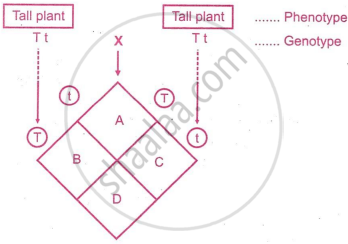
Look at the above diagram and answer the following questions:
- Write the genotypes of A, B, C and D.
- Write the phenotypes of A, B, C and D.
- Write the phenotypic ratio of progeny.
- Write the genotypic ratio of progeny.
A pea plant with purple flowers was crossed with white flowers, producing 50 plants with only purple flowers. On selfing, these plants produced 482 plants with purple flowers and 162 with white flowers. What genetic mechanism accounts for these results? Explain.
What is the phenotype of the following:
IA i
What is the phenotype of the following:
i i?
A cross between a red flower bearing plant and a white flower bearing plant of Antirrhinum produced all plants having pink flowers. Work out a cross to explain how this is possible.
In pea plants, the colour of the flower is either violet or white whereas human skin colour shows many gradations. Explain giving reasons how it is possible.
A heterozygous individual plant has a genotype AB/ab. List the type of gametes that will be produced with and without crossing over between the two genes. Explain your answer.
In snapdragon (Antirrhinum majus) a plant with red flowers was crossed with a plant with white flowers. Work out all the possible genotypes and phenotypes of F1 and F2 generations. Comment on the pattern of inheritance in this case.
A true breeding pea plant homozygous for axial violet flowers is crossed with another pea plant with terminal white flowers:
- What would be the phenotype and genotype of F1 and F2 generations?
- Give the phenotypic ratio of F2 generations.
- List the Mendel’s generalisations that can be derived from the above cross.
In Snapdragon, a cross between true-breeding red flowered (RR) plants and truebreeding white flowered (rr) plants showed a progeny of plants with all pink flowers.
The appearance of pink flowers is not known as blending. Why?
In Snapdragon, a cross between true-breeding red flowered (RR) plants and truebreeding white flowered (rr) plants showed a progeny of plants with all pink flowers.
What is this phenomenon known as?
What are the characteristic features of a true-breeding line?
Work out a cross between a tall pea plant bearing violet flowers (heterozygous for both) with a dwarf pea plant having white flowers. Write the genotypes and phenotypes of the progeny along with their ratios. Name such a cross and state its importance.
A cross was carried out between a pea plant heterozygous for round and yellow seeds with a pea plant having wrinkled and green seeds.
- Show the cross in a Punnett square.
- Write the phenotype of the progeny of this cross.
- What is this cross known as? State the purpose of conducting such a cross.
The possibility of a female becoming a haemophilic is extremely rare. Why?
What will be the results if crossing over does not occur at exactly equivalent positions on two homologous chromosomes?
A normal man marries a woman who is a carrier for colour-blindness. What will be the phenotypes of the child born to them? Depict the phenotypes through a possible cross.
Why is man unable to pass on a sex-linked gene to his son?
The son of a haemophilic man may not get this genetic disorder. Mention the reason.
Why is it that the father never passes on the gene for haemophilia to his sons? Explain.
Given below is the representation of amino acid composition of the relevant translated portion of β-chain of haemoglobin, related to the shape of human red blood cells.
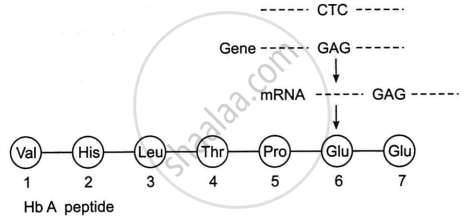
- Is this representation indicating a normal human or a sufferer from certain related genetic disease? Give reason in support of your answer.
- What difference would be noticed in the phenotype of the normal and the sufferer related to this gene?
- Who are likely to suffer more from the defect related to the gene represented the males, the females or both males and females equally? And why?
A relevant portion of β-chain of haemoglobin of a normal human is given below:

The codon for the sixth amino acid is GAG. The sixth codon GAG mutates to CAA as a result of mutation ‘A’ and into GUG as a result of mutation ‘B’. Haemoglobin structure did not change as a result of mutation ‘A’ whereas haemoglobin structure changed because of mutation ‘B’ leading to sickle-shaped RBCs. Explain giving reasons how could mutation ‘B’ change the haemoglobin structure and not mutation ‘A’.
Why is thalassemia cotegorised as a Mendelian disorder? Write the symptoms and explain the causes of the disease. How does it differ from Sickle cell anaemia?
Why are thalassemia and haemophilia categorized as Mendelian disorders? Write the symptoms of these diseases. Explain their pattern of inheritance in humans.
List any four symptoms shown by a Down’s syndrome/Turner’s syndrome/Klinefelter’s syndrome affected child. Explain the cause of the disorder.
About 8% of the human male population suffers from colour blindness, whereas only about 0.4% of the human female population suffers from this disease. Write an explanation to show how it is possible.
The progeny of a sexually reproducing organism is never the replica of the parents in all respects. Mention any three factors that cause this variation.
How do variations arise in sexually reproducing organisms? Explain very briefly.
A single base mutation in a gene may not ‘always’ result in loss or gain of function. Do you think the statement is correct? Defend your answer.
Nootan solutions for बायोलॉजी [इंग्रजी] इयत्ता १२ आईएससी 5 Principles of Inheritance and Variation NCERT EXERCISES WITH ANSWERS [Pages 211 - 212]
Mention the advantages of selecting the pea plant for the experiment by Mendel.
Differentiate between the following:
Dominance and Recessive
Differentiate between the following:
Homozygous and Heterozygous
Differentiate between the following:
Monohybrid and Dihybrid
A diploid organism is heterozygous for 4 loci; how many types of gametes can be produced?
Explain the law of dominance using a monohybrid cross.
Using a Punnett square, workout the distribution of phenotypic features in the first filial generation after a cross between a homozygous female and a heterozygous male for a single locus.
Define the following:
Test cross
Design a test-cross.
When a cross is made between tall plant with yellow seeds (TtYy) and tall plant with green seed (Ttyy), what proportions of phenotype in the offspring could be expected to be:
- Tall and green.
- Dwarf and green.
What is pedigree analysis?
Suggest how pedigree analysis can be useful?
A child has blood group O. If the father has blood group A and the mother has blood group B, work out the genotypes of the parents and the possible genotypes of the other offspring.
Explain codominance with a suitable example.
Explain incomplete dominance with suitable example.
Two heterozygous parents are crossed. If the two loci are linked, what would be the distribution of phenotypic features in the F1 generation for a dihybrid cross?
Briefly mention the contribution of T. H. Morgan in genetics.
How is sex determined in human beings?
Who had proposed the chromosomal theory of inheritance?
Mention any two autosomal genetic disorders with their symptoms.
What is point mutation?
Give one example of point mutation.
Nootan solutions for बायोलॉजी [इंग्रजी] इयत्ता १२ आईएससी 5 Principles of Inheritance and Variation VALUE BASED QUESTIONS [Page 213]
A teacher wants his/her students to find the genotype of pea plants bearing purple coloured flowers in their school garden. Name and explain the cross that will make it possible.
Given ahead is a table showing the genotypes and the phenotypes of blood groups in human population:
- Identify the genotypes (W) and (X) and the phenotypes (Y) and (Z).
- Name the pattern of inheritance exhibited by the phenotypes (Y) and (Z) in the table.
| S. No. | Genotype | Phenotype |
| 1. | (W) | |
| 2. | IBIO | (Y) |
| 3. | IAIB | (Z) |
| 4. | (X) | O |
A child suffering from Thalassemia is born to a normal couple. But the mother is being blamed by the family for delivering a sick baby.
- What is Thalassemia?
- How would you counsel the family not to blame the mother for delivering a child suffering from this disease? Explain.
- List the values your counselling can propagate in the families.
While crossing pure lines of white eyed female and red eyed males of Drosophila, a young breeder was much puzzled to find a rare specimen of white-eyed female along with a large population of red-eyed females and white-eyed males. What possible explanations could you suggest for the presence of this exceptional female in his experiment?
Ravi’s parent have normal colour vision but his maternal grandfather is colour blind. Gene for colour vision is located on X-chromosome.
- Work out a cross showing the per cent chances of Ravi and his siblings being colour blind.
- What is the genotype of his mother?
- What is the term used for this kind of inheritance?
Explain why it is scientifically incorrect to blame the mother for bearing female child?
Women are often blamed for producing female children. Consequently, they are ill-treated and ostracized. How will you address this issue scientifically if you were to conduct an awareness programme to highlight the values involved?
Do you agree to the perception in our society that the woman is responsible for the gender? Substantiate your answer scientifically.
In human beings, the sex of the child is determined by the father and not by the mother. Explain.
A cross between a normal couple resulted in a son who was haemophilic and a normal daughter. In course of time, when the daughter was married to a normal man, to their surprise, the grandson was also haemophilic.
- Represent this cross in the form of a pedigree chart. Give the genotypes of the daughter and her husband.
- Write the conclusion you draw of the inheritance pattern of this disease.
A pregnant human female was advised to undergo M.T.P. It was diagnosed by her doctor that the foetus she is carrying has developed from a zygote formed by an XX-egg fertilized by Y-carrying sperm. Why was she advised to undergo M.T.P.?
Ramu’s father has planted almost a hundred flowering plants of various varieties for his love of gardening. One fine morning while watering the plants, he noticed a flower with petals of a shade of red on a plant whereas other plants of the same variety bearing white coloured flowers. He shared this discovery with Mr. Verma during evening walk. Mr. Verma opines that this may be due to some supernatural power or bad spirit which may be inhabiting his garden. Ramu’s father is quite afraid after hearing this and has stopped watering the plant. How will you explain this biological phenomenon to Ramu's father and ward off his fear?
Nootan solutions for बायोलॉजी [इंग्रजी] इयत्ता १२ आईएससी 5 Principles of Inheritance and Variation DIFFERENTIATE BETWEEN [Pages 214 - 215]
Distinguish between the following pair:
Autosomes and Sex chromosomes
Differentiate between back cross and test cross.
Differentiate between chromosomal and gene mutation.
Differentiate between chromosomal mutation and genomatic mutation.
Differentiate between complete and incomplete linkage.
Differentiate incomplete dominance and codominance.
Differentiate between dominance and co-dominance.
Differentiate between dominance and epistasis.
Differentiate between dominance and recessiveness.
Differentiate between first filial generation (F1) and second filial generation (F2)
State a difference between a gene and an allele.
Differentiate between genotype and phenotype.
Differentiate between heredity and genetics.
Differentiate between the following:
Homozygous and Heterozygous
Differentiate between Klinefelter’s syndrome and Down’s syndrome.
Differentiate between Klinefelter’s syndrome and Turner’s syndrome.
Differentiate between law of segregation and law of independent assortment.
Differentiate between linkage and crossing over.
Differentiate between male and female heterogamety.
Differentiate between the following:
Monohybrid and Dihybrid
Differentiate between monohybrid cross and reciprocal cross.
Differentiate between monosomics and nullisomics.
Differentiate between paracentric inversion and pericentric inversion.
Differentiate between pleiotropy and polygenic inheritance.
Differentiate between point mutation and frame-shift mutation.
Differentiate between sex-linked and sex-influenced traits.
Differentiate between single crossing over and double crossing over.
Differentiate between spontaneous and induced mutations.
Differentiate between transition and transversion.
Differentiate between test cross and reciprocal cross.
Differentiate between ‘ZZ’ and ‘XY’ type of sex-determination mechanisms.
Solutions for 5: Principles of Inheritance and Variation
Nootan solutions for बायोलॉजी [इंग्रजी] इयत्ता १२ आईएससी chapter 5 - Principles of Inheritance and Variation
Shaalaa.com has the CISCE Mathematics बायोलॉजी [इंग्रजी] इयत्ता १२ आईएससी CISCE solutions in a manner that help students grasp basic concepts better and faster. The detailed, step-by-step solutions will help you understand the concepts better and clarify any confusion. Nootan solutions for Mathematics बायोलॉजी [इंग्रजी] इयत्ता १२ आईएससी CISCE 5 (Principles of Inheritance and Variation) include all questions with answers and detailed explanations. This will clear students' doubts about questions and improve their application skills while preparing for board exams.
Further, we at Shaalaa.com provide such solutions so students can prepare for written exams. Nootan textbook solutions can be a core help for self-study and provide excellent self-help guidance for students.
Concepts covered in बायोलॉजी [इंग्रजी] इयत्ता १२ आईएससी chapter 5 Principles of Inheritance and Variation are Heredity and Variation, Monohybrid Cross, Dihybrid Cross, Crossing Technique, Mendel's Laws > The Law of Dominance, Mendel's Laws > The Law of Segregation (Law of Purity of Gametes), Mendel's Laws > The Law of Independent Assortment, Genetic Terminology, Reasons for Mendel's Success, Applications of Mendel's Laws, Post Mendelian Genetics, Exceptions to Mendel's Principles > Incomplete Dominance, Exceptions to Mendel's Principles > Co-Dominance, Exceptions to Mendel's Principles > Pleiotropy, Mendel's Experiments on Inheritance, Exceptions to Mendel's Principles > Multiple alleles, Exceptions to Mendel's Principles > Polygenic traits - Quantitative inheritance, Pedigree Analysis, Chromosomal Theory of Inheritance, Linkage, Types of Linkage > Complete Linkage, Types of Linkage > Incomplete Linkage, Factors Affecting Linkage, Significance of Linkage, Crossing Over, Mechanism of Crossing Over, Types of Crossing Over, Factors Affecting Crossing Over, Significance of Crossing Over, Chromosomal Mapping, Autosomes and Sex Chromosomes, Sex Determination, Linked and Unlinked Genes, Mapping Technique, Significance of Chromosome Mapping, Basis of Sex Determination, Sex Determination in Honey Bees, Sex Linked Inheritance, Sex Linked Traits, Morgan and Drosophila, Sex-linked Inheritance in Drosophila, Sex-Linked Inheritance in Human Beings, Colour blindness, Haemophilia, Human Genetic Disorders, Mendelian Disorders in Humans, Autosomal Abnormalities, Down's syndrome (Mongolian Idiocy), Sex Chromosome Abnormalities, Disorders of Sex Development due to Sex-Chromosome Abnormality, Klinefelter's Syndrome, Turner's Syndrome, Variation, Recombinations, Mutations, Gene Mutations, Frame Shift Mutations, Substitution (Replacement) Mutations, Chromosomal Mutations or Aberrations, Deficiency or deletion, Duplication, Translocation, Inversion, Genomic Mutations or Heteroploidy or Numerical Aberrations, Aneuploidy, Gregor Johann Mendel – Father of Genetics, Euploidy, Induction of Gene Mutation, Implications of Mutations, Polyploidy: Instant Speciation.
Using Nootan बायोलॉजी [इंग्रजी] इयत्ता १२ आईएससी solutions Principles of Inheritance and Variation exercise by students is an easy way to prepare for the exams, as they involve solutions arranged chapter-wise and also page-wise. The questions involved in Nootan Solutions are essential questions that can be asked in the final exam. Maximum CISCE बायोलॉजी [इंग्रजी] इयत्ता १२ आईएससी students prefer Nootan Textbook Solutions to score more in exams.
Get the free view of Chapter 5, Principles of Inheritance and Variation बायोलॉजी [इंग्रजी] इयत्ता १२ आईएससी additional questions for Mathematics बायोलॉजी [इंग्रजी] इयत्ता १२ आईएससी CISCE, and you can use Shaalaa.com to keep it handy for your exam preparation.
