Advertisements
Advertisements
प्रश्न
Women are often blamed for producing female children. Consequently, they are ill-treated and ostracized. How will you address this issue scientifically if you were to conduct an awareness programme to highlight the values involved?
In our society the women are often blamed for giving birth to daughters. Can you explain why this is not correct?
Advertisements
उत्तर
Women are never responsible for determination of the sex of a child. Moreover, it is not appropriate to ill-treat a woman for giving birth to a girl child, as both males and females are equally important for the balance of nature and continuity of our species.
All human-beings have 23 pairs of chromosomes. A human sperm (haploid) has 22 autosomes and one of the two types of sex chromosomes, i.e. either X or Y. On the contrary, human females have 22 autosomes that are exactly same as males and contain two X chromosomes. The sex of an individual is determined by the type of the sex chromosome (X or Y) contained by the sperm that fuses with the ovum.
If the fertilising sperm has an X chromosome, then the baby would be a female and if a sperm with Y chromosome fuses with the ovum, it will develop into a male child. Thus, males are responsible for determination of the sex of a child.
APPEARS IN
संबंधित प्रश्न
Male and female gametes are ______.
Ovulation is induced by a hormone called ______.
Describe the process of budding in hydra.
In case of sexual reproduction, newborn show similarities about characters. Explain this statement with suitable examples.
Describe the process of oogenesis in human female.
In meiosis, the number of chromosomes becomes ___________.
If one pollen grain produces two male gametes, how many pollen grains are needed to fertilize 10 ovules?
The male sex hormone testosterone is secreted from ____________.
Answer the following type of question Assertion (A) and Reason (R).
(A) - In human males, testes are extra-abdominal and lie in scrotal sacs.
(R) - Scrotum acts as a thermoregulator and keeps the temperature lower by 2°C for normal sperm production.
The following is the illustration of the sequence of ovarian events (a-i) in a human female.
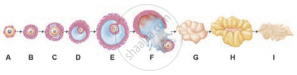
Identify the figure that illustrates ovulation and mention the stage of oogenesis it represents.
Identify the proper order of spermatogenesis and choose the correct option.
Draw a labelled diagram of a Graafian Follicle.
How many sperms are formed from a secondary spermatocyte?
Identify the wrong statement from the following.
Spermiation is the process of the release of sperm from ______.
The nutritive cells found in seminiferous tubules are ______.
The head of the epididymis at the head of the testis is called ______.
Acrosome is a type of ______.
The prostate gland and seminal vehicle perform the function of ______.
Fetal sex can be determined by examining cells from amniotic fluid looking for:
The spermatogonia undergo division to produce sperms by the process of spermatogenesis. Choose the correct one with reference to above.
The mother germ cells are transformed into a mature follicle through series of steps. Provide the missing steps in the blank boxes.

Given below are two statements.
- Statement I: The spermatids are non-motile and non-functional which get transformed into functional spermatozoa by the process of spermiogenesis.
- Statement II: During the process of this change, the spermatids remain held to each other and to Leydig's cells by cytoplasmic bridges.
In light of the above statements, select the correct answer from the option given below.
Name the germinal layers from which the following organs develop: Tongue, heart, sweat glands, vagina, mammary glands, kidney.
Sketch and label the process of oogenesis.
Distinguish between human sperm and ovum.
Select a correct pair of cells with identical set of chromosomes.
What is the primary purpose of gametogenesis in organisms?
