Advertisements
Advertisements
प्रश्न
Women are often blamed for producing female children. Consequently, they are ill-treated and ostracized. How will you address this issue scientifically if you were to conduct an awareness programme to highlight the values involved?
In our society the women are often blamed for giving birth to daughters. Can you explain why this is not correct?
Advertisements
उत्तर
Women are never responsible for determination of the sex of a child. Moreover, it is not appropriate to ill-treat a woman for giving birth to a girl child, as both males and females are equally important for the balance of nature and continuity of our species.
All human-beings have 23 pairs of chromosomes. A human sperm (haploid) has 22 autosomes and one of the two types of sex chromosomes, i.e. either X or Y. On the contrary, human females have 22 autosomes that are exactly same as males and contain two X chromosomes. The sex of an individual is determined by the type of the sex chromosome (X or Y) contained by the sperm that fuses with the ovum.
If the fertilising sperm has an X chromosome, then the baby would be a female and if a sperm with Y chromosome fuses with the ovum, it will develop into a male child. Thus, males are responsible for determination of the sex of a child.
APPEARS IN
संबंधित प्रश्न
Draw a diagram of the microscopic structure of human sperm. Label the following parts in it and write their functions:
- Acrosome
- Nucleus
- Middle piece
The following is the illustration of the sequence of ovarian events (a − i) in a human female

(i) Identify the figure that illustrates ovulation and mention the stage of oogenesis it represents.
(ii) Name the ovarian hormone and the pituitary hormone that have caused the above mentioned event.
(iii) Explain the changes that occur in the uterus simultaneously in anticipation.
(iv) Write the difference between ‘c’ and ‘h’.
(v) Draw a labeled sketch of the structure of a human ovum prior to fertilization.
Briefly describe the process of spermatogenesis.
Multiple choice question.
The given figure shows human sperm. Various parts of it are labelled as A, B, C, and D. Which labelled part represents acrosome?
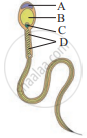
What is gamete formation?
In angiosperms, the pollen germinates to produce a pollen tube that carries two gametes. What is the purpose of carrying two gametes when a single gamete can fertilize the egg?
If one pollen grain produces two male gametes, how many pollen grains are needed to fertilize 10 ovules?
Sex organs produce gametes which are diploid.
The process which the sperm undergoes before penetrating the ovum is ____________.
Describe the structure of the human ovum with a neat labelled diagram.
Which of the following occurs during maturation phase of spermatogenesis?
Identify the proper order of spermatogenesis and choose the correct option.
Identify the longest period of menstrual cycle.
Which is the correct order of steps occurring during spermatogenesis?
Identify the CORRECT sequence of events.
Acrosome reaction in sperm is triggered by ______.
Which of the following contains a fluid filled cavity called antrum?
Which among the following has 23 chromosomes?
The nutritive cells found in seminiferous tubules are ______.
Which of the following contains the actual genetic part of a sperm?
Select the correct sequence of stages of spermatogenesis in a human male ______.
The region of the root tip whose cells undergo rapid elongation and enlargement and are responsible for the growth of the root in length is called the:
Human milk differs from cow's milk because human milk contains:
Distinguish between human sperm and ovum.
The diagram given below shows the various steps in spermatogenesis.

- Name the parts labelled '1', '2' and '3'.
- Name the process by which part '3' changes to part '4'.
Draw a labelled diagram of a section through the ovary.
In our society the women are often blamed for giving birth to daughters. Can you explain why this is not correct?
Match List - I with List - IІ.
| List - I | List - II |
| A. Head | I. Enzymes |
| B. Middle piece | II. Sperm motility |
| C. Acrosome | ΙII. Energy |
| D. Tail | IV. Genetic material |
Choose the correct answer from the options given below:
During oogenesis the meiotic division is arrested at ______ before fertilization.
