Advertisements
Advertisements
Questions
Women are often blamed for producing female children. Consequently, they are ill-treated and ostracized. How will you address this issue scientifically if you were to conduct an awareness programme to highlight the values involved?
In our society the women are often blamed for giving birth to daughters. Can you explain why this is not correct?
Advertisements
Solution
Women are never responsible for determination of the sex of a child. Moreover, it is not appropriate to ill-treat a woman for giving birth to a girl child, as both males and females are equally important for the balance of nature and continuity of our species.
All human-beings have 23 pairs of chromosomes. A human sperm (haploid) has 22 autosomes and one of the two types of sex chromosomes, i.e. either X or Y. On the contrary, human females have 22 autosomes that are exactly same as males and contain two X chromosomes. The sex of an individual is determined by the type of the sex chromosome (X or Y) contained by the sperm that fuses with the ovum.
If the fertilising sperm has an X chromosome, then the baby would be a female and if a sperm with Y chromosome fuses with the ovum, it will develop into a male child. Thus, males are responsible for determination of the sex of a child.
APPEARS IN
RELATED QUESTIONS
Define spermiation.
Name the functions - Acrosome of sperm.
Explain the structure of secondary oocyte.
Describe the process of oogenesis in human female.
Explain two main process in sexual reproduction.
At what stage of development are the gametes formed in newborn male and female?
Define gametogenesis.
Complete the analogy.
1 primary spermatocyte : 4 spermatozoa :: 1 primary oocyte : ____________.
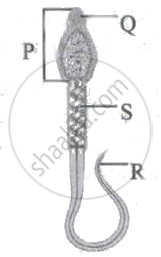
The part labelled as ______ contains the energy source that facilitates sperm motility.
Select the correct sequence of oogenesis.
The immature male germ cells differentiates into ______ at the end of meiosis I.
Which of the following is diploid?
What is the location of oogenesis?
Extrusion of second polar body from egg nucleus occurs ______.
Connective tissue around seminiferous tubules possess endocrine cells called ______.
Which among the following has 23 chromosomes?
During embryonic development, the establishment of polarity along anterior/posterior, dorsal/ventral or medial/lateral axis is called ______.
The nutritive cells found in seminiferous tubules are ______.
At what stage of life is oogenesis initiated in a human female?
Select the correct sequence of stages of spermatogenesis in a human male ______.
Penetration of the sperm in the ovum is followed by ______
Observe the given figure and answer the questions that follow.

- Label A and B.
- Identify the process.
- What happens during this process and what is formed?
The mother germ cells are transformed into a mature follicle through series of steps. Provide the missing steps in the blank boxes.

Explain Oogenesis with diagram.
Complete the analogy with respect to the structure of sperm.
Nebenkern : ‘X’ : : Acrosome is formed from : ‘Y’
In which structures does spermatogenesis occur?
What is the primary purpose of gametogenesis in organisms?
What are the two main types of gametogenesis based on the organ in which they occur?
