Advertisements
Advertisements
प्रश्न
If a genetic disease is transferred from a phenotypically normal but carrier female to only some of the male progeny, the disease is ______.
पर्याय
Sex-linked recessive
Autosomal dominant
Sex-linked dominant
Autosomal recessive
Advertisements
उत्तर
If a genetic disease is transferred from a phenotypically normal but carrier female to only some of the male progeny, the disease is sex-linked recessive.
Explanation:
If a genetic disease is passed from a phenotypically normal but carrier female to only some of the male offspring, it indicates a sex-linked recessive inheritance. In such cases, females can be carriers without showing symptoms because they have two X chromosomes, and the defective gene is recessive. Males, having only one X chromosome, exhibit the disease if they inherit the affected X from the carrier mother, leading to the disease manifesting only in some of the male progeny. This pattern is typical for diseases like haemophilia and color blindness.
संबंधित प्रश्न
A couple with normal vision bear a colour blind child. Work out a cross to show how it is possible and mention the sex of the affected child.
Webbed neck is characteristic of ______ syndrome.
Identify I and II in the given diagram of chromosome.
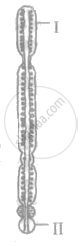
A disease caused by an autosomal primary non-disjunction is ______.
Extra chromosome ‘X’ is present in which one of the following cases?
A person with 47 chromosomes due to an additional Y-chromosome suffers from a condition called ______.
It is said, that the harmful alleles get eliminated from population over a period of time, yet sickle cell anaemia is persisting in human population. Why?
Describe Turner's syndrome.
Describe Klinefelter’s syndrome.
How many pairs of autosomes are present in the human karyotype?
