Advertisements
Advertisements
प्रश्न
A child suffering from Thalassemia is born to a normal couple. But the mother is being blamed by the family for delivering a sick baby.
- What is Thalassemia?
- How would you counsel the family not to blame the mother for delivering a child suffering from this disease? Explain.
- List the values your counselling can propagate in the families.
Advertisements
उत्तर
- Thalassemia is a group of autosomal recessive blood disorders characterized by severe anemia as a result of production of faulty haemoglobin chains. Mutations in the genes coding for the alpha, beta or delta chains constituting haemoglobin lead to the synthesis of improperly folded haemoglobin that is incapable of transporting oxygen efficiently.
- Thalassemia is an autosomal recessive disease, which means the mutation is carried on one of the autosomes, so the carrier can be any one of the two parents. It has an equal probability of coming from the mother or the father, so to just blame the mother for the child’s abnormality is unjustified.
- The values counseling can propagate in the families are:
- Give a healthy diet plan to the child.
- Accepting their child with all his/her positives and negatives.
- Neither of the parents is responsible for giving birth to a sick baby.
- The defect is caused by a random change in the genes of the child.
- Encouraging the child to follow his/her treatment regularly and lead a happy and normal life.
- Support the child emotionally by talking about fear, anxiety, and depression or stress the child feels.
संबंधित प्रश्न
Why is pedigree analysis done in the study of human genetics? State the conclusions that can be drawn from it.
A male rabbit of genotype 'AABBDDEE' is crossed with a female rabbit of genotype 'aabbddee' to produce F1 hybrid offspring. How many genetically different gametes can be produced by this F1 hybrid?
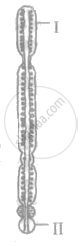
Identify I and II in the given diagram of chromosome.
Match the Column-I with Column-II and choose the CORRECT answer
| Column-I | Column-II | ||
| P. | Klinefelter syndrome | i. | Mutation in autosomal gene |
| Q. | Thalassaemia | ii. | Mutation sex chromosome linked gene |
| R. | Down syndrome | iii. | Trisomy of autosome |
| S. | Colour blindness | iv. | Trisomy of sex chromosome |
Trisomy is represented by ______.
“Genes contain the information that is required to express a particular trait.” Explain.
Identify chromosomal disorder caused due to non-disjunction of the 21st number of chromosomes and enlist its symptoms.
What is the normal female karyotype?
Which diagnostic method is used to detect Mendelian disorders?
Which diagnostic method is used to detect chromosomal disorders?
