Advertisements
Chapters
1: Reproduction in Organisms
2: Sexual Reproduction in Flowering Plants
3: Human Reproduction
4: Reproductive Health
UNIT 2 : GENETICS AND EVOLUTION
5: Principles of Inheritance and Variation
6: Molecular Basis of Inheritance
7: Origin of Life
8: Evidences and Theories of Biological Evolution
9: Human Evolution
UNIT 3 : BIOLOGY AND HUMAN WELFARE
10: Human Health and Diseases
11: Strategies for Enhancement in Food Production
12: Microbes in Human Welfare
UNIT 4 : BIOTECHNOLOGY AND ITS APPLICATIONS
13: Principles and Processes of Biotechnology
14: Biotechnology and Its Applications
UNIT 5 : ECOLOGY AND ENVIRONMENT
15: Organisms and Populations
▶ 16: Ecosystem
17: Biodiversity and Its Conservation
18: Environmental Issues
![Nootan solutions for बायोलॉजी [इंग्रजी] इयत्ता १२ आईएससी chapter 16 - Ecosystem - Shaalaa.com](/images/biology-english-class-12-isc_6:5d0f76efd5b64b75a3ef882e75824c08.png "Nootan solutions for बायोलॉजी [इंग्रजी] इयत्ता १२ आईएससी chapter 16 - Ecosystem")
Advertisements
Solutions for Chapter 16: Ecosystem
Below listed, you can find solutions for Chapter 16 of CISCE Nootan for बायोलॉजी [इंग्रजी] इयत्ता १२ आईएससी.
Nootan solutions for बायोलॉजी [इंग्रजी] इयत्ता १२ आईएससी 16 Ecosystem Test Your Progress [Pages 651 - 657]
OBJECTIVE TYPE QUESTIONS Choose the correct answer from the alternatives given.
Trophic levels are formed by ______.
plants only
animals only
organisms linked in food chains
top consumers in food chain
An oligotrophic lake is characterised by ______.
great changes in water level
long food chains
low nutrient contents and little life
high nutrient levels and abundant flora and fauna
A group of interconnected food chains is called a ______.
complex food chain
food web
food cycle
pyramid of biomass
Energy and nutrients enter a community by way of the ______.
producers
consumers
decomposers
detritivores
Which is the correct order in the food chain?
Plant-snail-thrush-hawk
Plant-snail-hawk-thrush
Snail-plant-thrush-hawk
Snail-thrush-plant-hawk
An ecosystem is a ______.
group of components that interact with one another
group of interacting chemicals arid their cycles
group of interacting species in one place at one time
biologic community and components of the physical environment with which the community interacts
A sequence of species through which the organic molecules in a community pass is called ______.
food chain
food web
nutrient cycle
food cycle
An ecological pyramid of biomass is a representation of the ecosystem’s ______.
tissue at each trophic level
biologic material in relation to abiotic material
energy flow through each trophic level
populations in each food web
Who of the following are the ultimate sources of energy for carnivorous organisms in the food chain of a forest ecosystem?
Sun
Photosynthetic species
Herbivorous species
Decomposer species
Differences in climates in various areas of the Earth result largely from ______.
ocean currents
complexity of the food chain in a particular region
movements of plates of the Earth’s crust
differences in the amount of sunlight striking at different latitudes
The concept of “trophic structure” of a community emphasizes the ______.
prevalent form of vegetation
keystone predator
feeding relationships within a community
effects of coevolution
Ecosystems have ______.
energy inputs and outputs
nutrient cycling but not outputs
one trophic level
both energy inputs and outputs, and nutrient cycling, but not outputs
Consider the components of a food chain: producers → herbivores → carnivores → top carnivores. Eventually, what happens to all the energy passed from one element to the next?
It recycles back to the producers.
It results in a much larger decomposer population.
It is dissipated into the environment.
It is recaptured by another food chain.
A natural food web ______.
contains only grazing food chains
contains several trophic levels
is usually unstable
all of the above
In what way are decomposers like producers?
Either one may be the first member of a grazing food chain.
Both produce oxygen for other forms of life.
Both require a source of nutrient molecules and energy.
Both supply organic food for the biosphere.
Which statement is true concerning this food chain: grass → rabbits → snakes → hawks?
Each predator population has a greater biomass than its prey population.
Each prey population has a greater biomass than its predator population.
Each population is omnivorous.
Both each predator population has a greater biomass than its prey population, and each population is omnivorous.
One of the lessons from an energy pyramid is that:
Only one-half of the energy in one trophic level is passed on to the next level.
The energy lost as heat or in cellular respiration is 10% of the available energy of each trophic level.
Ecological efficiency is highest for primary consumers.
Eating grain-fed beef is an inefficient means of obtaining the energy trapped by photosynthesis.
Which of these ecosystems has the lowest primary productivity per square meter?
Salt marsh
Open ocean
Grassland
Tropical forest
For any ecosystem, the amount of energy present in the ______ level is greater than that present in any other trophic level.
top consumer
decomposer
producer
herbivore
Which of the following depicts the pattern of flow of energy and materials through an ecosystem?
Food chain
Pyramid of numbers
Pyramid of biomass
None of these
Which of the following is a factor in vertical structuring of terrestrial ecosystems?
Plant structure
Penetrance of sunlight
Temperature
All of these
When we study the full assortment of organisms in an area, as well as the abiotic environment that affects them, we are studying the ______.
populations
niche
ecosystem
community
An ecosystem contains ______.
only the biotic components of the environment
only the energy flow components of an environment
both the living organisms and the abiotic components of the environment
only the food relationships found in an environment
Which kind of organism would be most likely to perform photosynthesis?
Omnivore
Herbivore
Deteritivore
Autotroph
Which is not a consumer?
Omnivore
Herbivore
Decomposer
Autotroph
Which eats only plant foods?
Omnivore
Herbivore
Deteritivore
Autotroph
Humans and animals such as bears are biologically adapted to be ______.
omnivores
herbivores
deteritivores
autotrophs
Fungi and bacteria are detritus feeders, also known as ______.
omnivores
herbivores
deteritivores
autotrophs
Energy flow in an ecosystem begins with ______.
omnivores
herbivores
decomposers
autotrophs
The only heterotrophs required in an ecosystem are ______.
omnivores
herbivores
decomposers
autotrophs
In a grazing food chain ______.
primary consumers eat detritus
primary consumers eat photosynthetic organisms
secondary consumers eat detritus
secondary consumers eat photosynthetic organisms
If we weighed all of the organisms at each level of this food web, which would be the heaviest?
Grass and trees
Grasshoppers and squirrels
Hawks and foxes
All levels would weigh the same
Which is not true about a complex food web?
Populations tend to remain about the same size.
Energy levels remain about the same for all trophic levels.
Inputs are constant, and outputs are minimal except for heat.
Most of the energy entering the system maintains the whole community.
Most natural food chains are only four or five links long. The number of trophic levels is limited because ______.
there are more predators than herbivores
winter kills off most insects and stops the food chains
the efficiency in utilizing the food eaten at each level is very low
all of the above
An ecosystem is characterized by which of the following?
Energy flow
Autotrophs converting solar energy to organic compounds
Decomposers recycling organic matter to inorganic compounds
All of the above
Ecosystems are characterized by:
One-way flow of energy through the biotic community of an ecosystem.
Interactions of organisms among themselves and the physical and chemical environment.
Cycling of materials from the abiotic environment through the biotic community and back to the abiotic environment.
All of the above.
Which of the following is true of ecological pyramids?
Pyramids built upon biomass of organisms at each level eliminate size as a factor in the organisms.
Energy gains between trophic levels occur based upon biomass conversion.
Limited number of trophic levels in an ecological pyramid are due to increasing complexity and size of organisms at each greater trophic level.
None of the above.
Which term describes the “mailing address” where an organism lives?
Competitive exclusion
Habitat
Niche
Mimicry
Which term describes the “occupation” of an organism within the community?
Competitive exclusion
Habitat
Niche
Mimicry
Green plants form the ______.
first trophic level
second trophic level
third trophic level
complete food chain
When a big fish eats a small fish which eats water fleas supported by phytoplankton, the water fleas are ______.
producers
primary consumers
secondary consumers
top consumers in this food chain
Producers in an ecosystem are ______.
organisms that can be used as manures.
animals in the food chain which produce more energy than they consume.
animals which cause an increase in biomass by rapid multiplication.
green organisms which fix solar energy by photosynthesis.
Most food chains are composed of ______.
1 or 2 species
3 or 4 species
8 or 9 species
more than 10 species
Which of the following statements concerning food chains is not true?
It shows which organisms feed on which other.
It shows the number of each organism eaten by another.
Plants form the basis of food chains.
It shows the order in which organisms are fed upon by other.
Which of the following factors is least likely to affect the type of organism colonizing a pond?
Acidity of water
Age of pond
Amount of rainfall
Amount of sunlight falling on the pond
A carefully controlled, closed community was established containing the following organisms. Which organism, if removed, would have the most serious and lasting effect on the others?
Green plant
Worm
Snail
Insect
The graphic presentation of various aspects of ecosystems are in the form of pyramids. When such a presentation is made with reference to energy at different trophic levels, it will make ______.
an erect pyramid
an inverted pyramid
a cylinder
a pyramid of variable shape
Which of the following constitutes the largest ecosystem of the world?
Ocean
River
Forest
Grassland
Which of the following can explain the energy stored in an ecosystem?
Pyramid of biomass
Food chain
Pyramid of energy
Food web
Which of the following components of an ecosystem has the greatest biomass?
Primary producers
Primary consumers
Secondary consumers
Decomposers
Of the total amount of energy that passes from one trophic level to another, about 10% is ______.
respired and becomes heat
passed out as faeces or urine
stored as body tissue
recycled to autotrophs
Which of the following is a primary producer in a pond ecosystem?
Algae
Fungi
Virus
Bacteria
Which one of the following has the largest population in a food chain?
Producers
Primary consumers
Secondary consumers
Decomposers
Secondary producers are ______.
Herbivores
Producers
Carnivores
None of the above
Name the first victim if carbon dioxide is removed from the Biosphere:
Secondary consumer
First consumer
Producer
Tertiary consumer
Which of the following is not a producer?
Agaricus
Ulothrix
Riccia
Dryopteris
Which of the following is an ecosystem service provided by a natural ecosystem?
Cycling of nutrients.
Prevention of soil erosion.
Pollutant absorption and reduction of the threat of global warming.
All of the above.
How much of the net primary productivity of a terrestrial ecosystem is eaten and digested by herbivores?
1%
10%
50%
95%
Among the following biogeochemical cycles, which one does not have losses due to respiration?
Phosphorus
Nitrogen
Sulphur
All of the above
A biotic community is an assemblage of ______.
food webs
interacting populations
closely related species
family units
Which one of the following Clements would consider to be the climax community in a humid environment?
The pioneer community.
Lichens, mosses, and ferns.
Large plants such as shrubs and trees.
Small native plants of the area, such as grasses and herbs.
Primary succession takes much longer than secondary succession because it involves ______.
time for the development of the soil horizons
more time for the development of a seed bank
colonization by organisms that are farther away
redevelopment of the atmospheric gases
Clements proposed the climax-pattern model of succession. Governing factors for this succession that he proposed were ______.
climate
soil conditions
each community modifies the environment
all of the above
In ______, a disturbed site in a community recovers and moves again toward the climax state.
area effect
primary succession
distance effect
secondary succession
All of the following increase as community succession progresses, except for ______.
relative amount of biomass produced by producers
number of species present
intricacy of trophic relationships
degree of specialization of species present
The seral communities developing on a water body are known as a ______.
hydrosere
hydrophyte
hydrosphere
hydrologic cycle
The process of mineralisation by microbes helps in the release of ______.
organic nutrients from humus
inorganic nutrients from humus
both organic and inorganic nutrients from detritus
inorganic nutrients from detritus and formation of humus
Which of the following ecosystems is most productive in terms of net primary production?
Tropical rainforests
Deserts
Estuaries
Grassland
During the process of ecological succession, the changes that take place in communities are ______.
random
orderly and sequential
rapid
not influenced by the physical environment
The reservoir for the gaseous type of biogeochemical cycle exists in the ______.
stratosphere
ionosphere
lithosphere
atmosphere
Indian scientist related with ecosystem is ______.
Birbal Sahni
R. Misra
Ram Udar
K.C. Mehta
Fill in the blanks with appropriate words.
The most important factor controlling the type of biome found on land is the ______.
Energy enters an ecosystem primarily as ______ and leaves an ecosystem primarily as ______.
All the living organisms ultimately depend on ______ as the ultimate source of energy.
The passage of materials from producer through primary, secondary, tertiary, or quaternary consumers is known as ______.
______ are the diagrammatic representations of the trophic structure and function at successive trophic levels of an ecosystem.
Freshwater ecosystems are categorized according to the speed of water flow. There are ______ ecosystems of nonflowing water and ______ ecosystems of flowing water.
In the ecosystem, primary producers are also known as ______.
The interconnection of food chain leads to the food interrelationship of organisms and this complex situation is thus known as ______.
Those animals which live directly on plants for their food are known as ______.
The quantity of abiotic materials at any given time in an ecosystem is termed as ______.
The functional status of an organism in its community is termed as ______.
The place where an organism lives is known as ______.
The word ‘ecosystem’ was coined by ______.
Pyramid of energy is always ______.
In an ecosystem second trophic level is occupied by ______.
In an ecosystem dominated by trees, the pyramid (of numbers) is ______ type.
The major reservoir of carbon on earth is ______.
Plants are called as ______ because they fix carbon dioxide.
In an ecosystem dominated by trees, the pyramid (of numbers) is ______ type.
Common detritivores in our ecosystem are ______.
An orderly sequence of communities over a period of time at the same place is known as ______.
The american ecologist F. E. Clements believed that succession follows a predetermined path until it reaches a final predictable stage, known as the ______ community.
During a succession the number of species ______ and the community biomass ______.
If the succession starts in a predominantly organic environment and is characterised by early dominance of heterotrophs, it is known as ______ succession.
If the succession starts on the area previously colonised but has been cleared off, it is called ______ succession.
Biomass and standing crop ______ with succession.
When one community replaces the other due to the modification of the environment by the community itself, then the succession is called ______.
State whether the following statement is true or false:
Two different regions having the same amount of annual rainfall can exhibit different vegetational constituents.
State whether the following statement is true or false:
An ecosystem is not a self-sufficient unit.
State whether the following statement is true or false:
The pyramid of energy is always upright.
State whether the following statement is true or false:
The only requirement of an ecosystem is a constant input of energy that comes by the process of respiration.
State whether the following statement is true or false:
Bioenergetics can be defined as the process of energy transfer between trophic levels.
State whether the following statement is true or false:
Herbivores are generally more numerous than carnivores.
State whether the following statement is true or false:
All food chains begin with a photosynthetic producer.
State whether the following statement is true or false:
Organisms in all trophic levels may be consumed by decomposers.
State whether the following statement is true or false:
Energy recycling is an important part of every ecosystem.
State whether the following statement is true or false:
A detritus food chain accounts for more energy flow than the grazing food chain, since most organisms die without being eaten.
State whether the following statement is true or false:
A pyramid of biomass is based on the number of organisms at each trophic level.
State whether the following statement is true or false:
Food chains are long and involved, with at least seven or eight trophic levels.
State whether the following statement is true or false:
Generally, a larger human population could be maintained on the same amount of cultivated land if people ate more plants rather than animals.
State whether the following statement is true or false:
Broad-leaved forests occur in the equatorial belt.
State whether the following statement is true or false:
Cropland ecosystem is a natural ecosystem.
State whether the following statement is true or false:
Human intervention in natural community interactions usually makes the community more stable.
State whether the following statement is true or false:
Clements called the first stage of secondary succession the climax community.
State whether the following statement is true or false:
Humans often disrupt natural succession to produce agricultural fields and managed forests.
State whether the following statement is true or false:
All successional trends lead towards relative xerophytism.
State whether the following statement is true or false:
Succession leads to the formation of a more or less stable community.
State whether the following statement is true or false:
Decrease in net community production and a corresponding increase in community respiration is a major functional aspect of succession.
State whether the following statement is true or false:
After fire, a primary succession starts at a very rapid rate.
State whether the following statement is true or false:
Ecological succession is directional, therefore a predictable process.
State whether the following statement is true or false:
Climax indicates a final and stable community in a successional series.
VERY SHORT ANSWER TYPE QUESTIONS
Of the three types of ecological pyramids-biomass, numbers, and energy flow-which one is always shaped like a real pyramid with the largest amount in the producer trophic level?
Arrange the following biotic components in order of their food chain:
predators, herbivores, producers, decomposers.
What is the source of energy used by plants in photosynthesis?
In terms of energy, who is at an advantageous position, a vegetarian or a non-vegetarian?
Which organisms represent the base of an ecological pyramid?
Give the name for a network formed by interlinking of a number of food chains.
Which ecological pyramid can never occur in an inverted form?
What are the starting points of a grazing food chain and a detritus food chain, respectively?
A reindeer moss (lichen) is eaten by the reindeer and which in turn is eaten by man. Which is the primary consumer?
Name two different components of an ecosystem.
Who coined the term ‘niche’ and in which year?
List the biotic components of an ecosystem.
What those organisms are called which break down the complex organic compounds present in dead animals and plants?
Which organism belongs to the first trophic level in the food chain comprising the following: rats, plants, hawks, and snakes?
While comparing two ecosystems ‘A’ and ‘B’, it was observed that ‘A’ has only first and second-order consumers, whereas ‘B’ has plus third, fourth, and fifth-order consumers. Which of the two would be more stable?
Which category of organisms forms the starting point of a food chain?
Which one of the following organisms is likely to have maximum concentration of D.D.T. in its body:
peacock, grasshopper, frog, grass, snake?
Can more than one species occupy the same niche for a very long time?
What type of organisms are primary consumers?
Given below are examples of the terrestrial and aquatic ecosystems. Identify and list them separately:
forests, freshwater, marine, desert, grassland.
Who coined the term ‘ecosystem’ and in which year?
What do you understand by the term ‘food chain’?
How you can define a ‘food web’?
Name the three types of ecological pyramids.
Write the equation that helps in deriving the net primary productivity of an ecosystem.
What does ‘R’ represent in the given equation for productivity in an ecosystem?
GPP − R = NPP
Construct a detritus food chain with minimum three trophic levels.
State the difference between the first trophic levels of detritus food chain and grazing food chain.
All the primary productivity is not available to a herbivore. Give one reason.
What is secondary productivity?
Explain ‘standing crop’ in an ecosystem.
Name an organism which occupies more than one trophic level in an ecosystem.
Arrange the following steps of decomposition in a sequential order:
Catabolism, Leaching, Mineralisation, Humification, and Fragmentation.
Who preferred the term ‘prevailing climax’ in place of climax?
Name the biotic succession starting on a bare rock?
Where would you look for signs of secondary succession?
Among the crustose, foliose, and fruticose lichens, which one is a pioneer species?
Write chief character of pyramid of energy.
Which organisms constitute the last trophic level?
Explain the role of the ‘first trophic level’ in an ecosystem.
How is the detritus food chain connected with the grazing food chain in a natural ecosystem?
Give a reason for the following:
Equilibrium of a forest ecosystem can be disturbed by uncontrolled hunting of big predators.
SHORT/LONG ANSWER TYPE QUESTIONS
Suppose the biotic component of an ecosystem consists of plants, grasshoppers, praying mantis, mice, frogs, snakes, bears, owls, and shrews. Develop the food web of this ecosystem, and explain how each of these organisms obtains its food at different trophic levels.
‘All life on earth depends on the Sun.’ Justify this statement.
Plants are said to be producers of food or energy. Do they really produce energy? Explain.
Explain why, in an ecosystem, energy is said to flow while nutrients are said to cycle.
What is the natural ecosystem?
How is a natural ecosystem different from a man-made ecosystem?
What is meant by food web?
Explain with examples the formation of a food web in the ecosystem.
What is a trophic level?
Describe any differences which occur in energy availability at various trophic levels.
In what essential features would you expect a terrestrial ecosystem to differ from a marine one?
Why is the length of a food chain in an ecosystem generally limited to 3-4 trophic levels? Explain with an example.
What is eutrophication?
Explain eutrophication with reference to an aquatic ecosystem.
Why is there always a loss of chemical energy with each step in a food chain?
Describe the food chain operating in a pond.
State the food habits of each trophic level in the pond food chain.
How do vultures and kites form an important constituent of our biotic environment?
What are the various structural components of an ecosystem? How are they linked together?
Write a short note on the food chain.
Write a short note on the ecological pyramids.
Write a short note on the food web.
Write a short note on the niche.
Write a short note on the agroecosystem.
What is a food chain?
How does the study of food chains in an area or habitat help us?
Give an example of a four-step food chain operating in a large lake.
What are the major ecosystems of the world?
Describe the forest ecosystem in detail.
Describe the flow of energy in an ecosystem with the help of various models.
Describe three types of trophic pyramids, indicating which organisms are on the top and bottom of each.
Distinguish between the following:
Autotrophs and Heterotrophs
Describe four different types of heterotrophs found in natural ecosystems.
With reference to food chains, what is a trophic level?
With reference to food chains, what is an ecological pyramid?
Nootan solutions for बायोलॉजी [इंग्रजी] इयत्ता १२ आईएससी 16 Ecosystem BOARD EXAMINATION QUESTIONS [Page 658]
Give a reason for the following:
Equilibrium of a forest ecosystem can be disturbed by uncontrolled hunting of big predators.
Climax stage is achieved quickly in secondary succession as compared to primary succession. Why?
Give a graphic representation of the phosphorus cycle in nature (ecosystem).
Give a graphic representation of the carbon cycle in nature.
Why is the pyramid of energy never inverted?
Define the Standing crop.
The Net primary productivity of a terrestrial ecosystem is 1500 kg per meter square per year, and the respiratory loss of the ecosystem is 1200 kg per meter square per year. Calculate the gross primary productivity of the given ecosystem.
In an ecosystem, a food chain follows the following pattern:
Grass → Insects → Snake → Peacock.
If 2000 J of energy is available at the level of producers in this food chain, how much energy would be available to the peacock?
In an ecosystem, is the climax stage achieved more quickly during the primary succession or during the secondary succession? Give a reason to justify your answer.
Define a biogeochemical cycle.
Give a graphic representation of the phosphorus cycle in nature (ecosystem).
Nootan solutions for बायोलॉजी [इंग्रजी] इयत्ता १२ आईएससी 16 Ecosystem HIGHER ORDER THINKING SKILLS QUESTIONS (HOTS) [Pages 658 - 659]
Can you work out how many trophic levels human beings function at in a food chain?
The pyramid of biomass in the sea is generally inverted. Explain.
Pyramid of energy is always upright, can never be inverted.
What are the shortcomings of ecological pyramids in the study of ecosystems?
Mention any two reasons why the primary productivity varies in different types of ecosystems.
How is the detritus food chain made up of? How do they meet their energy and nutritional requirements?
Biodiversity must be conserved as it plays an important role in many ecosystem services that nature provides. Explain any two services of the ecosystem.
Nootan solutions for बायोलॉजी [इंग्रजी] इयत्ता १२ आईएससी 16 Ecosystem NCERT EXERCISES WITH ANSWERS [Pages 659 - 660]
Fill in the blanks:
Plants are called as ______ because they fix carbon dioxide.
In an ecosystem dominated by trees, the pyramid (of numbers) is an ______ type.
In aquatic ecosystems, the limiting factor for the productivity is ______.
Common detritivores in our ecosystem are ______.
The major reservoir of carbon on earth is ______.
Which one of the following has the largest population in a food chain?
Producers
Primary consumers
Secondary consumers
Decomposers
The second trophic level in a lake is ______.
Phytoplankton
Zooplankton
Benthos
Fishes
Secondary producers are ______.
Herbivores
Producers
Carnivores
None of the above
What is the percentage of photosynthetically active radiation (PAR), in the incident solar radiation?
100%
50%
1-5%
2-10%
Distinguish between grazing food chain and detritus food chain.
Distinguish between production and decomposition.
Distinguish between upright and inverted pyramids.
Distinguish between a food chain and a food web.
Distinguish between litter and detritus.
Distinguish between primary and secondary productivity.
Describe the components of an ecosystem.
Define ecological pyramids.
Describe with examples of pyramids of number and biomass.
What is primary productivity?
Give a brief description of the factors that affect primary productivity.
Define decomposition.
Describe the processes and products of decomposition.
Give an account of energy flow in an ecosystem.
Write important features of a sedimentary cycle in an ecosystem.
Outline salient features of carbon cycling in an ecosystem.
Nootan solutions for बायोलॉजी [इंग्रजी] इयत्ता १२ आईएससी 16 Ecosystem VALUE BASED QUESTIONS [Page 660]
What will happen to an ecosystem if all producers are removed?
What will happen to an ecosystem if all organisms of herbivore level are eliminated?
What will happen to an ecosystem if all top carnivore population is removed?
A simple food web of five organisms A-E is shown below:
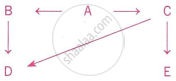
In organisms C were suddenly to be removed from the food web, how would the populations of organisms A, D, and E are affected? Explain your answer.
Nootan solutions for बायोलॉजी [इंग्रजी] इयत्ता १२ आईएससी 16 Ecosystem DIFFERENTIATE BETWEEN [Pages 660 - 661]
Differentiate between an agroecosystem and a forest ecosystem.
Differentiate between autogenic and allogenic succession.
Differentiate between autotrophic and heterotrophic succession.
Differentiate between an autotroph and a heterotroph.
Differentiate between biotic and abiotic components.
Differentiate between an ecosystem and a biome.
Differentiate between eutrophic lakes and oligotrophic lakes.
Distinguish between a food chain and a food web.
Differentiate between gross primary productivity and net primary productivity.
Differentiate between habitat and niche.
Differentiate between hydrosere and xerosere.
Differentiate between lentic and lotic habitats.
Differentiate between nektons and benthos.
Differentiate between primary and secondary succession.
Differentiate between the producers and consumers.
Differentiate between the pyramid of energy and the pyramid of numbers.
Differentiate between productivity and decomposition.
Solutions for 16: Ecosystem
Nootan solutions for बायोलॉजी [इंग्रजी] इयत्ता १२ आईएससी chapter 16 - Ecosystem
Shaalaa.com has the CISCE Mathematics बायोलॉजी [इंग्रजी] इयत्ता १२ आईएससी CISCE solutions in a manner that help students grasp basic concepts better and faster. The detailed, step-by-step solutions will help you understand the concepts better and clarify any confusion. Nootan solutions for Mathematics बायोलॉजी [इंग्रजी] इयत्ता १२ आईएससी CISCE 16 (Ecosystem) include all questions with answers and detailed explanations. This will clear students' doubts about questions and improve their application skills while preparing for board exams.
Further, we at Shaalaa.com provide such solutions so students can prepare for written exams. Nootan textbook solutions can be a core help for self-study and provide excellent self-help guidance for students.
Concepts covered in बायोलॉजी [इंग्रजी] इयत्ता १२ आईएससी chapter 16 Ecosystem are Productivity, Concept of Ecosystem, Biotic or Ecological Succession, Ecosystem Services, Ecological Pyramids, Biogeochemical Cycles (Nutrient Cycles), Decomposition, Components of an Ecosystem > Biotic Component, Producers, Consumers, Decomposers, Key Ecological Terms, Food Chain, Types of Food Chains, Trophic Levels, Food Web, Components of an Ecosystem > Abiotic Component, Functions of an Ecosystem, Structure of Pond Ecosystem, Flow of Energy, Efficiencies in Ecosystem, Carbon Cycle, Phosphorus Cycle, Causes of Succession, Kinds of Succession, Major Trends during Succession, Process of Succession, Major Trends in Biotic Succession, Biotic Succession > Hydrosere, Biotic Succession > Xerosere, Dominance of Species.
Using Nootan बायोलॉजी [इंग्रजी] इयत्ता १२ आईएससी solutions Ecosystem exercise by students is an easy way to prepare for the exams, as they involve solutions arranged chapter-wise and also page-wise. The questions involved in Nootan Solutions are essential questions that can be asked in the final exam. Maximum CISCE बायोलॉजी [इंग्रजी] इयत्ता १२ आईएससी students prefer Nootan Textbook Solutions to score more in exams.
Get the free view of Chapter 16, Ecosystem बायोलॉजी [इंग्रजी] इयत्ता १२ आईएससी additional questions for Mathematics बायोलॉजी [इंग्रजी] इयत्ता १२ आईएससी CISCE, and you can use Shaalaa.com to keep it handy for your exam preparation.
