Advertisements
Advertisements
प्रश्न
Briefly mention the contribution of T. H. Morgan in genetics.
Advertisements
उत्तर
Thomas Hunt Morgan (1866-1945), an American geneticist and Nobel Prize winner in 1933, is recognised as the “Father of Experimental Genetics” for his work on and discovery of linkage, crossing over, sex linkage, criss-cross inheritance, linkage maps, gene mutability, and so on. He is known as the fly man of genetics because he used fruit flies (Drosophila melanogaster) as research subjects in experimental genetics. His book “The Theory of Gene” primarily recognised genetics as a distinct discipline within biology. In 1910, he identified linkage and discriminated between linked and unlinked genes. Morgan and Castle’s (1911) “Chromosomal Theory of Linkage” argued that genes are located on chromosomes and ordered in a linear order. Morgan and Sturtevant (1911) discovered that the frequency of crossover (recombination) between two connected genes is exactly proportional to their distance. 1% recombination is equivalent to 1 centi Morgan (cM) or 1 map unit. He researched sex-linked inheritance and discovered a white-eyed male Drosophila in a red-eyed population, proving that the gene for eye colour is located on the X chromosome. The man passed genes on the X chromosome to the daughter, whereas the son received genes on the X chromosome from the mother. It is known as criss-cross inheritance.
APPEARS IN
संबंधित प्रश्न
If the number of chromosomes in an endosperm cell is 27, what will be the chromosome number in the definitive nucleus?
- 9
- 18
- 27
- 36
Classify the chromosomes on the basis of position of centromere.
Choose the correct options of the following question:
Study the given monohybrid cross:
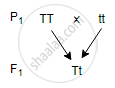
A test cross for this Fj will be:
Explain codominance in colour coat in cattle with checker board method.
An allohexaploidy contains
Genes G S L H are located on the same chromosome. The recombination percentage is between L and G is 15%, S and L is 50%, H and S are 20%. The correct order of genes is
Changing the codon AGC to AGA represents
Write the salient features of the Sutton and Boveri concept.
Telocentric chromosome differs from acrocentric chromosome in that ____________.
During cell division, spindle fibres get attached to the disc shaped structures present on the centromere are known as ______.
A plant having the genotype AABbCC will produce ______ kinds of gametes.
A gene pair hides the effect of another. The phenomenon is ______.
Which three scientists independently rediscovered Mendel’s work?
Experimental verification of ‘chromosomal theory of inheritance’ was done by ______.
How many types of gametes would be produced if the genotype of a parent is AaBB?
A couple has two daughters. What is the probability that the third child will also be a female?
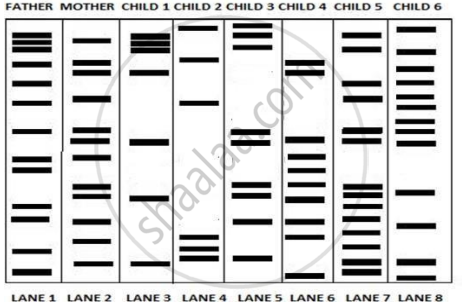
There was a mix-up at the hospital after a fire accident in the nursery division. Which of these children belong to the parents?
During mitosis, chromosomes distribution to the daughter cell is ______.
Which of the following phase follows S and G2 phases of interphase?
Experimental verification of the chromosomal theory of inheritance was done by ______.
A haemophilic man marries a carrier woman and they have a daughter. What is the probability of their daughter being haemophilic?
According to the Chromosomal Theory of Inheritance, what are the specific positions on chromosomes where genes are located called?
Which scientist provided the first experimental proof of the Chromosomal Theory of Inheritance using Drosophila melanogaster?
How many scientists independently rediscovered Mendel's laws of inheritance in the year 1900?
During which cellular process do homologous chromosomes separate and distribute one chromosome from each pair to resulting gametes?
