Advertisements
Advertisements
प्रश्न
Answer the following question.
Compare in any three ways the chromosomal theory of inheritance as proposed by Sutton and Bovery with that of experimental results on pea plant presented by Mendel.
Advertisements
उत्तर
Gregor Mendel, through his work on pea plants, discovered the fundamental laws of inheritance. He deduced that genes come in pairs and are inherited as distinct units, one from each parent. Mendel tracked the segregation of parental genes and their appearance in the offspring as dominant or recessive traits. He recognized the mathematical patterns of inheritance from one generation to the next.
Mendel did not investigate how characteristics are sorted and combined on the cellular level. Sutton and Boveri, working independently, suggested that chromosomes could be shown to bear the materials of heredity.
They noted that the behaviour of chromosomes was parallel to the behaviour of the gene and used chromosomes movement to explain Mendel's laws.
Sutton and Boveri argued that the pairing and separation of pair of chromosomes would lead to segregation of a pair of factors they carry. Sutton united the knowledge of chromosomal segregation with Mendelian principle and called it " chromosomal theory of inheritance".
APPEARS IN
संबंधित प्रश्न
Explain the types of chromosomes on the basis of position of centromere.
Describe the structure of chromosomes with a suitable diagram.
If the haploid number in a cell is 18. The double monosomic and trisomic number will be
From the following identify the statements that are CORRECT with respect to homologous and non-homologous region of X and Y chromosomes.
i. Non-homologous region of X chromosome is longer and contains more genes than that of non-homologous region of Y chromosome.
ii. X-linked genes are present on nonhomologous region of X-chromosome.
iii. Y-linked genes are present on homologous region of Y-chromosome.
iv. Crossing over occurs only between homologous regions of X and Y chromosomes.
Which of the following statements indicates parallelism in genes and chromosomes?
- They occur in pairs.
- They segregate during gamete formation.
- They show linkage.
- Independent pairs segregate independently.
What are minisatellites?
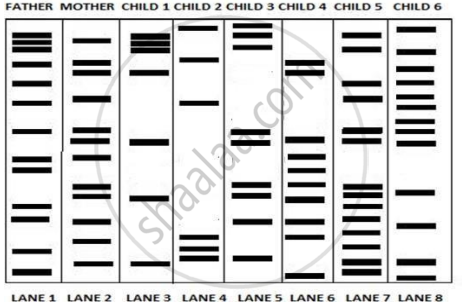
There was a mix-up at the hospital after a fire accident in the nursery division. Which of these children belong to the parents?
Which of the following phase follows S and G2 phases of interphase?
Genes located on same locus but having different expressions are:
During which cellular process do homologous chromosomes separate and distribute one chromosome from each pair to resulting gametes?
