Advertisements
Advertisements
प्रश्न
What kind of relationship did Mrs. Croft share with her daughter Helen?
Advertisements
उत्तर
The relationship of Mrs. Crost with that of her daughter did not seem to be that of love and affection. They shared a very practical life based on strong reasons and logic. She seemed to be a matter of fact person who didn't believe in getting emotional on stuff. She carried on her responsibilities for her mother as a mere schedule. Care and empathy were what lacked in her. She knew what were her mother's weaknesses. This is clear when she says: ‘She slips sometimes.’ The gap between their generations was visible when they differed on women wearing miniskirts on the streets. Helen was quite indifferently calm of the fact that Mrs. Croft was three years older than a century and needed constant assistance, supervision, and above all, love.
APPEARS IN
संबंधित प्रश्न
Write an application in response to the following advertisement using information given in the CV provided :
| SITUATION VACANT |
| Wanted Smart, English speaking salesman for an electronic showroom. Good salary offered. An experienced candidate will be preferred. Write giving details to : The Proprietor, Ganesh Electronics, M.G. Road, Solapur. |
| C. V. (Resume) | |
| (1) Name: | Suhas Randive |
| (2) Age: | 29 years |
| (3) Address: | 105, Roshan Apartment, L.T. Road, Pune - 11 |
| (4) Educational: | B. A. (First class), Pune University qualification |
| (5) Experience: | 3 years' experience of working as a salesman in a textile shop. |
| (6) Interests: | Travelling, photography, reading. |
Have you are wondered why soldiers are always clad in green? This is to enable them to camouflage themselves during wartime. Hiding in the jungles, their green attire blends into the surrounding trees and shrubs, making it difficult for the enemies to spot them.
Long before man-made use of camouflaging, insects have already adopted the tactic of disguise to escape from the clutches of their predators. By having body colour close to those of the rocks and dried leaves, they can escape from being pursued by the predators.
Butterflies and moths have developed a variety of camouflage strategies since they are quite defenceless and their predators are abundant. Possessing wings which resemble dried leaves help certain butterflies and moths to hide among heaps of dried leaves when predators are around.
Fortunately, not all insects choose the art of disguise to escape from their predators; otherwise, the world would be so dull and colourless. There are insects which assimilate the bright body colours of bees and wasps to escape from being pursued by their predator. Long ago, birds have already learnt to avoid brilliantly coloured wasps and bees in fear of their painful stings. Hence, over millions of years, many harmless insects have assimilated the bees and wasps by imitating. their bright body colours and shapes. In this way, they appear dangerous and hence ward them off.
The beefy, not only appears like the bumblebee in terms of body colour, even its hums sound similar too. The only difference is that the beefy does not have a stirring and is hence harmless. The hoverfly is another insect which imitates. the body colours of the wasps. Their bodies are striped yellow and black. The only deviations are that hoverflies do not have stings, and they have only one pair of wings each while wasps have two pairs each. These variations are hardly noticed by the predators and hence help them to escape.
A1. Complete the table with the information from the passage : (2)
| Insects | Similarity | Difference |
| Bumblebee - Beefy | ||
| Wasp - Hoverfly |
A2. Complete the tree diagram : (2)

A3. Find out : (2)
‘Nature has given a self-protection mechanism to insects’.
Find out at least two examples from the passage to prove this statement.
A4. Vocabulary - (2)
Find the words from the passage for :
(i) animal or bird that hunts other for food
(ii) to get free from danger
(iii) to prevent something from harming
(iv) to make a copy
A5. Personal response - (2)
‘Soldiers disguise themselves to prevent enemies to spot them’.
Give two more examples when the disguising technique is used by humans.
A6. Grammar - (2)
Rewrite the following sentences in the ways instructed :
(i) They have only one pair of wings.
(Make it negative without changing the meaning)
(ii) Insects have already adopted the tactic of disguise to escape from the clutches of their predators.
(Replace infinitive with gerund and rewrite)
(B) Summary : (3)
Summarise the above extract with the help of the points given and suggest a suitable title.
Camouflage of soldiers and insects - reason and ways for disguising - assimilation of insects - need of imitation.
In the following items, sentence A is complete, while sentence B is not. Complete sentence B, making it as similar as possible to sentence A. Write sentence B.
(A) As soon as the bell rings, the children run out to play.
(B) No sooner __________________________________.
Fill in the blank with the suitable word.
Sita’s daughter carried _____________ the family business when Sita went abroad.
Fill in the blank with the suitable word.
Her aunt looks _____________ her aging grandparents.
Alack, it was I who leaped at the sun
To give it my loving friends to keep!
Naught man could do,have I left undone:
And you see my harvest, what I reap
This very day, now a year is run.
Read the above lines and answer the question that follow.
Comment on the tone of the Patriot in this stanza.
Thus I entered, and thus I go!
In triumphs, people have dropped down dead,
"Paid by the world, what dost thou owe
Me? "....God might question; now instead,
'Tis God shall repay: I am safer so.
Read the above lines and amswer the question that follow.
How did the leader come and go?
In “A Horse and Two Goats”, how did Muni feel about his married life?
The author shows death as a relief from a harsh life. Justify with reference to the story.
Why was Margot unhappy on Venus in “All Summer in a Day”?
Hardly had the teacher left the room, when all the children started making a noise.
(Begin : No sooner ………..)
"School days are the happiest days of our lives." Express your views either for or against this statement.
Since her childhood, Meera has been good in Mathematics.
(End: ............................ childhood)
Discuss the following statement in groups of four.
“The landscape is an inner one, a spiritual and conceptual space.”
Below is a topic for essay writing. Follow the steps listed above to write on this topic.
Public Health In Transition
Discuss with your partners
Talking about teachers among friends.
Discuss the following in pairs or in small groups.
‘It was worth a wound—it was worth many wounds—to know the depth of loyalty and love that lay behind that cold mask’— how does this comment throw light on the kind of relationship between Holmes and Watson?
See if you understand what the following words that are parts of a house mean. Look up the dictionary if you don't.
|
parlour |
foyer |
lounge |
porch |
|
lobby |
attic |
portico |
|
Discuss in pairs.
‘Failure had a tempo faster than success.’
How is Satyajit's financial crash introduced to the reader?
Find out different career opportunities in the field of social work.
Write down the significance of the following in the context of 'On to the Summit':
husiar.
Enlist any four facts which made the capturing of Tiger Hill a national challenge.
The cherry tree is a narrative poem. Features that make it a narrative poem are given below. Justify them with proper examples.
Characters are referred to.
Write a summary of the poem using the following points:
- Title
- Introductory paragraph (about the poem, type, nature, tone)
- Main body (central idea, the gist of the poem)
- Conclusion (opinion, views, appeal)
Write a letter to your friend about the Great Indian Bustard. You may use the following points:
- Why we need to protect the bird.
- What you plan to do to help the bird.
Note down ways in which you can make your life less ordinary in terms of nurturing relationships.
Given in a mixed order below are some good human attributes of the family. Pick out from the box and write it against the line that reflects it.
After some days, Elizabeth informed that she wanted the family to move to a safer place.
Write what you think about the following thoughts and actions of Mathilde :
Mathilde and her husband decided to replace the necklace.
Imagine what must have happened after Mathilde’s friend discovered that the diamonds were real. Do you think she would return the necklace to Mathilde? Would that make Mathilde happy?
Prepare a formal invitation for a function you have arranged at home. It should clearly state the following points:
- Who is inviting people to the function.
- What the program is.
- The date and time.
- The venue. (The place where
- A polite request to attend the function. the function will take place.)
‘..... and that’s how I realized that courage and hope can help me overcome any major mishap/problem in life.’ Write an episode/experience from your own life that leads to the above conclusion.
Maintain a diary at least for a week. Write about your interactions with other people in your surroundings in 3-4 lines. Also write whether you find the interactions happy unhappy, satisfactory-unsatisfactory, enjoyable-stressful, etc.
Write the reason in your own words.
Akbar had to dress like a slave.
Is the insect described in the poem a real insect? Think about an imaginary creature. Describe it in your own words. You may draw its picture and label it.
You have an Environment Protection Week to be celebrated in your school. You have invited an environmentalist. You have to interview him/her about how to save environment. Frame about 10-12 questions for the interview.
Read the script from:
| Joan (Girl) | Good morning, Captain squire ........... (up to) |
| Joan | (Simply) ............. Polly and Jack have promised to come with me. |
Write a summary of that part of the script (in Indirect speech) in 15 to 20 lines.
Write a report of an event held at your school using Passive voice. Use Simple Past Tense to narrate the event.
Write a newspaper article in about 100 words, comparing the achievements of the two sportswomen based on the information you have already collected.
Create a poster for the following.
You are Sita/ Sudhan. Design a poster in not more than 50 words to focus on not wasting water. Be creative.
Write the dialogue and complete the story.

What will Glory say? Do you think you can help Glory by giving some ideas to Ravi?
| Glory |
You can write a story about the ______ and the ______. |
| Ravi | Great idea! Thank you! |
| Glory | ______ Ravi. |
The word in the sentence is jumbled. Write them in order.
I around me looked.
Silent letter.
What is common in the following groups of words?
- knee, knife, knot, know ______
- neighbour, daughter, fight, straight ______
- honest, honour, hour, heir ______
Try and make more silent letter words.
gnat: ______, ______
tongue: ______, ______
chalk: ______, ______
whistle: ______, ______
I got ______ to see his favourite heroine.
Rewrite the passage below using capital letters where necessary
one saturday afternoon amarjit and his little sister rani went for a picnic to india gate. there they saw ducks, water and their friend raj
Complete the following stories by using an appropriate word from the box given below –
| my, his, he, your |
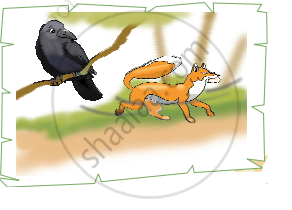
Sitting on a tree a crow was enjoying a piece of bread. A hungry fox wanted to have that bread. said very sweetly, “Dear brother, I've heard that ______ voice is very sweet. Please sing a song for me.” The foolish crow opened ______ beak and the piece of bread fell down. The fox picked it up in ______ mouth and ran away.
In the sentence below the capital letter, comma, full stop and question mark are missing. Put these in the correct place.
what is the colour of the sky
Work in a group and decide the things that you can do to help your grandparents or any old person.
Now, write five of these things that you will do.
What was her first impression of America?
Why did the photographer feel happy after taking the photograph?
Respond to the following advertisements.
Classified Advertisement
| WANTED 100 part-time Graphic Artists Experienced in Photoshop and InDesignSalary negotiable. Apply to: MM Graphics, Triplicane, Chennai - 5 or Mail your Resume to [email protected] |
Block Advertisement
|
Female IELTS Teachers Required Postgraduates in English with a minimum of 3 years experience Must be bold and confident Good salary, transport and food allowance provided Apply to: ARV Institute of Languages 149B, Bose Road, Coimbatore Ph: 98400 xxxxx Email: [email protected] |
Do you think it is important not to be swayed by every passing mood?
Write an essay of about 200 word
The profession you would like to choose
Read the given sentence and underline the 'no' word.
Ram has no book.
Imagine someone has invited your family to a programme and you were the only person at home when the invitation was given orally.
Write a note (4-5 lines) to pass on the message to the other people in your family. Or, Write an imaginary conversation in which you pass on the message to your parents.
Write a composition (300-350 words) of the following:
Your teacher has asked you to form a group and work on a particular project. Write an account of how you worked together and what each of you learned from the experience.
Write a composition (300-350 words) of the following:
‘Peer pressure is a force for good.' Express your views either for or against this statement.
