Advertisements
Advertisements
प्रश्न
Write the appreciation of the poem.
- About the poem/poet/title
- Theme
- Poetic devices, language, style
- Special features/novelties/focusing elements
- Values, message
- Your opinion about the poem
Advertisements
उत्तर
Appreciation of the poem ‘Nose versus Eyes’
The poem ‘Nose versus Eyes’ by William Cowper is a satirical take on the judiciary.
The theme dwells on the proceedings of a court where judgment is passed without careful consideration.
The rhyme scheme of the poem is ‘abab’ and provides a song-like flow to the poem. The notable features of the poem are the use of Imagery, Simile, Personification, and Inversion. While inversion has been used to maintain the rhyme scheme and add to poetic effect, imagery helps to paint a vivid picture of the court setting in the minds of the readers. The highlight of the poem is the personification of the eyes, nose, and tongue. The characters assigned to each one of them are perfectly fitting and add to the humorous nature of the poem.
Though the poem is a mockery of the legal system, the message is to highlight the general pitfalls of selective hearing and warn the reader to exercise good judgment. The poem also reveals the failure of the legal system in delivering justice. This is particularly obvious in the lines ‘then shifting his side, as a lawyer knows how’ and ‘what were his arguments few people know’. The irony of the poem is that the judgment was made in favour of the one, who had no use of it i.e. the Nose. In a court of justice, injustice was served to the eyes.
Overall the poem is apparently funny but upon a closer look, the depth of the poem is revealed.
APPEARS IN
संबंधित प्रश्न
Imagine you are Gitika. Road the following conversation and write a suitable message for your mother in 50-60 words:
Ankita : Hi, didi ! I'm Ankita on the line. Is aunty at home?
Gitika : No, she has gone to visit my grandparents. Is there any problem?
Ankita : No, I just wanted to inform her that we have a special havan tomorrow at 9 a.m. at our place. My mother has specially invited all of you.
Gitika : Okay, Thanks ! I'll inform her and we will definitely come.
Fill in the blank with the suitable word.
Her aunt looks _____________ her aging grandparents.
What does the tree symbolise in the poem?
Do you agree with the poet that a nation’s growth depends upon the wealth of trees? Why/why not?
Explain and discuss the themes in the poem.
But a caged BIRD stands on the grave of dreams
His shadow shouts on a nightmare scream
His wings are clipped and his feet are tied
So he opens his throat to sing.
Read the above lines and answer the question that follow.
What is the main conflict in this poem?
There's nobody on the house-tops now...
Just a palsied few at the windows set;
For the best of the sight is, all allow,
At the Shambles' Gate-or, better yet,
By the very scaffold's foot, I trow.
Read the above lines and answer the question that follow.
Why does Browning say that the palsied watched the execution?
Thus I entered, and thus I go!
In triumphs, people have dropped down dead,
"Paid by the world, what dost thou owe
Me? "....God might question; now instead,
'Tis God shall repay: I am safer so.
Read the above lines and amswer the question that follow.
Give an example of Antithesis from the poem ‘The Patriot: An Old Story.’
The eight other runners pulled up on their heels
The ones who had trained for so long to complete
one by one they all turned around and went back to help him
And brought the young boy to his feet.
Then all the nine runners joined hands and continued
The hundred-yard dash now reduced to a walk
And a banner above that said (Special Olympics)
Could not have been more on the mark.
That's how the race ended, with nine gold medals
They came to the finish line holding hands still
And a standing ovation and nine beaming faces
Said more than these words ever will.
Read the lines given above and answer the following question:
Explain with reference to context.
What thoughts are uppermost in the soldier’s mind as he talks with the old man?
Show liow Narayan depicts women in the story and their role in a man’s life.
Fill in the blank with an appropriate word:
I don't know what they were arguing __________ but I could hear angry voices.
Your school recently held a jubilee celebration. Write a letter to your friend who was unable to attend, giving details of the function and your role in it.
How did the narrator and Lord Otori overpower the intruder?
Read the extract given below and answer the questions that follow:
Mabel: [Utterly surprised] Ronny! Do they want me in Court?
Dancy: No.
Mabel: What is it, then? Why are you back?
Dancy: Spun.
Mabel: [Blank] Spun? What do you mean? What’s spun?
Dancy: The case. They’ve found out through those notes.
Mabel: Oh [Staring at his face] Who?
(i) Where are Mabel and Dancy at this time? What was Mabel doing just before this conversation?
(ii) Why did Mabel say, “Do they want me in court?” Explain the meaning of spun in the extract?
(iii) What ‘notes’ is Dancy talking about now?. How does Mabel react immediately after the extract”:
(iv) Dancy leaves a note for his best friend towards the end of the play. What is the name of his best friend? What is written in the note?
(v) What does Dancy do at the end? Why does he do that? What is your opinion of Mabel and Dancy?
Fill in the blank with an appropriate word:
Ashok leaned ______ the wall tiredly.
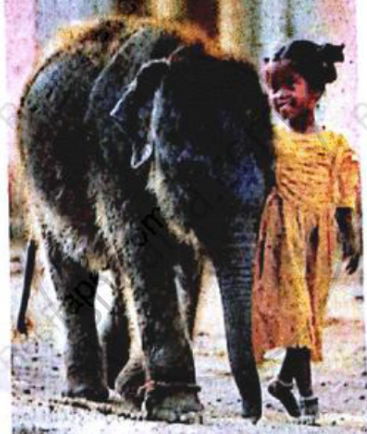
Study the picture given below. Write a story or a description or an account of what it suggests to you. Your composition may be about the subject of the picture or you may take suggestions from it; however, there must be a clear connection between the picture and your composition.
The following three compound words end in-ship. What does each of them mean?
| airship | flagship | lightship |
Discuss the following statement in groups of four.
“The Emperor may rule over the territory he has conquered, but only the artist knows the way within.”
Discuss in groups of four.
The problems of over population that directly affect our everyday life.
You have not received your Roll Number card for the Class XII examination. Write a letter to the Registrar, Examination Branch, CBSE asking for it.
What was John Garrideb's objective in inventing the story of Alexander Hamilton Garrideb and his legacy?
Examine the subtle humour in the narration of the story that lightens the gravity of the subject matter.
Look at the highlighted expressions in the following sentences from the text and explain their figurative meaning.
- 'I went through it, sir, with a fine-toothed comb and never a Garrideb could I catch.'
-
'They are my favourite covert for putting up a bird, and I would never have overlooked a cock pheasant as that.'
-
'There is no bolt-hole for you in this country.'
-
'When his castle in the air fell down, it burred him beneath the ruins.'
Describe a recent quarrel that you have had with your brother, sister, or friend. How did it start? What did you quarrel about? How did it end?
We add ‘un-’ to make opposites. For example, true — untrue. Add ‘un’– to the word below to make its opposite. Then look up the meaning of the word you have formed in the dictionary.
trained: ____________
Answer the following question:
“It was to be a battle of champions.” (8)
(i) What qualities did the two champions have? Pick out words and phrases from the paragraph above this line in the text and write them down.
|
Mongoose |
Cobra |
| (a) ________ | (a) ________ |
| (b) ________ | (b) ________ |
| (c) ________ | (c) ________ |
(ii) What did the cobra and the mongoose do, to show their readiness for the fight?
Discuss the following with your partner and complete the following sentence.
Food adulteration means _________________.
Narrate in your own words a similar based on text to the class.
Would you like to join the Indian Army/Navy/ Air force? If not, suggest other ways in which you could serve your nation.
Complete Dr. APJ Abdul Kalam’s profile with information picked from the lesson.
PROFILE - Dr APJ Abdul Kalam
- Title:
- Profession:
- Branch of science:
- Important position in Government held:
- His three visions for India:
Complete the tabular columns to specify Dos and Don’ts associated with the 'Expansion of Ideas'.
| Expansion of Ideas | |
| Dos | Don’ts |
| (i) Begin impressively | (i) Do not go off-track |
| (ii) | (ii) |
| (iii) | (iii) |
| (iv) | (iv) |
Complete the table. One is done for you.
| The World around you | What we should aim to be | |
| 1. | Callous | Caring for people, environment, life |
| 2. | Violent | |
| 3. | Greedy | |
| 4. | Corrupt |
Describe the climax scene in your own words. Write your comments on it.
‘Invictus’ is an example of Traditional Poetry. ‘Please Listen’ is an example of Free Verse.
Say ‘WHY’?
The writer grew less dogmatic and more open-minded.
Write an imaginary dialogue contesting opposite views on a topic of your choice, e.g., ‘Girls should learn to do all the housework and not boys.’
Form groups of 5. Find at least two fairy tales/folk tales each and share them with other members of your group. Make a collection of 10 different stories in each group.
Find more topics from your Environmental Studies or Mathematics textbooks for drawing tree diagrams. Draw and label the diagrams.
| Life on earth began with unicellular I organisms known as protozoa. The following are the stages of evolution of animals. Invertebrates are animals without a backbone, for e.g., a snail. The vertebrates are animals which have a backbone. E.g., Aquatic animals like fish. Animals which: live in water and also on land are called amphibians. E.g. A frog. A few invertebrates are worms and mosquitoes and a few I vertebrates are reptiles. |
What are the themes of the singers’ songs?
Pick out the nouns from the poem. Write as many Cinquain poems as you can.
Application form annual day participation.

______ do you get up?
Can we try to complete another dialogue now?
Rathi is visiting a shop to buy a pen. Let us try and complete the dialogues between her and the shopkeeper.
| Rathi | Hi Akka! |
| Shopkeeper | Hi! How can I help? |
| Rathi | I need a______. |
| Shopkeeper | Sure. Which colour? |
| Rathi | Give a______ pen. |
| Shopkeeper | Do you need a ten rupee pen or a five rupee pen? |
| Rathi | Give me the ______rupee pen. |
| Shopkeeper | Do you want anything else? |
| Rathi | ______. |
| Shopkeeper | Thank you. Goodbye. |
| Rathi | ______ |
Punctuate the following sentence.
the dog wags its tail when its pleased but a cat waves its tail when its angry.
Punctuate the following sentence.
she fed the baby washed the dishes put the lights off and went to sleep.
You woke up one morning and found yourself in the land of dwarfs!
Write a paragraph describing your experiences there and how you got back home finally. You may begin like this.
Everything around me looked different. ______
Describe the appearance of the policeman on the beat.
What does each of the following mean in the story? Choose the right option.
a guardian of peace:
What made her feel confident about the competitive players? Explain.
Why do patients leave the clinic without meeting the dentist?
What was the only similarity between Leacock’s face and his photograph?
Write a paragraph of about 150 word, on the following topic.
The teacher I like the most
Attempt a description of the following process, in about 100 word each, either using the imperative or the passive.
Organising a birthday party in your house
Read the following questions and answers. Form pairs and frame similar questions and answers for this website. How to use this website:
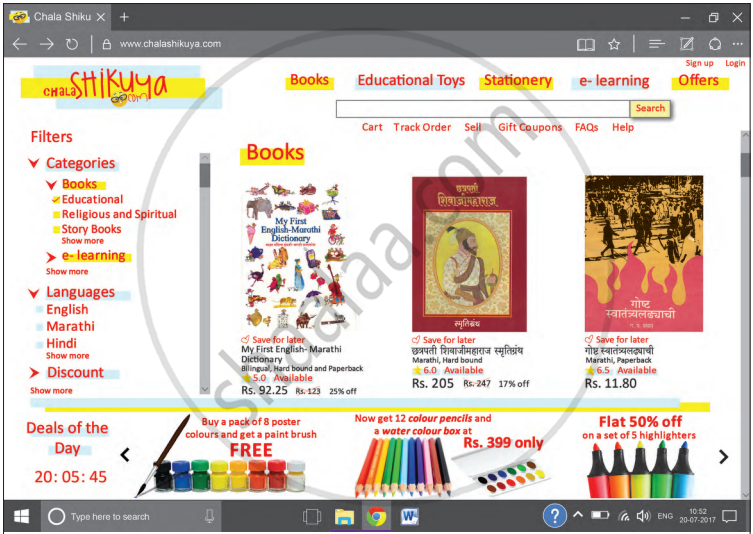
How to use this website:
- If I want to buy a story book on this website, where can I find it?
- In the categories on the left, in the options under Books you will find story books. Click that option. - I want a CD of the dictionary.
- Go to ‘e-learning’. Under that Click the ‘dictionary’ option. - Where can I look for books in the Hindi language?
-You can go to the Languages option on the left and tick the box before Hindi. - How can I find what discounts are available?
- Under the filters on left you will find discounts. - Are there any specific deals/offers on specific days?
- There is a CSY (Chalashikuya) deal. You can click on it and find out the deal of the day. - Can I purchase only one thing at a time?
- No, you can buy many things at a time. Select whatever you want and add to the cart and then browse again for another product. - When will my order be delivered?
- Maximum in 10 working days. You can also track your order by clicking the icon ‘track order.’ - There is one icon ‘Gift Coupons’. What does it mean?
- You can give a gift coupon to your friend by using this icon and he/she can purchase the product of his/her choice with the help of it. - Is this site only for purchasing?
- No, you can also sell your old books and other educational things here. - How can I find out whether the product is good or not?
- You can see the ratings and reviews of users below each product.
What might success mean to the following people? Think about it and write.
A teacher
In your opinion what things will help to make the world a better place? Discuss with your friends and write down at least three of the things.
The following are the different steps in a drama/play. They are in a mixed-up order. Rearrange them in ‘a’ proper order. Just write the order numbers in brackets.
- Characters Enter
- Climax
- Curtain opens
- Action begins
- Scene of the play
- Curtain closes
- Finale (Final outcome)
- Interaction of characters
Divide the students into groups of five. They sit in a circle. They choose one object of daily use such as a bag, wallet, box, etc. The group leader writes four sentences about it.
- I have found a ______
- It’s (colour)
- It’s (shape)
- It has a ______
- I found it (place where it was found)
Others, too, write four sentences each.
- • I’ve lost a ______
- It’s (colour)
- It’s (shape)
- It has a ______
- • I lost it (place where it was lost)
They all open read their lines, beginning with the group leader. The player whose description matches the group leader’s the most gets the object.
Informal Letter -
Write a letter to your friend describing the details of the vacation.
