Advertisements
Advertisements
प्रश्न
Write the appreciation of the poem.
- About the poem/poet/title
- Theme
- Poetic devices, language, style
- Special features/novelties/focusing elements
- Values, message
- Your opinion about the poem
Advertisements
उत्तर
Appreciation of the poem ‘Nose versus Eyes’
The poem ‘Nose versus Eyes’ by William Cowper is a satirical take on the judiciary.
The theme dwells on the proceedings of a court where judgment is passed without careful consideration.
The rhyme scheme of the poem is ‘abab’ and provides a song-like flow to the poem. The notable features of the poem are the use of Imagery, Simile, Personification, and Inversion. While inversion has been used to maintain the rhyme scheme and add to poetic effect, imagery helps to paint a vivid picture of the court setting in the minds of the readers. The highlight of the poem is the personification of the eyes, nose, and tongue. The characters assigned to each one of them are perfectly fitting and add to the humorous nature of the poem.
Though the poem is a mockery of the legal system, the message is to highlight the general pitfalls of selective hearing and warn the reader to exercise good judgment. The poem also reveals the failure of the legal system in delivering justice. This is particularly obvious in the lines ‘then shifting his side, as a lawyer knows how’ and ‘what were his arguments few people know’. The irony of the poem is that the judgment was made in favour of the one, who had no use of it i.e. the Nose. In a court of justice, injustice was served to the eyes.
Overall the poem is apparently funny but upon a closer look, the depth of the poem is revealed.
APPEARS IN
संबंधित प्रश्न
Point out -
Point out two instances where you find Chaitanya's victory over his disability.
Photographs
What do you think is the message of the poem?
What arc the poetic devices used in Maya Angelou’s poem “Caged Bird”?
Which poetic device is used in the line: ‘Making it rich, and like a lily in bloom,’
What lesson is learnt from the poem?
What thoughts are uppermost in the soldier’s mind as he talks with the old man?
What is the primary purpose of “Hearts and Hands” by O. Henry?
Fill in the blank with an appropriate word:
I don't know what they were arguing __________ but I could hear angry voices.
Re-write the following sentences according to the instructions given after each. Make other changes that may be necessary, but do not change the meaning of each sentence.
- As soon as we lit the candle, the power supply was restored.
(Begin: No sooner………. ) - The bee is more industrious than all other creatures.
(Use: ‘most industrious’) - The old woman was too slow to catch the bus.
(Begin : The old woman was so……… ) - “I’ll do it tomorrow,” he promised.
(Rewrite in indirect speech) - Though Reema got an expensive gift she was not happy.
(Begin: In spite of……… ) - I prefer reading a book to watching a movie.
(Begin: I would rather…….. ) - I have never seen Mr. Roy lose his temper.
(Begin: Never…….. ) - She found your keys in the garage.
(Begin: The keys……… )
Join the following sentence to make one complete sentence without using and, but or so.
They bought a new car. They can travel long distances.
Re-write the following sentence according to the instruction given. Make other changes that may be necessary, but do not change the meaning of the sentence.
As soon as Sania sat down to study, the lights went off.
(Begin: No sooner……….)
My daughter believes_____________ fairies.
Every one of them was an experienced mountaineer.
(Begin: There was no .................................)
Given below is an interesting combination of words. Explain why they have been used together.
scientific detachment
(i) What do you understand by the terms `outsider art’ and `art brut’ or `raw art’?
(ii) Who was the “untutored genius who created a paradise” and what is the nature of his contribution to art?
What does the notice 'The world's most dangerous animal' at a cage in the zoo at Lusaka, Zambia, signify?
Make a list of jobs which would give you an opportunity to help the society or serve the country. Also mention the different ways in which they can be beneficial to the people and also the country.
Multiple Choice Question:
The quarrel finally ended when ______
Use the phrase in a sentence of your own, after finding out its meaning.
lifted off
We add ‘un-’ to make opposites. For example, true — untrue. Add ‘un’– to the word below to make its opposite. Then look up the meaning of the word you have formed in the dictionary.
qualified: ____________
The poet is prompted to call the sower an ‘august personality’ which means one who has reached the highest position in his workplace.
Explain this using the following point.
Hard work
Complete the table. One is done for you.
| The World around you | What we should aim to be | |
| 1. | Callous | Caring for people, environment, life |
| 2. | Violent | |
| 3. | Greedy | |
| 4. | Corrupt |
Discuss the following and write about the following in your own words in 5-6 lines.
Which events in the story (Part I and Part II) changed Mathilde’s life?
Gather information on any one of the following by talking to your elders, family members, and from other sources in your mother tongue and write a short note on it in English.
A special dish that is prepared on a special occasion at home.
Write a character sketch of Papa Panov in your own words.
Imagine you are Dorothy and write about the day’s events in 5-8 lines in your (Dorothy’s) diary.
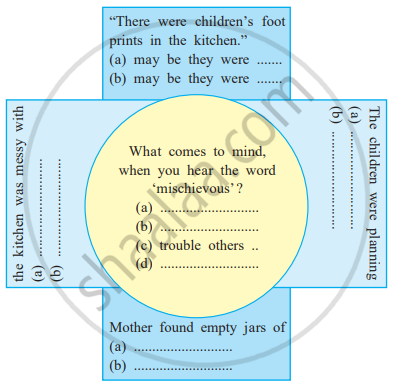
Read the evidence/sentences given below and offer a possible explanation of what happened in this house? Make up some questions to gather more information.
Now collect all your evidences and write a story in your notebook. Give a suitable title.
Collect information from newspapers, magazines, periodicals, and books about any two famous sports women. Prepare their profiles. Use the following format.
| Name | Details |
| Date of birth | |
| State/Team she represents | |
| Sports/ Games she is associated with | |
| Debut (first entry) | |
| Best in her career | |
| Hobbies | |
| Awards/ Medals received |
The man who came to the house gave the cross as a gift to the girl. Why did he do this? What do you think would have happened if he had taken back the cross with him?
Dinesh and Divya have been assigned homework on non-finite. They are not sure when to use a gerund and when to use an infinitive. They decide to meet their teacher and get their doubts cleared. The teacher introduces them to Mr. Gerund and Ms. Infinitive.
Your mom made your favourite dinner. ______
Write a letter of enquiry for the following.
Write a letter to the head of the BSNL office enquiring regarding the internet broadband scheme launched recently.
Imagine that you are the sports captain of your school. Write a formal letter to the sports captain of another school inviting her/ his team for a friendly match. You may choose any sport. Give details of time and place
Write some sentences about the picture.

It, is, has, walks, elephant, legs, tusk, trunk, big, long, slowly, strong.
Complete the paragraph with suitable words from the box.
| around, across, with, along, to, after, next to, into, from. |
One day, as I was walking ______ the bank of the river, I saw my friend running ______ the field. He was calling my name and waving ______ me. I stopped and waited. ______ sometime he reached where I was standing. He said, “I went all ______ the town looking for you. I have some exciting news to share ______ you. Do you remember the old house ______ the neem tree? Guess who is moving ______ that house? Janak Das, the great magician. Now we can learn lots of magic tricks ______ him.”
______ do you play?
Connect the pairs of sentences below using and or but.
- Raju plays cricket.
- He also plays hockey.
Discuss and write –
- Why do cats and dogs fight?
- Why do we walk across the road, not run?
- Why do people like ice-cream?
Look at the following words. They are group names.
troop of soldiers
swarm of bees
team of players
litter of puppies
fleet of ships
library of books
Find out stories about other great people’s lives and their childhood and write these in your notebook. Collect at least two such stories and share them with your friends.
You could think of famous
- scientists
- religious people
- freedom fighters
- brave children
- astronauts
- artists
The ______of flowers was lying on the table.
Do your work ______[neat]
Where did the author study in his childhood?
What does each of the following mean in the story? Choose the right option.
arm in arm:
What does each of the following mean in the story? Choose the right option.
plainclothes man:
‘Seeing is believing’. How is this humorously disproved in this story? Bring out the irony in the situation.
Write conversation on the following situation.
Between two friends on the importance of punctuality
The narrator got angry because
______.
“To me, it is but a worthless bauble.” Why did the photographer’s touch of technical expertise appear a worthless bauble to Leacock?
Read the given sentence and underline the 'no' word.
Ram has no book.
It is widely believed that people do their best work when they are promised rewards for their achievements. Our schools and workplaces operate on the assumption that good work occurs when people are competing for grades, money, or recognition from others. In truth, the prospect of rewards provided by others can inhibit and limit people’s drive and creativity. People do their best work when motivated from within by their enjoyment of a particular challenge and their satisfaction in doing something well.
What do you think motivates people to do their best? Plan and write an essay in which you develop your point of view on this issue. Support your position with reasoning and examples taken from your reading, studies, experience, or observation.
You had to cycle home through the town on the day of a festival. Describe the sights, the sounds and the mood of the people around you. What were your feelings at the end of the ride?
You are the editor of your school magazine. You want to bring about awareness among the students on the topic -Noise Pollution: A threat to all life forms. Write an article in about 300 words based on the following points:
Causes of noise pollution - effects on humans - effects on other living creatures - measures to reduce noise pollution - role of authorities - conclusion.
Do you have a role model? What qualities do you appreciate in your role model?
Translate the following sentence into your mother tongue.
The third question according to Socrates is - is it useful?
Write a short note on your mother tongue and the attempts you make to study it well.
Imagine someone has invited your family to a programme and you were the only person at home when the invitation was given orally.
Write a note (4-5 lines) to pass on the message to the other people in your family. Or, Write an imaginary conversation in which you pass on the message to your parents.
Write a composition (in approximately 400 – 450 words) on the following subject.
You had to go on a train journey with your family. On reaching the railway station, you discovered that your train was delayed by two hours. Describe how you spent those two hours, detailing what you saw, the sounds you heard, and the interactions you had with the people around you. Express your feelings when you saw the train finally approaching the station.
Write a composition (in approximately 400 – 450 words) on the following subject.
Write an original short story that ends with the words "..….That is when they realised that sometimes, the most extraordinary stories begin with the simplest of moments."
