Advertisements
Advertisements
प्रश्न
Complete the tabular columns to specify Dos and Don’ts associated with the 'Expansion of Ideas'.
| Expansion of Ideas | |
| Dos | Don’ts |
| (i) Begin impressively | (i) Do not go off-track |
| (ii) | (ii) |
| (iii) | (iii) |
| (iv) | (iv) |
Advertisements
उत्तर
| Expansion of Ideas | |
| Dos | Don’ts |
| (i) Begin impressively. | (i) Do not go off-track. |
| (ii) Clearly explain the symbolism of the proverb. | (ii) Do not be ambiguous while explaining the meaning of the proverb. |
| (iii) Ensure that each paragraph has a topic sentence. | (iii) Don’t include too many ideas in one paragraph. |
| (iv) Include anecdotes, examples, and experiences as well as maintain unity and clarity of thought. | (iv) Don’t forget to maintain coherence and a logical link between the sentences with the help of discourse markers, conjunctions, and conjunctive phrases. |
| (v) Keep in mind the ‘Proportion of Space’ and ‘Proportion of Emphasis’, that is, important ideas should be given more space and prominence and vice versa. | (v) Don’t forget to conclude the expansion with a strong and relevant point, that is, try to use quotes similar to the one given in the question. (This will create a full circle of thought). |
APPEARS IN
संबंधित प्रश्न
Here is a topic for you to
1. think about;
2. give your opinion on.
Find out what other people think about it. Ask your friends/seniors/parents to give you their opinion.
‘Career Building Is the Only Goal of Education.’
Or
‘Getting a Good Job Is More Important than Being a Good Human Being.’
You can use the following phrases
(i) while giving your opinion:
• I think that...
• In my opinion...
• It seems to me that…
• I am of the view that...
• As far as I know...
• If you ask me...
(ii) saying what other people think:
• According to some...
• Quite a few think...
• Some others favour...
• Thirty per cent of the people disagree...
• Fifty per cent of them strongly feel...
(iii) asking for others’ opinions:
• What do you think about...
• What do you think of...
• What is your opinion about...
• Do you agree...
• Does this make you believe...
Photographs
Explain how diction is important in the poem with the help of an example.
Explain the importance of rythm in the poem.
Who is the we referred to in the first line?
The poet compares the flowers to the milky way. Is the comparison apt?
There's nobody on the house-tops now...
Just a palsied few at the windows set;
For the best of the sight is, all allow,
At the Shambles' Gate-or, better yet,
By the very scaffold's foot, I trow.
Read the above lines and answer the question that follow.
What is ‘scaffold’?
Thus I entered, and thus I go!
In triumphs, people have dropped down dead,
"Paid by the world, what dost thou owe
Me? "....God might question; now instead,
'Tis God shall repay: I am safer so.
Read the above lines and amswer the question that follow.
Can one see the faith of humans in God in the poem?
Which is the turning point in the poem?
What human value is displayed by the action of the eight contestants?
The eight other runners pulled up on their heels
The ones who had trained for so long to complete
one by one they all turned around and went back to help him
And brought the young boy to his feet.
Then all the nine runners joined hands and continued
The hundred-yard dash now reduced to a walk
And a banner above that said (Special Olympics)
Could not have been more on the mark.
That's how the race ended, with nine gold medals
They came to the finish line holding hands still
And a standing ovation and nine beaming faces
Said more than these words ever will.
Read the lines given above and answer the following question:
How would the nine contestants have felt when they all reached the finish line together? Which words indicate this? Do you think they were happy because they had won the gold medal? Why?
Discuss how the author uses comic irony to describe the incident surrounding the statue?
Discuss the theme of supernatural and paranormal as presented in the story?
Don John:
Fie, fie, they are not to be nam'd my lord, not to speak of, There is not chastity enough in language Without offence to utter them. Thus, pretty lady, I am sorry for thy much misgovernment.
Claudio:
O, Hero! What a Hero hadst thou been If half thy outward graces had been plac'd About thy thoughts and counsels of thy heart! But fare thee well, most foul, most fair; farewell Thou pure impiety and impious purity For thee I'll lock up all the gates of love, And on my eyelids shall conjecture hang To turn all beauty into thoughts of harm, And never shall it more be gracious.
(i) Where are the speakers? What leads Claudio to speak in this manner?
(ii) What are the charges levelled against Hero by Don Pedro?
(iii) Explain the lines:
"What an I lero hadst thou been If half thy outward graces had been plac'd About thy thoughts and counsels of thy heart!"
(iv) What are the immediate reactions of Leonato and Hero to Claudio's words?
(v) What impressions do we form about Leonato in this scene?
(vi) Give the meanings of the following words as they are used in the context of the passage: misgovernment; impiety; conjecture
(A) I am afraid you cannot get admission to the college without clearing the admission test.
(B) I am afraid you cannot be……………….
The delivery boy was requested to bring the parcel the next day. (Rewrite using direct speech)
I have appointment________the dentist.
How does G. K. Chesterton in his essay On Running after one's Hat, romanticize difficult situations by dwelling on the notion that "An inconvenience is only an adventure wrongly considered'"?
Read the extract given below and answer the questions that follow:
Inspector: [Sharply] Are you sure there was nobody in the room already?
De Levis: [Taken aback] I don’t know. I never thought. I didn’t look under the bed if you mean that.
Inspector: [Jotting I Did not look under bed. Did you look under it after the theft?
De Levis: No. I didn’t.
Inspector: Ah! Now, what did you do after you came back from your bath? Just give us that precisely.
(i) What reply did De Levis give to the inspector’s last question in the extract?
(ii) What made De Levis check the contents of his pocketbook? What did he find there?
Whom did he go to upon discovering the theft?
(iii) Who was Robert? Where was Robert’s room? At what time did he take De Levis’ clothes and boots?
(iv) What is the Inspector’s final theory of the theft?
(v) Whom did De Levis accuse of stealing his money? What were his reasons for making this accusation?
Every one of them was an experienced mountaineer.
(Begin: There was no .................................)
Locate Ile Amsterdam on the world map.
Discuss the following in groups of two pairs, each pair in a group taking opposite points of view.
Traditions, rituals, and funerary practices must be respected.
Below is a topic for essay writing. Follow the steps listed above to write on this topic.
Think before you shop
Why didn't John Garrideb like the idea of including Holmes in the hunt for the third Garrideb?
How did Holmes' digressions sometimes prove in the end to have a bearing on the matter on hand?
Identify instances of ironical comment in the story.
Read the descriptions below of what the snake did and what the mongoose did. Arrange their actions in the proper order
| (i) ceased to struggle |
|
| (ii) tried to mesmerised the mongoose |
|
| (iii) coiled itself around the mongoose |
|
| (iv) struck the crow |
|
| (v) struck again and missed |
|
| (vi) struck on the side that the mongoose pretended to attack |
|
The words in the box are all words that describe movement. Use them to fill in the blanks in the sentence below.
The snake _______________ his head ______________ to strike at the crow.
Write down the significance of the following in the context of 'On to the Summit': Ice axe.
Write in 100 words what the cherry tree in the poem symbolises.
Your examinations are only two months ahead. Plan your schedule of studies and write in your notebook.
Discuss with your partner on the following topic. Express your views and opinions in favour of and against the topic.
Are sports essential in Jr. Colleges?
Given in a mixed order below are some good human attributes of the family. Pick out from the box and write it against the line that reflects it.
Ten years had passed and the young boys grew to be young men and their parents were proud of them.
‘The Storyteller’ has a story within a story.
Search from the Internet or your library books for other stories that have another story within. Enlist at least 3 to 5 of them.
Write a report of the following event in about 100-120 words.
You are the Coordinator of the Science Forum of your school. An event had been organized on account of National Science Day for the members of the forum. Now, write a report on the observation of “National Science Day” at your school.
The fly gives into flattery and becomes the spider’s prey. If you are asked to give a happy ending to the poem, how will you save the fly? Write in your own words.
Look at the picture given below and frame your own slogan.

Draft Letter for the following.
You are Ajeet, living in a remote village in Tirunelveli. You participated in a health camp organized by your school. You were surprised to observe that most of the residents were unaware of health and hygiene. As a concerned citizen, write a letter to the editor stating the need to organize such camps focusing on the importance of health and hygiene.
Draft Letter for the following.
You are Sanjay. Your colony utilizes solar energy to light the common areas. You find many friends of your colony forgetting to switch off the lights in the common area. As a responsible citizen, write a letter to a newspaper, echoing the importance to conserve and preserve solar energy.
Fill in the blanks with different words and write your own poem.
Your Title for the poem:______
My ______would say:
“Little boy/girl______
Go to ______
and get some ______, ______
______ and ______”
And so I go to the _______
_____ all the way
and when ______ asks me
what I want
I rattle off a list: “
______, ______
______ and ______”
And back home,
______ twists my ears
Ouch!
Write a narrative paragraph on Kamarajar, using the given information and add more information on your own.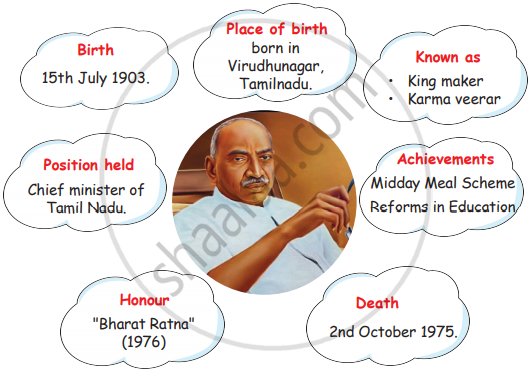
Punctuate the following sentence.
next wednesday my sister mita is going to join the state bank of india.
What did Hiawatha love?
Look at the words given below and put them under the things that they are made of –

Which of the following would you expect a carpenter to use at work?
bench, poker, plane, chisel, fork, spade, blotting paper, lawn-mower, telescope, pincers, jaw, scissors, hammer, map, nails, lathe, pencil, anvil.
How is school education in the village different from that in the city?
Describe the photographer.
Why did Leacock assume that the photographer was praying?
We may not have money to buy all our wants at the same time. In such a situation, what are the options available?
Bring out the humorous elements in the play.
Write a dialogue between a student and teacher on 'Importance of Yoga'.
Write letter to your father asking permission to go on a educational tour.
In H.C. Anderson's story, what forces the Little Match Girl to go about selling matches on the street?
What might success mean to the following people? Think about it and write.
A doctor
Write a composition (in approximately 400 – 450 words) on the following subject.
You had to go on a train journey with your family. On reaching the railway station, you discovered that your train was delayed by two hours. Describe how you spent those two hours, detailing what you saw, the sounds you heard, and the interactions you had with the people around you. Express your feelings when you saw the train finally approaching the station.
Write a composition (in approximately 400 – 450 words) on the following subject.
During the lunch break, a surprising sight unfolded as a monkey entered your school campus. Narrate your experience as you took charge and guided junior students to their classrooms ensuring their safety.
