Advertisements
Advertisements
प्रश्न
Referring closely to specific instances in the play 'Arms and the Man', discuss how Shaw presents class distinctions and social snobbery.
Advertisements
उत्तर
Throughout, Arms and the man by George Bernard Shaw,slight variances are used in the speech of the characters to indicate class distinctions. It is clear that Shaw, a noted socialist, has a great deal of concern about class issues and instead of making the reader keenly aware of these notions throughout Arms and the Man via any direct mention, Shaw uses their dialogue as well as cues within the setting to reveal these elements. “Despite the prominence of debate and speechmaking in his plays, one sometimes forgets that before Shaw-the-playwright came Shaw-the-debater and public speaker. All were platform spellbinders". Part of the reason it is so easy to forget that there a number of encoded social messages within Arms and the Man by George Bernard Shaw, is because is remarkably deft at conveying injustices and problems through characterization and language. Shaw’s writing style is thus very critical of the Victorian-era societyyet instead of doing this overtly, he relies on gestures, dialogue, and setting to set the stage for the debate. His “public speaking" would, in this sense be limited to the voices of his characters who come from variable class backgrounds and have a system of language that is suitable for their class. Only through this mode can George Bernard Shaw open a platform for class debates. Without being told the first thing about this character’s thoughts, it is clear that reader should be immediately attentive to class distinctions through outward appearances. It should also be noted that this setting is beautiful, but we are not expected to focus on the beauty in a traditional way, but rather to pay attention to the social statement—that there is a woman who obviously pays more for her clothes than the upkeep of her living quarters. In the mind of one critic, “The world, as he [George Bernard Shaw] looks out upon it, is a painful spectacle to his eyes. Pity and indignation move him. He is not sentimental, as some writers are, but the facts grind his soul… in a word, art has an end beyond itself; and the object of Shaw’s art in particular is to make men think, to make them uncomfortable, to convict them of sin''. As this essay makes clear, his is an especially succinct observation in this scene since there is opportunity for sentimentality and romanticism (since she is framed by a lovely setting) but this is not enough for George Bernard Shaw; he must shift the object of the reader’s gaze away from physical beauty to the darker world of class and character. This same shift in possibilities, from the potential sentimentality to the social critique, is apparent in terms of language as well as setting descriptions. The ultimate effect of this writing style is that the reader becomes implicated in-class debates (as well as other equally prominent debates about the nature of war as well) and is left with a moving story as well as something more to consider.
APPEARS IN
संबंधित प्रश्न
Have you are wondered why soldiers are always clad in green? This is to enable them to camouflage themselves during wartime. Hiding in the jungles, their green attire blends into the surrounding trees and shrubs, making it difficult for the enemies to spot them.
Long before man-made use of camouflaging, insects have already adopted the tactic of disguise to escape from the clutches of their predators. By having body colour close to those of the rocks and dried leaves, they can escape from being pursued by the predators.
Butterflies and moths have developed a variety of camouflage strategies since they are quite defenceless and their predators are abundant. Possessing wings which resemble dried leaves help certain butterflies and moths to hide among heaps of dried leaves when predators are around.
Fortunately, not all insects choose the art of disguise to escape from their predators; otherwise, the world would be so dull and colourless. There are insects which assimilate the bright body colours of bees and wasps to escape from being pursued by their predator. Long ago, birds have already learnt to avoid brilliantly coloured wasps and bees in fear of their painful stings. Hence, over millions of years, many harmless insects have assimilated the bees and wasps by imitating. their bright body colours and shapes. In this way, they appear dangerous and hence ward them off.
The beefy, not only appears like the bumblebee in terms of body colour, even its hums sound similar too. The only difference is that the beefy does not have a stirring and is hence harmless. The hoverfly is another insect which imitates. the body colours of the wasps. Their bodies are striped yellow and black. The only deviations are that hoverflies do not have stings, and they have only one pair of wings each while wasps have two pairs each. These variations are hardly noticed by the predators and hence help them to escape.
A1. Complete the table with the information from the passage : (2)
| Insects | Similarity | Difference |
| Bumblebee - Beefy | ||
| Wasp - Hoverfly |
A2. Complete the tree diagram : (2)

A3. Find out : (2)
‘Nature has given a self-protection mechanism to insects’.
Find out at least two examples from the passage to prove this statement.
A4. Vocabulary - (2)
Find the words from the passage for :
(i) animal or bird that hunts other for food
(ii) to get free from danger
(iii) to prevent something from harming
(iv) to make a copy
A5. Personal response - (2)
‘Soldiers disguise themselves to prevent enemies to spot them’.
Give two more examples when the disguising technique is used by humans.
A6. Grammar - (2)
Rewrite the following sentences in the ways instructed :
(i) They have only one pair of wings.
(Make it negative without changing the meaning)
(ii) Insects have already adopted the tactic of disguise to escape from the clutches of their predators.
(Replace infinitive with gerund and rewrite)
(B) Summary : (3)
Summarise the above extract with the help of the points given and suggest a suitable title.
Camouflage of soldiers and insects - reason and ways for disguising - assimilation of insects - need of imitation.
What is the free bird metaphor for.
The end justifies the means.' Argue for or against the statement.
She shouted angrily_________ the disobedient boy.
It is dangerous as well as illegal to drive a motorcycle without a helmet. (Begin: It is not ................................................. )
I have never seen a film as bad as this. ·
(Begin: This is ........................................ )
What were the results of the CT scan?
The movement words
Below is a topic for essay writing. Follow the steps listed above to write on this topic.
Fascinating facts about water
Explain the following phrase
Spinning yarns
Use it in a sentence of your own.
How does the narrator bring out the contrast between the Indian way of life and American society? Do you think his wife Mala adjusted comfortably to the new way of life?
Read the poem ‘The Road Not Taken’ by Robert Frost.
Multiple Choice Question:
What does ‘We’ here refer to?
The extract deals with the atmosphere of two homes. Collect the words associated with - Garden.
Consult the thesaurus and note down synonyms for 'ordinary'.
- One synonym of the ordinary is banal.
Eg. He finds English poetry very banal. - Similarly, find the meaning and make use of the words trite, routine, cliched, and regular in your own sentences.
Place the given areas of questioning from the list in the appropriate columns.
- future plans
- inspiration
- overcoming hurdles/ struggle
- coach/ mentor/ guide/ teacher
- message for the youngsters
- family support
- alternate career choice
- first or maiden award/ achievement /success /setbacks
- a turning point in life/ success formula/technique.
| Section of the interview | Aspects to be covered | |
| 1. | Introduction | Welcoming/Greeting, Introduction of the guest/Occasion. |
| 2. | Opening questions | |
| 3. | Main body | |
| 4. | Concluding questions | |
| 5. | Summing up | Concluding the statement, Expressing gratitude. |
You can add your points.
Can you think of a parallel scene of dawn or evening when everything is steeped in golden light?
Study the following format of an informal letter carefully. Using the format,

Write an informal letter to your friend who has gone to another town for a month.
Answer the following question :
What are the benefits of travel?
Draft Letter for the following.
You are Ajeet, living in a remote village in Tirunelveli. You participated in a health camp organized by your school. You were surprised to observe that most of the residents were unaware of health and hygiene. As a concerned citizen, write a letter to the editor stating the need to organize such camps focusing on the importance of health and hygiene.
Draft Letter for the following
You are Sudha. Your neighbour has a pet dog that barks continuously. Write a letter to the Editor of a weekly newspaper of your locality, highlighting the nuisance and noise pollution created thus. Also, suggest ways to solve the problem.
Draft Letter for the following.
You are Raja. The street lights of your area do not work properly. As a responsible citizen, write a letter to the newspaper enlightening them about the problem and also suggest ways to brighten the area.
Discuss and write –
- Why do cats and dogs fight?
- Why do we walk across the road, not run?
- Why do people like ice-cream?
Find one word from the story that means
to be seen nowhere d ______.
Complete the following stories by using an appropriate word from the box given below –
| my, his, he, your |
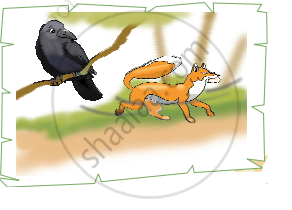
Sitting on a tree a crow was enjoying a piece of bread. A hungry fox wanted to have that bread. said very sweetly, “Dear brother, I've heard that ______ voice is very sweet. Please sing a song for me.” The foolish crow opened ______ beak and the piece of bread fell down. The fox picked it up in ______ mouth and ran away.
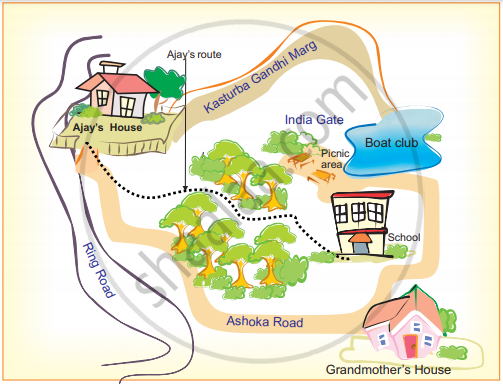
Use the above map to answer the questions.
- What does the dotted line on the map show?
- What road would Ajay take to get to the boat club?
- What building is next to the picnic area?
- What road passes by Ajay’s house?
- What other way could Ajay use to get from his house to his grandmother’s house?
Now write:
Use verbs like go, turn, cross
Use prepositions like: across, between, in front of, beside, near, behind, and write how you get home from school.
What are the strengths and weaknesses of Jimmy Wells from Bob’s point of view?
Describe Mary Kom’s personal experiences during her first International Championship match from the time of selection to winning the medal.
Write a dialogue between a student and teacher on 'Importance of Yoga'.
Think before you use! Name some ‘ready to eat’ and ‘ready to cook’ food items available in the market. Discuss the following in groups.
- Discuss whether it is necessary to use such items and why they are sold.
- Discuss the possible adverse effects of such food items.
