Advertisements
Advertisements
प्रश्न
While building a bridge, a group of people comes together. They are architects, designers, engineers, officers, masons, politicians, building material suppliers, carpenters, etc. Write about the qualifications of these people. Choose any career from the list above and complete the table.
| Your choice of career/ careers | Skill/Qualifications |
Advertisements
उत्तर
| Your choice of career/ careers | Skill/Qualifications |
|
Architect |
ability to imagine and think creatively, able to analyse everything in detail / a bachelor's degree in architecture |
|
Engineer |
good with numbers, ability to think practically, innovative thinking / a bachelor's degree in engineering (specifically, civil engineering in case of construction of a bridge) |
APPEARS IN
संबंधित प्रश्न
How does the poet use the contrast between the two birds to reveal racism in America?
Can the poem The Patriot be considered a dramatic monologue? Justify.
How does Seattle justify his religion as opposed to what the white men had said about it?
How does the story “A Horse and Two Goats” develop the idea of the need to interact with people who have vastly different identities from your own?
Fill in the blank with an appropriate word:
The poet's mother was stung __________ a scorpion.
Choose two of the passages (a) to (c) and answer briefly the questions that follow:
Raina :
Come away from the window (She takes him firmly back to the middle of the room. The moment she releases him he turns mechanically towards the window again. She seizes him and turns him back, exclaiming) Please! (He becomes motionless, like a hypnotized rabbit, his fatigue gaining fast on him. She releases him, and addresses him patronizingly). Now listen. You must trust to our hospitality. You do not yet know in whose house you are. I am a Petkoff.
The Man: A pet what?
Raina : [rather indignantly] I mean that I belong to the family of the Petkoffs, the richest and best known in our country.
The Man: Oh yes, of course. I beg your pardon. The Petkoffs, to be sure. How stupid of me!
Raina: You know you never heard of them until this moment. How can you stoop to pretend!
The Man: Forgive me. I'm too tired to think, and the change of subject was too much for me. Don't scold me.
(i) Why did the man keep turning to the window?
(ii) Which examples of the social superiority of the Petkoff's does Raina give the man?
(iii) Which opera does Raina mention? With whom does she compare herself? What does this tell you about her?
(iv) In Raina's opinion, what should the man have done instead of threatening her?
(v) What does the man tell Raina about his father? Why does he do so?
(vi) What does the man do at the end of the scene?
Fill in each of the numbered blanks with the correct form of the word given in brackets. Do not copy the passage, but write in the correct serial order the word or phrase appropriate to the blank space.
Example:
(0) One morning, I (0) ……. (see) the python curled up on the dressing table.
Answer: saw.
It was (1) ……. (gaze) at its own reflection in the mirror. I (2) ……… (go) for grandfather, but by the time we (3) ……… (return) to the room, the python (4) …….. (move) on. He was seen in the garden, and once the cook saw him, (5) ……… (crawl) up the ladder to the roof. Then we (6) …….. (find) him on the dressing table again, (7) (admire) himself in the mirror. “He’s trying to look better for Aunt Mabel,” I said. I (8) ……. (regret) this remark immediately because grandmother overheard it and held up my pocket money for the rest of the week!
Fill in the blank with an appropriate word:
The cyclist rode quickly ______ the path.
Re-write the following sentence according to the instructions are given. Make other changes that may be necessary, but do not change the meaning of the sentence.
The monsoon is the best season in our country.
(Rewrite using ‘good’)
To what is the bird’s movement compared? What is the basis for the comparison?
Combine the following sets of ideas to show the contrast between them.
(i) The Emperor may rule over the territory he has conquered.
(ii) The artist knows the way within.
Distinguish between the following pairs of sentences.
Green stripes could be used or alternatively black ones.
Why didn't John Garrideb like the idea of including Holmes in the hunt for the third Garrideb?
Discuss the following in pairs or in small groups.
The cleverest of criminals leave behind clues to their crime.
There are certain words that are repeated in the poem. For example, ‘no more’ (Line 7).
Find out other similar expressions.
Explain the effect they have created in the poem.
Your teacher will speak the word given below. Write against two new words that rhyme with it.
wax ______ ______
Your teacher will speak the word given below. Write against two new words that rhyme with it.
chop ______ ______
How did Kalpana Chawla meet her end? When did this tragedy in space take place?
The word ‘round’ usually means a kind of shape. What is its meaning in the story?
Re-word the line from the story:
Miss Beam was all that I had expected — middle-aged, full of authority.
Notice the use of ‘there’ in the following sentences.
-
There was a big crowd at the fair.
-
There were many things I’d have liked to buy.
Now rewrite the following sentences using ‘there’ in the beginning. Look at the following examples.
-
I can do nothing to help you.
-
There is nothing I can do to help you.
-
A man at the door is asking to see you.
-
There is a man at the door asking to see you.
1. This park has beautiful roses.
2. Your story has no fun in it.
3. We have no secrets between us.
4. My village has two primary schools.
5. This problem can be solved in two ways.
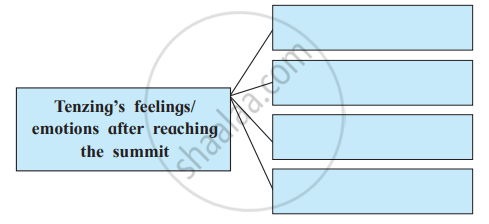
Complete the web highlighting the feelings/emotions of Tenzing after reaching the summit.
Rewrite the given statements in their order of occurrence.
The most difficult task of maintaining the hold on Tiger Hill was achieved in this way:
- 8 Sikh was ordered to attack and capture Helmet and India Gate.
- Bodies of the Pakistani soldiers were collected and buried appropriately.
- During the ferocious artillery duels, the Grenadiers hung on their precarious perch with grit and determination.
- Sikh fought back successfully two counterattacks with forty to fifty personnel.
- An ad-hoc column of 8 Sikh climbed the steep rock and captured India Gate.
- In spite of heavy casualties, 8 Sikh captured Helmet on 5 July.
You have noticed that many of your classmates are not interested in outdoor games or participating in co-curricular activities. Discuss some ways in which they will be encouraged to participate in activities.
Let’s compose a poem. Two lines are given. Add two of your own.
There is another sky,
Ever serene and fair
Given below are a few famous bridges in India. Find out more information about them and write in your notebook.
- The Howrah Bridge.
- Laxman Zhula
- Pambum Bridge
- Worli Sea Link
Think of different ways of classifying them, for example, electric and non-electric, day-time sources and night-time sources
Read the following note from a school girl’s diary:
|
Miss Fernandes is our new class teacher. She is slim and fit even at the age of 50. With her grey hair, spectacles, and plain formal clothes, she looks so strict! But we discovered that her classes can be great fun. We begin each class with a simple two-minute game or activity. Today we had to write as many words beginning with 'a' as we could, within 60 seconds. I wrote 50! I got a pot on my back for making 'the best effort'! I feel on top of the world. |
Write diary entries for the interesting or important events that take place in your school. Write at least 3 entries.
You must have heard about the Film and Television Institute of India (FTII), Pune. It is India's top media Institute. It plays an important role in providing talent to commercial cinema, TV, and web serials. Browse the internet and find information about other institutes in India and abroad, write it in your notebook.
Imagine that you are a compere of a ‘Prize Distribution Ceremony’ of your college. Write a script for the same.
You can take the help of the following points.
- Introduction – A brief introduction of the programme / function / show
- Welcome speech – Welcome to all guests. Felicitation – felicitation of the guests (the principal, vice-principal, etc.).
- Lighting the lamp
- Welcome song
- Main events
- Vote of thanks
Relate the life-story of Caesar, rearranging the facts in a proper sequence in the form of a flow chart:
- Caesar begins to upset things at home
- Neighbour flings a stick at Caesar
- Young crow is saved by the narrator
- Caesar begins to trouble neighbours
- The crow is named Caesar
- Caesar passes away
- Caesar objects to being caged.
Hold a debate on - 'Pets or Pests?'
Say ‘WHY’?
The writer found his stay abroad very profitable.
Write in your own words:-
What are the latest modern methods of depositing money in your own or somebody else’s account?
Archaic words are those that are no longer used in a language, but sometimes their usage adds a historical or old-times flavour to a piece of writing.
Examples:
- behold – look
- afeared – frightened
- forsooth – indeed
- hither – this place
Now find out some archaic words from your mother tongue or another language that you are proficient in and write down at least ten of them, and against each, their modern equivalent and meaning in English.
| Archaic Language | |||
| Archaic Word | Modern Equivalent | Meaning in English | |
| 1. | |||
| 2. | |||
| 3. | |||
| 4. | |||
| 5. | |||
| 6. | |||
| 7. | |||
| 8. | |||
| 9. | |||
| 10. | |||
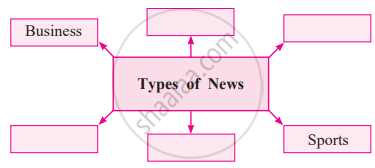
Complete the remaining blocks determining the types of news.
Write an appreciation of the poem.
| Point: | |
| Title | |
| Poet | |
| Rhyme scheme | |
| Favorite line | |
| Theme/Central idea | |
| Figures of speech | |
| Special features - Type of the poem, language, style, tone, implied meanings, etc. | |
| Why I like/dislike the poem |
Expand the theme in a write-up of about 20 lines.
‘Rumours are spread by fools and accepted by greater fools.’
You are Aadhav. While you were away on a holiday, your house was burgled. Use appropriate modals and complete the letter to your friend telling him/ her about it.
No. 36, Gandhi Road
Chennai – 45
04 August 2018
Dear Ramesh,
How are you? I feel sad to inform you that my house was burgled last week when I was on a holiday. Burglars ______ have known from the accumulated newspaper pile that I had gone away. When I came back last Sunday, I found the back-door lock broken. I ______ have forgotten to bolt the back-door from inside and they _______ have entered through it. My room was ransacked. They took my laptop and other valuables. I ______ have deposited the jewellery in a bank locker to avoid this loss. I _______ have informed my neighbours about my week-long trip. Well, I have registered an FIR with the police. They are investigating the case. They have assured that I _____ get my jewels back. The burglars ______ be caught very soon. Convey my regards to all at home.
Yours lovingly,
Aadhav
Create a pamphlet for the following:
Make an attractive pamphlet for your school’s Fair organised for raising funds for (any) relief (Specify the date, time, types of stalls, and the reasons for the fair).
How do you cook rice in your house?
Fill in the gaps in this recipe for cooking rice. Use the words in the box
|
boil |
water |
heat |
keep |
rice |
lid |
low |
water |
more |
ready |
What you'll need
- 1 cup uncooked white rice
- 2 cups water
- pinch of salt
How to make it
- ______the rice until the ______runs clear.
- Drain the water and ______ aside.
- In a medium sized pan, bring water to ______.
- Add the salt, stir, and then add the rinsed and drained ______.
- Reduce the heat, cover the rice, and let it simmer on ______ heat for 20 minutes.
- Check after 15 minutes to see if all the ______ has evaporated. If it has, the rice is ______.
- If not, replace the ______ and let the rice simmer for 5 ______
- Remove from ______ and serve
Fill in the form given below.
POST OFFICE SAVING BANK
ACCOUNT OPENING/PURCHASE OF CERTIFICATE APPLICATION FORM FOR INDIVIDUALS

Fill in the blank by choosing the preposition from the option.
The frogs jumped ______ the well.
Punctuate the following sentences using capital letters, full stops (.) commas (,) question marks (?) apostrophe ( ' ) exclamation mark (!) wherever necessary.
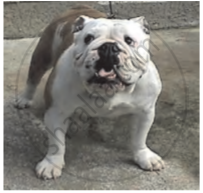
dear samir,
i am sending you a photograph of my newest pet frisky is a bulldog and a very playful puppy by next summer he should be old enough to go with us on our long walks i m sure you are looking forward to seeing him I know you will like him
warm regards
sanju
Who do you think is the naughtiest child in your class? Describe her/him in five lines.
The ______ sang beautifully.
A message is a verbal, written, or recorded communication sent to or left for a recipient who cannot be contacted directly.
You are the Sports Captain of your school. Write a message to the Physical Director, requesting him to be present during the football team selection scheduled for tomorrow.
We have heard of the proverb ‘Familiarity breeds contempt. Do you think that the passage of time strengthens friendship? Share your reasons with your class.
Read and understand the data presented in the pie-chart below on factors affecting health, and write an article for your school magazine highlighting the fact that it’s our lifestyle that determines how healthy we remain. Write your article in about 150 words. Give a suitable title too.

The factors which affect health are given percentage-wise in the pie chart.
Describe Bertie’s problem.
One has to be cautious and not be carried away by stories. How did Sletherby exhibit caution?
Reading a map
Nowadays though locations are traced easily using GPS, (Global Positioning System) one should know what to look for in the map to reach the destination. Here are a few general instructions to be followed while reading a map.
- Identify and understand the elements of the map correctly.
- Look out for the title to know what the map shows.
- Study the symbols/colors that are used on the map and find what they stand for.
- Look at the scale of the map. (whether to be scaled or not to be scaled)
- Look for the pointer to know the direction.
Let us together scale the summit. Here is a drawing of the Everest showing the way to the summit, and the position of the camps with their heights. Trace the trekking trail to reach the summit with the given details and write an interesting paragraph in about 100 words.
The Summit of Mount Everest

Read the given sentence and underline the no word.
I have no coat.
Write letter to your father asking permission to go on a educational tour.
- What do you like best about your school?
- Do you think school is fun?
- Which is the part that you don’t like?
- How often should the teacher give you a test?
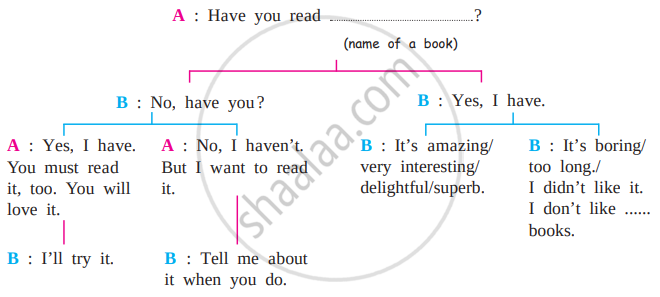
Use the following charts to prepare meaningful dialogues.
Use your ideas to fill in the blanks.
Write a composition (300-350 words) of the following:
Describe the locality in which you live. Give details of the things you see and hear as you walk around your locality. What do you especially like about the place?
Imagine someone has invited your family to a programme and you were the only person at home when the invitation was given orally. Write a note (4-5 lines) to pass on the message to the other people in your family. Or, Write an imaginary conversation in which you pass on the message to your parents.
Read the passage given below and answer the questions (i), (ii) and (iii) that follow.
| (1) | “Can I see the Manager?” I said, and added solemnly, “Alone.” I don't know why I said “Alone.” “Certainly,” said the accountant and fetched him. | |
| (2) | The Manager was a grave, calm man. I held my fifty-six dollars clutched in a crumpled ball in my pocket. “Are you the Manager?” I asked. God knows I did not doubt it. “Yes,” he said. “Can I see you …. alone?” I asked. |
5 |
| (3) | The Manager looked at me in some alarm. He felt that I had an awful secret to reveal. “Come in here,” he said, and led the way to a private room. He turned the key in the lock. “We are safe from interruption here,” he said; “Sit down.” We both sat down and looked at each other. I found no voice to speak. “You are one of Pinkerton’s men, I presume,” he said. |
10 |
| (4) |
He had gathered from my mysterious manner that I was a detective. I knew what he was thinking, and it made me worse. |
15
20
|
| (5) | The Manager got up and opened the door. He called to the accountant. “Mr. Montgomery,” he said unkindly loud, “this gentleman is opening an account, he will deposit fifty-six dollars. Good morning.” I rose. A big iron door stood open at the side of the room. “Good morning,” I said, and stepped into the safe. “Come out,” said the Manager coldly and showed me the other way. |
30 |
| (6) | I went up to the accountant’s wicket and poked the ball of money at him with a quick convulsive movement as if I were doing a conjuring trick. My face was ghastly pale. “Here,” I said, “deposit it.” The tone of the words seemed to mean, “Let us do this painful thing while the fit is on us.” He took the money and gave it to another clerk. |
35 |
| (7) | He made me write the sum on a slip and sign my name in a book. I no longer knew what I was doing. The bank swam before my eyes. “Is it deposited?” I asked in a hollow, vibrating voice. “It is,” said the accountant. “Then I want to draw a cheque.” My idea was to draw out six dollars of it for present use. Someone gave me a chequebook through a wicket and someone else began telling me how to write it out. The people in the bank had the impression that I was an invalid millionaire. I wrote something on the cheque and thrust it in at the clerk. He looked at it. |
40
45 |
| (8) | “What! Are you drawing it all out again?” he asked in surprise. Then I realised that I had written fifty-six instead of six. I was too far gone to reason now. I had a feeling that it was impossible to explain the thing. I had burned my boats. All the clerks had stopped writing to look at me. Reckless with misery, I made a plunge. “Yes, the whole thing.” “You withdraw all your money from the bank?” “Every cent of it.” “Are you not going to deposit anymore?” said the clerk, astonished. “Never.” |
50
55 |
| (9) | An idiot hope struck me that they might think something had insulted me while I was writing the cheque and that I had changed my mind. I made a wretched attempt to look like a man with a fearfully quick temper. | |
| (10) | The clerk prepared to pay the money. “How will you have it?” he said. This question came as a bolt from the blue. “What?” “How will you have it?” “Oh!”— I caught his meaning and answered without even trying to think— “in fifties.” He gave me a fifty-dollar bill. “And the six?” he asked dryly. “In sixes,” I said. He gave it to me and I rushed out. As the big door swung behind me. I caught the echo of a roar of laughter that went up to the ceiling of the bank. Since then, I bank no more. I keep my money in cash in my trousers pocket and my savings in silver dollars in a sock. |
60
65
70 |
| Adapted from: My Financial Career By Stephen Leacock |
||
-
- Find a single word from the passage that will exactly replace the underlined word or words in the following sentences. [3]
- The kind stranger went and got back the ball from where it had rolled into the bush.
- I took offence at the expression on his face that was clearly meant to insinuate I was a liar.
- The firm experienced a financial loss when the contract went to a contender who had just entered the business.
- For each of the words given below, choose the correct sentence that uses the same word unchanged in spelling, but with a different meaning from that which it carries in the passage. [3]
- alarm (line 8)
- The silence from the other end set off alarm bells in her head.
- The pallor of his skin alarmed those standing around.
- I set my alarm for six o’clock but slept through it.
- The sound of the approaching jets caused some alarm in the war room.
- wicket (line 44)
- The wicketkeeper was the true saviour of the day for that one match.
- The team wanted to bat while the wicket was still dry.
- The man at the window handed us our tickets through the wicket.
- The quick loss of wickets demoralised the team.
- reason (line 48)
- After the tragedy, his ability to reason is severely diminished.
- They reasoned they could get better seats if they arrived early.
- Recipients of funds were selected without rhyme or reason.
- We have every reason to celebrate.
- alarm (line 8)
- Find a single word from the passage that will exactly replace the underlined word or words in the following sentences. [3]
- Answer the following questions as briefly as possible in your own words.
- With reference to the passage, explain the meaning of the expression of the ‘I had burned my boats?’ [2]
- Cite any two instances of the behaviour of the bank employees that indicate the insignificance of a deposit of fifty-six dollars. [2]
- Why do you think the people in the bank thought of the narrator as an “invalid millionaire?” [2]
- Summarise why the narrator decided ‘to bank no more’ (paragraphs 6 to 10). You are required to write the summary in the form of a connected passage in about 100 words. Failure to keep within the word limit will be penalised. [8]
