Advertisements
Advertisements
प्रश्न
Write a summary of the sonnet. Refer to the earlier poems for the points to be covered for writing the summary.
- Title
- Introductory paragraph (about the poem, type, nature, tone)
- Main body (central idea, the gist of the poem)
- Conclusion (opinion, views, appeal).
Advertisements
उत्तर
Upon Westminster Bridge
'Upon Westminster Bridge' is a sonnet composed by William Wordsworth. It is a Petrarchan sonnet consisting of an octave and a sestet. The tone of the poem changes from overwhelmed to calm to excited and amazed by the end.
The poet begins by describing a majestic scene that he has set his eyes upon – the city of London in the wee hours of a morning from Westminster's Bridge. He describes the beauty of the early morning sun adorning the city with sunshine and observes the silence and stillness of the city before its people awake. As he gazes at the structures of the city i.e. ships, towers, domes, theatres, and temples, he notes that they lie open to the sky and glitter in the rays of the morning sun. The poet observes that the air is not polluted because it is early in the day and work hasn't begun. He describes the beginning of a new day with the first rays falling on the sleeping city and notices how even the river flows calmly, at its own pace, thus evoking a sense of calm in the poet. Tying up the two contrasting ideas of a busy city and nature, the poet paints a beautiful picture in our minds. He finally ends the poem by calling out to God in sheer amazement and refers to the sleeping city of London as the 'mighty heart' that is lying still. It is a sublime finish to the fourteen-line sonnet.
The poem is a beautiful comparison between a city and nature and how both have a calming effect on a person when they are observed in the silence of the morning. The subject of the poem substantiates the fact that Wordsworth was a true Nature poet. The use of simple language makes it easy to understand and this is the biggest appeal of the poem as it makes the poem attractive to readers.
APPEARS IN
संबंधित प्रश्न
The school captain was elected by the students of classes XI and XII.
(Begin: The students ………………….)
In the following items, sentence A is complete, while sentence B is not. Complete sentence B, making it as similar as possible to sentence A. Write sentence B.
(A) He is so old that be cannot remember events of the past.
(B) He is too ............................................................................
Research the Battle of Blenheim. Then write an essay defending Wilhelmine’s position that the battle was a “wicked thing” or Kaspar’s position that it was a | “great victory.”
What is the advice of the poet? Is there any relevance of this advice to our present day?
Which figure of speech is used in the lines:
(Last week in someone’s place we saw
A dozen eyeballs on the floor.)
What do you like about this poem?
But a caged BIRD stands on the grave of dreams
His shadow shouts on a nightmare scream
His wings are clipped and his feet are tied
So he opens his throat to sing.
Read the above lines and answer the question that follow.
What is the main conflict in this poem?
Can the poem The Patriot be considered a dramatic monologue? Justify.
Show liow Narayan depicts women in the story and their role in a man’s life.
'Appearances can be deceptive'. Give your views on this topic.
Fill in the blank with an appropriate word:
I don't know what they were arguing __________ but I could hear angry voices.
Write an original short story that begins with the words: “It's not my fault”, he shouted………”
Read the extract given below and answer the questions that follow:
Mabel: [Utterly surprised] Ronny! Do they want me in Court?
Dancy: No.
Mabel: What is it, then? Why are you back?
Dancy: Spun.
Mabel: [Blank] Spun? What do you mean? What’s spun?
Dancy: The case. They’ve found out through those notes.
Mabel: Oh [Staring at his face] Who?
(i) Where are Mabel and Dancy at this time? What was Mabel doing just before this conversation?
(ii) Why did Mabel say, “Do they want me in court?” Explain the meaning of spun in the extract?
(iii) What ‘notes’ is Dancy talking about now?. How does Mabel react immediately after the extract”:
(iv) Dancy leaves a note for his best friend towards the end of the play. What is the name of his best friend? What is written in the note?
(v) What does Dancy do at the end? Why does he do that? What is your opinion of Mabel and Dancy?
Fill in the blanks with an appropriate word:
- The teacher spoke for Raju when he was wrongly accused of stealing money.
- We can visit her at the hostel at 3 pm and 6 pm on Saturdays.
- The Sinha's have lived in New Delhi 1943.
- Little children are often afraid of the dark.
- Sneha has applied for a scholarship.
- It took Ahmed many months to get the loss of his friend.
- She turned the generous offer made by the manager.
- We were asked to take our footwear as we were entering a place of worship.
Fill in the blank with an appropriate word:
The young man put the flute _______ his lips and began to play.
Join the following sentence to make one complete sentence without using and, but or so.
The child helped her mother to make breakfast. She washed the tomatoes.
Given below is an interesting combination of words. Explain why they have been used together.
virtual body
Below is a topic for essay writing. Follow the steps listed above to write on this topic.
Fascinating facts about water
What does the notice 'The world's most dangerous animal' at a cage in the zoo at Lusaka, Zambia, signify?
Distinguish between the following pairs of sentences.
The team played two matches successively.
How is Satyajit's financial crash introduced to the reader?
Match the words and phrases with their meanings in the box below.
|
|
|
paragraph numbers |
|
1. |
homesick |
(3) |
|
2. |
practically |
(4) |
|
3. |
it pains me |
(7) |
|
4. |
appreciate |
(9) |
|
5. |
thoughtless |
(10) |
|
6. |
exercise |
(11) |
|
7. |
relief |
(13) |
|
8. |
ghastly |
(14) |
|
Almost |
it hurts me |
terrible |
|
test the strength of |
understanding the difficulties |
|
|
wanting to be home |
a welcome change |
not very caring |
Imagine you are journeying through a desert. Write a couple of paragraphs describing what you see and hear.
Complete the following web diagram.

Write down the significance of the following in the context of 'On to the Summit': Anchor.
You might have learned about organic farming. Make groups and discuss the difference between conventional farming and organic farming and write it down.
| Sr.No. | Conventional Farming | Organic Farming |
| 1. | ||
| 2. | ||
| 3. |
Dr. Babasaheb Ambedkar has cited the quotes by John Stuart Mill and Daniel O’Connel. Go through the lesson and write down 4 to 5 lines for each of them.
Complete the flow chart showing the events on the day of the assault.

‘Even small things in nature play a big role. So protect nature!’
Frame some slogans based on the above topic.
Form groups of 5-8. Translate the play into your mother tongue (or Hindi) as a group activity. Enact the translation in the classroom.
Do you have pet animals? Write an interesting story about your own or your friends' pet.
Write a letter to your Class Teacher or the Principal of your school to make any one of the two following requests.
You wish to start a news bulletin for your school/ class. It will be a one-page bulletin to be published every week. A different group of students will manage the preparation of the bulletin every time.
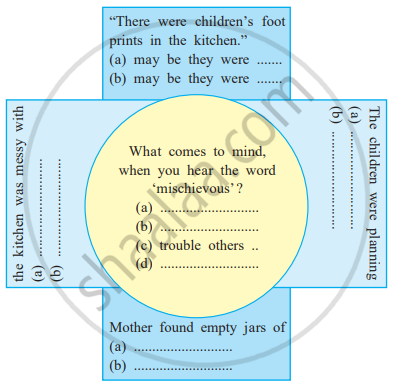
Read the evidence/sentences given below and offer a possible explanation of what happened in this house? Make up some questions to gather more information.
Now collect all your evidences and write a story in your notebook. Give a suitable title.
Here is a dialogue between a father and his daughter. Continue the dialogue with at least five utterances and use all the clues given above.
| Father: | Hi Mary, it has been a very long time since we went on a trip. Let’s plan one. |
| Mary: | Yes, dad. I am also longing to go. Why don’t we plan one for this weekend? |
| Father: | Sure. Tell me, where shall we go? |
| Mary: | Some place nearby but for at least two days. |
| Father: | Hmm… I think we should go to the reserved forest nearby. |
| Mary: | Yeah. I’ve never been to a forest. I have seen a forest only on the TV and movies. The forest is a good choice! |
| Father: | OK. If we are going to the forest, we must list out what we should carry with us for two days. |
| Mary: | I think we should carry suitable clothes like ________________________ |
| Father: | What about the food? Do you have any idea, Mary? |
| Mary: | Yeah. For food, I suggest ________________________ |
| Father | ________________________ |
| Mary: | ________________________ |
The fly gives into flattery and becomes the spider’s prey. If you are asked to give a happy ending to the poem, how will you save the fly? Write in your own words.
What is the name of her diary?
Read the given slogans and match them appropriately with their theme.
| 1. | One for all and all for one | Junk food |
| 2. | Limit your fast food otherwise, it would be your last food | Save water |
| 3. | Restricting a woman restricts the growth of the family | Cleanliness |
| 4. | Clean and green makes perfect scene | Woman empowerment |
| 5. | It takes a lot of blue to stay green | Unity |
Look at the picture given below and frame your own slogan.

Look at the picture given below and frame your own slogan.

Write an article for the following.
Recently while returning home from school you were knocked down by a speeding motorcycle. You escaped with minor injuries. You are Kishore/ Kavitha of class XI, studying in GHSS, Coimbatore. Write an article to The Hindu, in about 150-200 words expressing your concern about the increasing number of road accidents due to reckless driving. Also, stress the importance of following traffic rules.
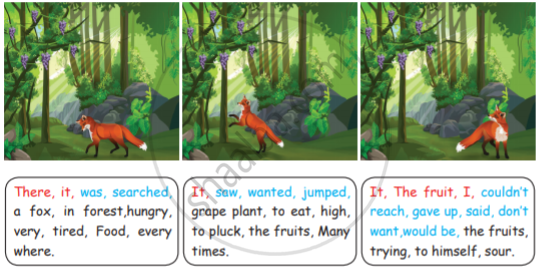
Write the hungry fox story on your own by looking at the pictures and using the clues given under each picture.
______ do you want for your birthday?
Find one word from the story that means
- to walk fast h ___________ .
Write rhyming words for the words given below. One has been done for you.
- morning - evening
- car
- high
- boots
- heat
- where
Make opposites with the words –
| dis ______ in______ |
| respect | |
| able | |
| efficient | |
| own | |
| capable | |
| secure |
See the picture Travel Time below. Answer the questions that follow.
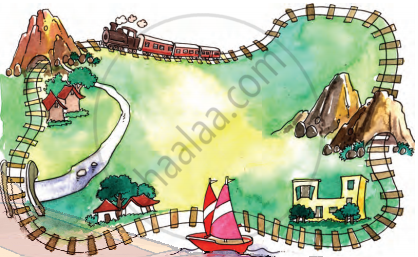
- Where did you go for an excursion/holiday?
- With whom did you go?
- What did you take with you?
- What was the first thing you saw when you reached your destination?
- What did you like best about the place?
- How long did you stay there?
- What did you miss about home?
How did the cop come to understand that Bob had been successful in the West?
‘Seeing is believing’. How is this humorously disproved in this story? Bring out the irony in the situation.
The sun brought about a positive change in the attitude of the children. Illustrate the statement.
Attempt a description of the following process, in about 100 word each, either using the imperative or the passive.
Preparing your favourite dish
Write the contraction for the following phrase.
are not - ______.
News Report:
Read the following headline and prepare a news report with the help of the given points:
21-Year-Old Mayur Wins World Chess Championship
Make use of the following guidelines:
- Headline
- Dateline
- Lead line
- Body of the report
Think before you use! Name some ‘ready to eat’ and ‘ready to cook’ food items available in the market. Discuss the following in groups.
- Discuss whether it is necessary to use such items and why they are sold.
- Discuss the possible adverse effects of such food items.
What might success mean to the following people? Think about it and write.
A doctor
Prepare a set of questions to interview -
A well-known social worker in your area.
Imagine someone has invited your family to a programme and you were the only person at home when the invitation was given orally.
Write a note (4-5 lines) to pass on the message to the other people in your family. Or, Write an imaginary conversation in which you pass on the message to your parents.
With close reference to Act III, describe Alonso's response to the perceived loss of his son, Ferdinand. Write your answer in a short paragraph of about 100-150 words.
Imagine someone has invited your family to a programme and you were the only person at home when the invitation was given orally.
Write a note (4-5 lines) to pass on the message to the other people in your family. Or, write an imaginary conversation in which you pass on the message to your parents.
