Advertisements
Advertisements
प्रश्न
Bring out the humorous elements in the play.
Advertisements
उत्तर
Jane, Aunt of Jack, gives a wedding gift of two hundred pounds to him and Jill to start a contented life. But Jane buys a home, a car, piano, dining table, cot, sofa, and even a radio on loan. Every month he pays more than his salary towards the payment of EMIs. Initially, Aunt Jane is pleased with Jack’s comfortable life. The dramatic irony of the whole play starts when Jack tells Jane that he owes his comfortable life to her. She asks if she had given to them two thousand pounds instead of two hundred by an oversight.
Aunt Jane infers that the house would cost a great deal of rent. It was only then she has a rollercoaster ride on the shocking truth about all Jack’s worldly possessions. He says that they thought it uneconomic to go on paying rent and be Mr. Tenant. To be wise, he decided to become Mr. Owner by just paying ten pounds and a few quarterly payments. Jill supports her husband’s wisdom saying that he had a pay hike of five shillings. Then it dawns on Jane that all the possessions may be bought on hire purchase of long-term EMI-based loans. Such loans collect a lot of interest concealed under EMIs. She asks if they own the car. Jack says the steering wheel, one of the tires, about two of the cylinders belong to them. Jack and Jill reveal the wonderful strategy of living on future earnings.
They explain that radio, piano, and furniture have been purchased on EMI from Mr. Sage. Mrs. Jane is dumbstruck. She abhors sitting on the furniture and the cot which do not belong to her relatives but to some creditors like Mr. Sage or Spencer. She gives 10 pounds as a gift and leaves. She turns down the offer of a car ride as one tire and two cylinders only belong to Jack. As soon as they leave, Jill sends the gift cheque to Dr. Martin. The black comedy apparent is that with one more installment, she could call the baby their own.
APPEARS IN
संबंधित प्रश्न
Imagine you are Gitika. Road the following conversation and write a suitable message for your mother in 50-60 words:
Ankita : Hi, didi ! I'm Ankita on the line. Is aunty at home?
Gitika : No, she has gone to visit my grandparents. Is there any problem?
Ankita : No, I just wanted to inform her that we have a special havan tomorrow at 9 a.m. at our place. My mother has specially invited all of you.
Gitika : Okay, Thanks ! I'll inform her and we will definitely come.
Which of these words would you use to describe Santosh Yadav? Find reasons in the text to support your choices, and write a couple of paragraphs describing Santosh’s character
| contented | determined | resourceful | polite | adventurous | considerate |
| weak-willed | fearful |
independent |
pessimistic |
patient | persevering |
Does the poem have feministic overtones?
Later, too, the old man uses the expression famous victory? Why?
Mention the two moods of the poet?
What does the poem “Abou Ben Adhem” convey?
Fill in the blank with an appropriate word:
There was a steep rise ……… onion prices.
The tree grew at a dangerous slant and had to be cut ________
Write a letter to the Editor of a magazine describing a dance performance you have seen or an art gallery you have visited.
Distinguish between the following pairs of sentences.
Green stripes could be used or alternatively black ones.
How does the bond of affection between Mrs. Croft and the narrator evolve?
Describe the cycle of events in Satyajit's life that brought him back to where he began.
Although the author was not a vindictive man he was very happy to see the twenty-one stone lady
who had impoverished him twenty years ago, and says he had finally had his revenge. What makes him say this?
Discuss the following with your partner and complete the following sentence.
Organic fertilizer means ______________.
Report writing

Study the web diagram and write the characteristics of report writing.
Complete the table. One is done for you.
| The World around you | What we should aim to be | |
| 1. | Callous | Caring for people, environment, life |
| 2. | Violent | |
| 3. | Greedy | |
| 4. | Corrupt |
Rewrite the play in the form of a short story.
Think and write in your own words.
Why do you think, birds greet the autumn season gladly?
Imagine Taffy comes to you for help to write a letter of apology, in the modern script we use. She wants to express her regret to the stranger-man for her mother’s action. Write that letter of apology (informal) on her behalf.
Speech development
- Content
- Greeting and introduction of the topic
- Exposition of main theme/clarity of message/organised thoughts and ideas.
- Moral and practical application with examples.
- Conclusion
- Speaking Presentation
- Verbal clarity- pronunciation of words, voice modulation and projection.
- Presentation/Speaking style - mannerism, audience eye contact, ability to keep the audience engaged.
- Confidence - gestures and expressions, stage courage
- Useful phrases and vocabulary
- It’s pleasure to see you all/I am happy to see you today/It’s good to see you all here.
- Today’s topic is .........../My talk is about ........... My topic is ...........
- The purpose/aim of this speech.
- I will focus on one/two/three major issues.
- If you have any question, feel free to ask me.
Write an article for the following.
The service provided by the conservancy workers in your city is very poor. You find all the street corners dumped with garbage thrown by the residents of the locality. It causes a menace for the public at large. You are Ramya/Rajan of Class X, studying in TM Model School, Dharmapuri. Write an article in about 150-200 words to the editor of The Indian Express, about this and suggest ways by which the situation could be improved.
“I cannot come.” Mala said that ______
This is Rajiv’s family. They are a healthy family. See what each one does to remain healthy.

See the picture Travel Time below. Answer the questions that follow.
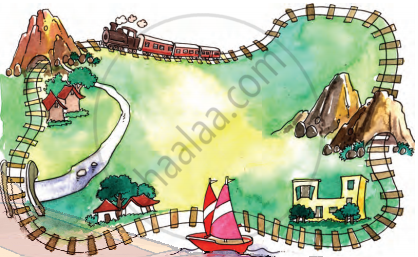
- Where did you go for an excursion/holiday?
- With whom did you go?
- What did you take with you?
- What was the first thing you saw when you reached your destination?
- What did you like best about the place?
- How long did you stay there?
- What did you miss about home?
The Government of Tamil Nadu has imposed a ban on the use of plastic. Effective implementation of this ban depends on public awareness and individual responsibility.
Write an article of 150 words for your school magazine to create an awareness of the dangers posed by indiscriminate use of plastic. Expand the ideas given below as notes.
Notes:
a. Introduction
(i) Plastic – synthetic material – doesn’t decompose in soil
(ii) Inevitable role of plastic – man’s day-to-day life
b. Human Health Hazard
(i) Leeching of plastic into food – micro plastic entering food chain
(ii) Human body’s inability to deal with this unnatural substance
(iii) Reaction of microplastic in human body and ill effects
c. Adverse Effects on Plants and Animals
(i) Plastic particles choking waterways – affect aquatic animals
(ii) Ingestion by aquatic and terrestrial animals–blocking of intestines and respiratory passages
d. Environmental Degradation
(i) Manufacturing process and burning of plastics–pollute atmosphere
(ii) Plastic–non-biodegradable – interferes with soil microorganisms – affects soil fertility
e. Conclusion
(i) Suggestions for restricted use – alternatives for one-time use of plastics
(ii) Segregation of plastic waste – for recycling
Attempt a description of the following process, in about 100 word each, either using the imperative or the passive.
Sending a letter by courier service
Imagine someone has invited your family to a programme and you were the only person at home when the invitation was given orally.
Write a note (4-5 lines) to pass on the message to the other people in your family. Or, Write an imaginary conversation in which you pass on the message to your parents.
Do you have a role model? What qualities do you appreciate in your role model?
Suppose one of your parents or an older relative wants to know about online shopping and you are explaining how to do it. Write a conversation between you and your parent/relative about it.
What leads Mathew Arnold to tell his beloved, “Ah, love, let us be true’, in the last stanza of the poem, The Dover Beach? Write your answer in a short paragraph of 100-150 words.
