Advertisements
Advertisements
प्रश्न
Describe the cycle of events in Satyajit's life that brought him back to where he began.
Advertisements
उत्तर
Satyajit witnessed a lot of changes in his life till the time the story was written. He had started his career as a client at a bank. He then caught a forgery and thus got promoted as a Managing Director. However, all these events turned out to be a turning point in his life. At present, he regretted reaching heights of success just by chance and not hard work. Now he realises that the tempo of failure is always faster than that of success. Today, he faced a crisis when it came to job, wealth, in fact, any resource at all. The wheel of fortune had turned and had completed an entire rotation bringing Satyajit back to where he had begun. He was reduced to nothing after enjoying glorious days when he owned a fortune. Once, it was he who was looked up to for financing and fulfilling the needs of the people. Now, he had to avert such situations to avoid the shame and dismay he felt at his present situation.
APPEARS IN
संबंधित प्रश्न
Write an original short story in which two children and their Grandfather are the main characters.
How does the poem make use of contrast? Consider the contrast between the poet and the daffodils, and between his feeling before, while and after seeing the daffodils.
His tune is heard on the distant hill’. Explain
What does the word “clipped” mean in this poem?
But a caged BIRD stands on the grave of dreams
His shadow shouts on a nightmare scream
His wings are clipped and his feet are tied
So he opens his throat to sing.
Read the above lines and answer the question that follow.
Explain with reference to the context.
It was roses, roses, all the way,
With myrtle mixed in my path like mad;
The house-roofs seemed to heave and sway,
The church-spires flamed, such flags they had,
A year ago on this very day.
Read the above lines and answer the question that follow.
When was the patriot welcomed?
What does Hemingway want to convey about the affects of war through the story?
Besides being an amusing tale about a failure to communicate the story “A Horse and Two Goats” makes some crucial points also. Justify.
Discuss how the author uses comic irony to describe the incident surrounding the statue?
Discuss theme of kindness and compassion in “Hearts and Hands” by O. Henry?
Your uncle has offered to get you a pet for your birthday. Write a letter to him telling him what you would like, give reasons for your choice and tell him how you Would-take care of your pet.
Fill in the blank with an appropriate word:
The old woman could not get ……… the shock.
Fill in the blank with an appropriate word:
Ashok leaned ______ the wall tiredly.
Re-write the following sentence according to the instructions are given. Make other changes that may be necessary, but do not change the meaning of the sentence.
Has Alia written to you?
(Begin: Have you……….)
What lessons do we learn from such hazardous experiences when we are face-to-face with death?
In what ways do you think we could help prevent the extinction of languages and dialects?
Notice the following sentence patterns.
And who art thou? said I to the soft-falling shower.
Rewrite the above sentences in prose.
What according to the poem is involved in the process of growing up?
How did Holmes guess that John Garrideb would go to 136, Little Ryder Street? Did he expect to find what he ultimately did before he went there?
How does the bond of affection between Mrs. Croft and the narrator evolve?
Look at this cartoon by R.K. Laxman. Read the sentence given below the cartoon. Discuss the following questions with your partner.
- What is it about?
- Do you find it funny? If so, why?
- Do you think a cartoon is a serious drawing? Why or why not?

Use the phrase in a sentence of your own, after finding out its meaning.
on board
Do you have a ‘dream’, or something you very much wish to do? Write a paragraph saying what you want or wish to do. Then say (in another paragraph) how you think you can make your dream come true.
What do you know about Kalpana Chawla’s education? How did she become an American citizen?
The words in the box are all words that describe movement. Use them to fill in the blanks in the sentence below.
The snake _______________ his head ______________ to strike at the crow.
Re-word the line from the story:
Miss Beam was all that I had expected — middle-aged, full of authority.
List the reactions of the agricultural officer to the author’s inquiry about Kasbai rice seeds. One is done for you.
(a) He had not heard of Kasbai.
(b) ___________________________
(c) ___________________________
Discuss with your partner and describe the atmosphere in the woods when Peter Crouch was heading towards Mrs. Adis’s House. It was -
- a dark moonless night.
- _________________________
- _________________________
The cherry tree is a narrative poem. Features that make it a narrative poem are given below. Justify them with proper examples.
It is a time-bound poem.
Browse on the net and gather a variety of templates to write a 'Curriculum Vitae'.
Write the character sketch of Dr. Stockmann.
Discuss the following and write about the following in your own words in 5-6 lines.
Which events in the story (Part I and Part II) changed Mathilde’s life?
Compare the Indian Monsoon season to a powerful king of a prosperous kingdom. Write down a few similarities. Use them to compose a poem of your own.
Write a character-sketch of the ‘Stranger-man’ using examples from the story to support the following attributes.
- ignorant, innocent, and polite
- calm and cool
- jumps to wrong conclusions
- hasty and unwise at times
Fill in the value trees with the best qualities you like to follow in your life from the given list. Write a few lines about your favourite quality in the box.
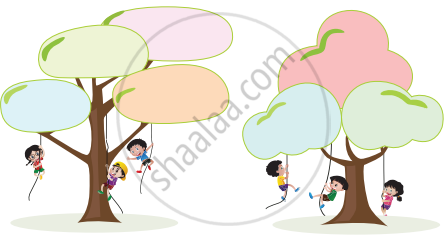
| Best qualities in life | ||||
| Affectionate | Cooperative | Gratitude | Loving | Responsible |
| Ambitious | Courageous | Happiness | Loyal | Self-confident |
| Brave | Dependability | Helpfulness | Good manners | Self-control |
| Calm | Diligence | Honest | Patriotic | Self-esteem |
| Caring | Enthusiastic | Humble | Peaceful | Sensitive |
| Cheerful | Fairness | Imaginative | Perseverance | Sincerity |
| Committed | Faithfulness | Intelligent | Polite | Successful |
| Compassionate | Flexible | Joyful | Positive | Tolerant |
| Concerned | Forgiveness | Kind | Rational | Truthful |
| Confident | Generosity | Leader | Resourceful | Versatile |
| Contented | Giving | Logical | Respect | Witty |
| My favourite quality is... __________________________________________________________________________________ __________________________________________________________________________________ |
||||
Fill in the blanks with different words and write your own poem.
Your Title for the poem:______
My ______would say:
“Little boy/girl______
Go to ______
and get some ______, ______
______ and ______”
And so I go to the _______
_____ all the way
and when ______ asks me
what I want
I rattle off a list: “
______, ______
______ and ______”
And back home,
______ twists my ears
Ouch!
Imagine a conversation among your friends about the four characters in the play – Tabaqui, Shere Khan, Mother Wolf and Father Wolf. Use the hints to write it.
- The characters' entry in the play.
- Compare and contrast their character traits.
- The reaction of the characters on seeing the man cub.
______ do you play?
______ do you get up?
Use the following clues to complete the following exercise.
| play | stop | buy | learn | see | meet | learn |
| be | eat | go | travel | start | read | visit |
Write three things you have not done in the last three years.
- I have not played ______
- ____________
- ____________
Two stories got mixed up. Sort them out and write them in the appropriate boxes.
- We thought the lion had eaten someone.
- Suddenly the kite lifted him off the ground and took him over the treetops.
- He saw a shoe in the lion's cage.
- Finally, the kite brought him back to the park.
- Our class had gone to the zoo.
- Puran was flying the brand new kite in the park.
- Some children stood and screamed, and some ran to the Director of the zoo.
- Puran was frightened and excited.
- The lion had not eaten anyone, because the shoe was one of the lion's toys.
Correct the use of the describing word in the following sentence.
Which is the lightest of the two parcels?
Connect the pairs of sentences below using and or but.
- It is time to get up for school.
- I want to sleep for some more time.
Find one word from the story that means
to think w ______.
Imagine you are going on a journey to the centre of the earth. What do you think you will see? What would you feel?
In the sentence below the capital letter, comma, full stop and question mark are missing. Put these in the correct place.
on monday i will go to school
The hunter shot at the ______of birds.
What was the happiest time of the day for grandmother?
What was the daily routine of the grandmother at home?
Describe Honario Saltpen-Jago.
Write an application for the post of Personal Secretary to the Managing Director of a company. Include the following details: Educational qualification, experience, various other qualifications required for the post.
Installing a computer
The description of installing a computer in your study room is given in the form of jumbled sentences. Rearrange the sentences in the right order and form a coherent paragraph.
| 1. | Once you connect the CPU, connect the keyboard and mouse. |
| 2. | Before turning on the power, check that all parts are connected to the CPU. |
| 3. | First, open the box and take out the computer parts. |
| 4. | Plug both the computer and the monitor with a power cord. |
| 5. | Set the computer on a table or flat surface. |
| 6. | Finally, turn on the power. |
Write a composition in approximately 350 – 400 words on the following subjects:
(You are reminded that you will be rewarded for orderly and coherent presentation of material, use of appropriate style and general accuracy of spelling, punctuation, and grammar.)
You have recently shifted to a new city. Describe the area where you live, your next-door neighbours, the difficulties you faced while shifting and why you like/dislike the place.
Write a composition (300 - 350 words) on the following:
It is very important for young people to spend time quietly or alone for a short while every day. If you were given an hour to spend on your own, how will you spend it? What will you learn from the process?
Write the full form for the following.
wasn’t - ______
- Within one minute, write as many meaningful phrases as possible using the numbers given below. Do not repeat the ideas.
- One: ______
- Two: ______
- Three: ______
- Four: ______
- Five: ______
- Six: ______
- Seven: ______
- Forty: ______
- A hundred: ______
- Try to imagine a situation/context where all the above items fit in. Describe it in 8-10 lines.
- Think of a title for your passage.
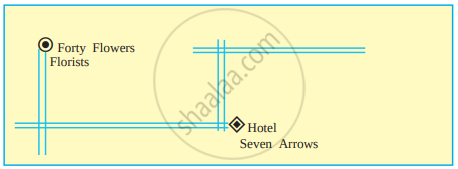
- Try to draw a map incorporating your phrases in a meaningful way. (Two examples are given below.) Write a key/index for your map.
What makes you happy?
Write a composition (in approximately 400-450 words) on the following subject:
Music
Write a composition (in approximately 400 – 450 words) on the following subject.
Parents should not influence their children when choosing the subjects they wish to study. Argue either FOR or AGAINST the given statement.
