Advertisements
Advertisements
प्रश्न
Reading a map
Nowadays though locations are traced easily using GPS, (Global Positioning System) one should know what to look for in the map to reach the destination. Here are a few general instructions to be followed while reading a map.
- Identify and understand the elements of the map correctly.
- Look out for the title to know what the map shows.
- Study the symbols/colors that are used on the map and find what they stand for.
- Look at the scale of the map. (whether to be scaled or not to be scaled)
- Look for the pointer to know the direction.
Let us together scale the summit. Here is a drawing of the Everest showing the way to the summit, and the position of the camps with their heights. Trace the trekking trail to reach the summit with the given details and write an interesting paragraph in about 100 words.
The Summit of Mount Everest

Advertisements
उत्तर
Tips on Elements of the Map:
- Map Title: The title is a center, a short summary of a map. It should determine the area covered and provide some communication of the map content, as “The Summit of Mount Everest”.
- Map Scale: A scale is the prime essential of a map. Map scale can be defined as part of a map that compares distance on a map to distance in the real world.
- Direction: The direction is normally shown on a map by means of the geographical grid, Meridians (of longitudes) are supposed to extend north-south, and parallel (of longitudes) are east-west lines. A straight arrow pointing northward also marked that is called “north arrow”. The Map show’s the route marked in red dotted lines having 9 camps at different levels (height).
The trek starts from the base camp which is located on Khumbu Glacier and ends at the south summit.
- Phases of climbing Mount Everest:
Everest is our tallest mountain. Its altitude and the technicalities of the climb are not to be underestimated. Climbing Everest requires intensive training. You might be lucky, and the climb might go well even if you didn’t do your homework. But you will undoubtedly notice that Everest lives up to its fearful reputation should the conditions turn against you. By then though, it might simply be too late if not well prepared. Everest is also a gorgeous mountain. And just as we continue to
launch ourselves into space even though missions sometimes turn into tragedy, mountaineers will always try to climb Everest to experience the majesty, beauty, and adventure of our closest frontier to the Universe.
Let’s start the trek at the Base camp Route no. 1 which is situated on the Khumbu Glacier at 17,900 feet. Distance from Route No. 1 & Route No. 2 is 1500 feet reaching route no.2 at 19400 feet- Icefall. This place is similar to a massive horror chamber at an amusement park. There are countless scary things that can happen here. An avalanche can bury the climbers alive. After climbing further 800 feet, it reaches Route No.3 20,200 feet – Camp-1, Valley of silence. This is a vast, flat area of endless snow, deep crevasses, and mountain walls frequently washed by avalanches. Here climbers set up camp 1. At night one listens to the deep, murmuring cracking sounds under the tents. It is the crevasses opening and closing deep down in the glacier beneath. It is here that for the first time, just a few steps around a comer, we gain first close sight of Everest.
After 1000 feet of an endless, slow march through the silent valley, the climbers reach at last a rocky patch, at the foot of the icy Lhotse wall. This marks route no.4 Camp-2 at 21,200 feet. This place is absolutely stunning. Clouds roll in from the lower ranges of the Himalayas, up the valley, and into the camp. Further climbing 800 feet it takes us to Route No.5 which is at 22,000 feet, next comes Route No. 6 at 23,000 feet Camp-3, Lhotse Face/Wall.
Imagine sliding a fun, icy slope on a sunny winter’s day. Only this one is 1200 meters (4000 ft) high. The dangerous part is to hang on to the rope of dubious strength and to change carabiners between the ropes. Further, 1000 feet upwards the climbers can reach Route No.7 at 24,000 feet they are now almost beside South Col Lhotse.
From Route No.7 to Route No.8 the distance is around 2000 feet. The climbers are now, at Geneva Spur which is 26,000 feet above sea level. It is camp-4, The Death Zone: Camp 4 sits on a plateau resembling a moonscape. The climbers are at the edge of the atmosphere, and the sky owns a strange, dark blue color. It is surely the closest one can get to space on earth. Only a small climb above camp, you look down the Tibetan plateau with its vast brown plains, white glaciers, and the other alpine giants – Kanchenjunga, Lhotse, Makalu -in the distance. It’s all magic and unreal.
The final destination is quite far from here. Further climbing 1700 feet climbers reach Route No.9 which is at the height of 27,900 feet.
South Summit at 28,700 feet.
There, in the distance, the climbers can see a worm of light slowly moving up a dark wall. Its climber's head torches flickering in the dark. It’s completely silent. Nobody talks. If you do, you whisper. It is terrifying, and you climb and climb, awaiting the first ray of dawn. It’s desperately cold. It’s steep and at parts very icy. The ice ax and the crampons barely cut into the ice. The mountain projects itself onto the morning fog. The shadow towers in front of the climbers like a giant mirage. Beneath lies, the world in all its glory, Everest glowing in the rising sun.
APPEARS IN
संबंधित प्रश्न
Why is the word ‘ cried’ used by the poet in the line, ‘It was the English, Kaspar cried’?
How was the country affected by the war?
The Principal said, “All the prizes will be distributed tomorrow.”
(Begin : The Principal said that ……………. )
What do you notice about the beginning and the ending of the poem?
Give reasons for the following.
Srinath’s disappointment with Satyajit.
We add ‘un-’ to make opposites. For example, true — untrue. Add ‘un’– to the word below to make its opposite. Then look up the meaning of the word you have formed in the dictionary.
attended: ____________
Notice the use of ‘there’ in the following sentences.
-
There was a big crowd at the fair.
-
There were many things I’d have liked to buy.
Now rewrite the following sentences using ‘there’ in the beginning. Look at the following examples.
-
I can do nothing to help you.
-
There is nothing I can do to help you.
-
A man at the door is asking to see you.
-
There is a man at the door asking to see you.
1. This park has beautiful roses.
2. Your story has no fun in it.
3. We have no secrets between us.
4. My village has two primary schools.
5. This problem can be solved in two ways.
Write down the significance of the following in the context of 'On to the Summit':
husiar.
Pick out the examples of alliteration from the poem and write them down.
You have just returned after your first experience of the kite - festival in Gujarat / Ahmedabad. You were thrilled with the festivities.
You have a friend who lives abroad. Write a letter to your friend describing how you enjoyed the kite-festival.
Write a summary of the poem.
- Title
- Introductory paragraph (about the poem/ type/nature/tone)
- Main body (central idea/gist of the poem)
- Conclusion/ opinions/views/appeal.
Write what you think about the following thoughts and actions of Mathilde :
Mathilde worked very very hard to pay the debt.
Prepare a formal invitation card for the Art Festival.
Do you have pet animals? Write an interesting story about your own or your friends' pet.
Discuss the following elements of a detective or mystery story.
- a mystery
- strange happenings
- a smart detective who investigates the happenings
- a crime/possibility of a crime
- preventing the crime and catching the criminal.
- characteristics of the victim
- characteristics of the criminal
- characteristics of the detective
Use the elements to prepare outlines of detective stories using your imagination. Write a story using any one of the outlines.
On seeing these pictures, you would have gone down your memory lane. Write a paragraph in about 50 words describing your favourite sport when you were young.

Create a poster for the following.
Say ‘No to Drugs’ – Design a poster for it is not more than 50 words. You may use slogans/ phrases.
Let's write a poem.
I have a kite but need a friend to fly it with,
I know a song but need someone to hear it,
I have a ball but need someone to catch it,
I ______
I ______
I ______
I ______
Do you know a fish breathes from its gills? Write two sentences about other animals which can breathe under water.
In the sentence below the capital letter, comma, full stop and question mark are missing. Put these in the correct place.
laxmi why are you crying
Choose a story that you like.
In groups of four, write down dialogues for the story and make it into a short play. You may then present it in the class.
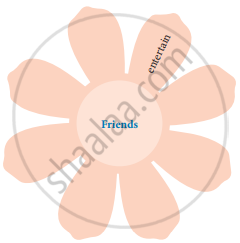
What do you expect your close friends to do for you? Beautify the petals with your thoughts.
Why was Mary Kom named the ‘Queen of Boxing’ and ‘Magnificent Mary'?
How did Woman 5 move ahead in the waiting list of patients?
Observe the following picture and write a paragraph in about 150 word about each one of them.

Imagine someone has invited your family to a programme and you were the only person at home when the invitation was given orally.
Write a note (4-5 lines) to pass on the message to the other people in your family. Or, Write an imaginary conversation in which you pass on the message to your parents.
What makes you sad?
Imagine someone has invited your family to a programme and you were the only person at home when the invitation was given orally.
Write a note (4-5 lines) to pass on the message to the other people in your family. Or, Write an imaginary conversation in which you pass on the message to your parents.
Imagine someone has invited your family to a programme and you were the only person at home when the invitation was given orally.
Write a note (4-5 lines) to pass on the message to the other people in your family. Or, Write an imaginary conversation in which you pass on the message to your parents.
Write a composition (in approximately 400 – 450 words) on the following subject.
During the lunch break, a surprising sight unfolded as a monkey entered your school campus. Narrate your experience as you took charge and guided junior students to their classrooms ensuring their safety.
