Advertisements
Advertisements
प्रश्न
What does the poet mean when he says ‘good bye’?
Advertisements
उत्तर
When the poet says ‘good bye’ he really means “good riddance”.
APPEARS IN
संबंधित प्रश्न
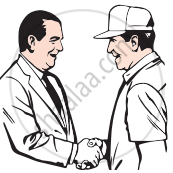
Guess what friendly words these two gentlemen exchange when shaking hands.
What do you associate with the title of the poem?
What is the relationship between the narrator and the listener?
What does he desire to unlearn and relearn?
Interpret each of the following expression used in the poem, in one or two line.
shake hands without hearts
Explain the following lines with reference to the context.
Once upon a time, son They used to laugh with their eyes:
Read the poem again and complete the summary using the words given in the box.
In the poem ‘Confessions of a Born Spectator,’ Ogden Nash talks about how people choose different sports in their lives or decide to become athletes. While admiring the talents of athletes and sportsmen, the poet (i)______he is glad that he is neither a sportsman nor an athlete. Children have different (ii)______and wish to play various games. Each child has in mind something in particular, but the narrator is (iii)______he is not one of the players. Though the narrator (iv) ______the talents of all athletes, he derives satisfaction from watching them, but does not wish to (v) ______places with them. He also sometimes regrets that (vi)______athletes play rough games without caring for the feelings of their sporting rivals. He feels that good sense and caution win over ego. The narrator wholeheartedly offers (vii) ______the modest (viii) ______of athletes. Ultimately the narrator is (ix)______that he himself is not an athlete.
|
thanksgiving exchange glad confesses physiques zealous satisfied aims admires |
Do you go for leisurely walks? If you are a city-dweller, what or who would you expect to see on your way?
If you go to a village, what scenes would you observe?
Complete the summary of the poem by filling in the blanks with the words given below.
The poet, in a relaxed state of mind, is sitting in a (1) ______. He reflects on how his mood brings (2) ______thoughts, which are inevitably followed by (3)______ones. He feels connected to all of nature, and senses an inherent joy in all (4)______. He has faith in the fact that all the primroses and periwinkles around him (5)______ the air they breathe. He feels that every bird in the grove moves with (6)______. As the twigs catch the breezy air, they do so with the same pleasure (7)______ all life on earth. This joy of nature seems to be heaven-sent. Nature’s holy plan is to offer joy and peace to all forms of life on earth. The poet’s pleasant train of thought slowly leads to the sad reflection of how mankind alone has wrought sorrow and (8)______ upon itself. He firmly believes that man is meant to spend his days blissfully taking part in the vitality and joy surrounding him in (9)______. He therefore concludes rhetorically, emphasizing that he has good reason to (10)______ the distress, man unnecessarily brings upon himself.
| creations | abundance | savour |
| pleasant | suffering | grove |
| lament | pervading | sorrowful |
| ecstasy |
Read the lines given below and answer the question that follow.
And I must think, do all I can,
That there was pleasure there…
- What did the poet notice about the twigs?
- What was the poet’s thought about then?
Read the following line and identify the figure of speech used in each extract.
And ‘tis my faith that every flower
Enjoys the air it breathes.
Read the following line and identify the figure of speech used in each extract.
What Man has made of Man?
How does the poet feel while enjoying the beauty of Nature?
Does Nature affect a person’s thoughts and feelings? Explain.
How do people bring grief and sorrow to one another?
The poet finds joy in various objects of Nature. Explain.
Answer in a paragraph of about 100−150 words.
Do you think the poet wants to say that man is unhappy because he has lost his link with nature and forgotten how to enjoy nature, or because man is cruel to other men?
Write a letter to the Councillor of your Ward, explaining why a park is necessary in your locality.
What is Macavity’s nickname?
Where can you encounter Macavity?
Who does the Secret Service suspect when a loss is reported?
Mention any two qualities of Macavity.
Describe the appearance and qualities of Macavity.
Identify the literary devices used in the following lines:
- He sways his head from side to side, with movements like a snake.
- They say he cheats at cards.
Which path should we follow in life?
What does ‘Everest’ in the title stand for?
Who is Bolingbroke? Is he a friend or foe?
Explain the following line with reference to the context in about 5 to 8 line:
“Our lands, our lives, and all are Bolingbroke’s,
And nothing can we call our own but death;”
