Advertisements
Advertisements
प्रश्न
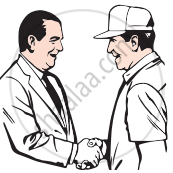
Guess what friendly words these two gentlemen exchange when shaking hands.
Advertisements
उत्तर
| James | Hi, John, great to see you. How are you? |
| John | Hi, James, I’m fine. It is nice to see you. |
APPEARS IN
संबंधित प्रश्न
What is the relationship between the narrator and the listener?
What happens to the poet when he visits someone for the third time?
What does the poet mean when he says ‘good bye’?
What pleasantries does the poet use to fake cordiality?
What does he desire to unlearn and relearn?
Interpret each of the following expression used in the poem, in one or two line.
to unlearn all these muting things
Read the line given below and answer the question that follow.
‘Most of all, I want to relearn How to laugh, for my laugh in the mirror Shows only my teeth like a snake’s bare fangs!’
- Why does the poet want to relearn how to laugh?
- Whom does the poet want to relearn from?
- Mention the figure of speech used here.
Why would the referee ask whether there was a doctor in the stands? What stands is he referring to?
Why does the poet prefer to buy tickets worth their weight in radium? Bring out the significance of the metal referred to here.
According to the poet, what contributes most to the injuries sustained by the athletes?
Read the following line and identify the figure of speech used in each extract.
To her fair works did Nature link
The human soul that through me ran.
Work in groups of 4−6. Discuss how you would preserve the environment and protect Nature. One or two representatives may share their ideas with the class.
People admire some of these animal qualities. What are they? Have you noticed some of them in yourself or in others? Share your views with the class.
Why does the poet say Macavity is ‘outwardly’ respectable?
Who does the Secret Service suspect when a loss is reported?
Explain the following line with reference to the context.
And when you think he’s half asleep, he’s always wide awake
Which line is repeated in the poem? What is the effect created by this repetition?
Which path should we follow in life?
What does ‘hillock’ refer to in the line ‘Every hillock has a summit to boast!’?
Read the given line and answer the question that follow.
We are proud of the position we hold; humble as we are
- What is the speaker proud of?
- How is the speaker both humble and proud?
- Pick out the alliteration in these lines.
Creative Activity
- Write eight words you associate with success.
- Use the words to write eight lines that mean success to you or how success makes you feel.
- Arrange your lines into a poem.
- Share your poem with the class and post a copy on the notice board.
Discuss the following topics in groups of five and choose a representative to sum up the views and share them with the class.
To succeed in life, one must have a single-minded devotion to duty.
The historical background:
The poem is an extract from William Shakespeare’s play King Richard the Second. The play is based on true events that occurred towards the end of the 14th century.
Richard II was crowned the King of England in the year 1367. He continued to be the British Monarch until 1399, when he was deposed by his cousin, Henry of Bolingbroke, who crowned himself King Henry the Fourth in the same year. Shakespeare’s play is a dramatic rendition of the last two years of King Richard II’s life. In this brief span of time, he was ousted from his royal position and sent to prison, where he died in captivity.
The following extract is set in the Coast of Wales. King Richard and some of his followers awaited the arrival of the Welsh army [after facing defeat at the hands of his cousin, Bolingbroke], of about 10000 warriors. But to their shock and surprise, they received the message that the army was not coming to their rescue. His followers tried to boost their King’s courage against the news, only in vain. When Richard came face to face with the reality of his terrible fate, he spoke the following verse, famously known as the “Hollow Crown” speech in theatrical circles. In it, King Richard is reminded of the power of Death that overshadows everything else, including the power of rulers, and renders them as powerless as any commoner at a moment’s notice.
Fill in the blank with appropriate word from the box and complete the statement suitably:
Alexander the Great, wished to conquer many lands and ______the entire world.
What does ‘flesh’ mean here?
What are the various functions and objects given up by a defeated king?
How does the king establish that he and his subjects are equal in the end?
