Advertisements
Advertisements
प्रश्न
What are the various functions and objects given up by a defeated king?
Advertisements
उत्तर
A defeated king abdicates his crown. He parts with his scepter too. He hands over his right to rule the kingdom to the victorious king. He gives up the right to levy taxes on subjects. Fie also gives up his right and listens to the woes of ordinary subjects and solves them.
APPEARS IN
संबंधित प्रश्न
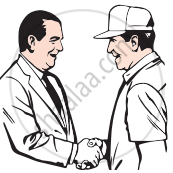
Guess what friendly words these two gentlemen exchange when shaking hands.
What does he desire to unlearn and relearn?
Explain the following lines with reference to the context.
Once upon a time, son They used to laugh with their eyes:
Explain the following line with reference to the context.
There will be no thrice.
‘Face is the index of the mind.’ Does this adage concur with the views of the poet?
How does the poet establish the victory of common sense over ego?
According to the poet, what contributes most to the injuries sustained by the athletes?
Read the given line and answer the question that follow in a sentence or two
When snaps the knee and cracks the wrist….
Identify and explain the use of the literary device in this line.
Everybody is special and everybody is a hero. Each one has a story to tell. In the light of this observation, present your views.
If you go to a village, what scenes would you observe?
Read the following line and identify the figure of speech used in each extract.
To her fair works did Nature link
The human soul that through me ran.
The poet finds joy in various objects of Nature. Explain.
The poet experiences sadness because ______.
The poem speaks of ______.
Answer in a paragraph of about 100−150 words.
Do you think the poet wants to say that man is unhappy because he has lost his link with nature and forgotten how to enjoy nature, or because man is cruel to other men?
What scene in nature gives you pleasure? Talk for a minute describing a natural scene that gave you a lot of joy. What did you see, hear, smell or feel, that gave you joy?
‘Nature can nurture’. Describe how this process happens.
What is Macavity’s nickname?
Why does the poet say Macavity is ‘outwardly’ respectable?
Read the given lines and answer the question that follow.
He’s the bafflement of Scotland
Yard, the Flying Squad’s despair:
For when they reach the scene of crime
— Macavity’s not there!..
- What is ‘Scotland Yard’?
- Why does the flying squad feel disappointed?
Give four instances where the poet has used alliteration in the poem.
Who are the ‘deserving ones’?
Which path should we follow in life?
What does ‘hillock’ refer to in the line ‘Every hillock has a summit to boast!’?
Read the given line and answer the question that follow.
He, who does not stoop, is a king we adore. We bow before competence and merit;
- Who is adored as a king?
- What is the figure of speech used in the first line?
Complete the passage given below, with suitable words from the box:
Lima, a (a)______and (b)______woman, kept (c)______at her colleagues and went on taxing them with hard labour. Though they were (d) ______to her, she being their head, they were offended and filled with (e)______. It so happened, that Lima was (f)______from her high position due to a serious blunder she had committed. Lima, having lost all her (g)______and glory, realized how arrogant she had been. She gave up her pride and with (h)______sought an apology from everyone. She thus turned over a new leaf and bid (i)______to them.
| farewell | ceremonious | deposed |
| reverence | vain | pomp |
| conceited | sorrow | scoffing |
What hides within the crown and laughs at the king’s grandeur?
Explain the following line with reference to the context in about 5 to 8 line:
“Comes at the last, and with a little pin
Bores through his castle wall, and farewell king!”
Read the poem once again carefully and identify the figure of speech that has been used in each of the following line from the poem:
“Let’s talk of graves, of worms, and epitaphs;
Make dust our paper, and with rainy eyes Write sorrow on the bosom of the earth’’.
Based on your reading of King Richard’s speech, answer the following questions in about 100 - 150 words each. You may add your own ideas if required to present and justify your point of view.
Who does the future generations remember easily - the victor or the vanquished? Give reasons. Also, cite relevant references from King Richard’s speech.
