Advertisements
Advertisements
प्रश्न
Where can you encounter Macavity?
Advertisements
उत्तर
One may meet Macavity in a street or in the square. But he vanishes when a crime is committed.
APPEARS IN
संबंधित प्रश्न
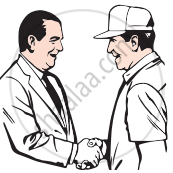
Guess what friendly words these two gentlemen exchange when shaking hands.
Interpret each of the following expression used in the poem, in one or two line.
laugh with their eyes
Explain the following line with reference to the context.
There will be no thrice.
The poet is satisfied just watching the heroic deeds of others. What could be the reason?
Are the athletes conscious of the feelings of others? Why do you say so?
Why does the poet prefer to buy tickets worth their weight in radium? Bring out the significance of the metal referred to here.
Explain the following with reference to the context in about 50–60 word each.
I am just glad as glad can be That I am not them, that they are not me…
Why do accidents usually happen in the playground? Give your own examples and explain
What sort of encouragement should an athlete in India be given? Give a few suggestions.
If you go to a village, what scenes would you observe?
Explain the following line with reference to the context in about four to five sentence each.
The birds around me hopp’d and play’d,
Their thoughts I cannot measure.
Read the following line and identify the figure of speech used in each extract.
What Man has made of Man?
People admire some of these animal qualities. What are they? Have you noticed some of them in yourself or in others? Share your views with the class.
Describe Macavity’s appearance.
Why does the poet say Macavity is ‘outwardly’ respectable?
Read the given lines and answer the question that follow.
He sways his head from side to
side, with movements like a snake;
And when you think he’s half asleep,
he’s always wide awake…
- Explain the comparison made here.
- What does he pretend to do?
Read the given lines and answer the question that follow.
For he’s a fiend in feline shape, a monster of depravity
- How is the cat described in this line?
- Explain the phrase ‘monster of depravity’.
Who are the ‘deserving ones’?
What does ‘hillock’ refer to in the line ‘Every hillock has a summit to boast!’?
Read the given line and answer the question that follow.
He, who does not stoop, is a king we adore. We bow before competence and merit;
- Who is adored as a king?
- What is the figure of speech used in the first line?
Read the given line and answer the question that follow.
Honour is a property, common to all: In dignity and pride no one need to be poor.
- Who are considered rich?
- What is their asset?
Creative Activity
- Write eight words you associate with success.
- Use the words to write eight lines that mean success to you or how success makes you feel.
- Arrange your lines into a poem.
- Share your poem with the class and post a copy on the notice board.
How does the king establish that he and his subjects are equal in the end?
Bring out King Richard’s feelings when he was defeated.
Explain the following line with reference to the context in about 5 to 8 line:
“Comes at the last, and with a little pin
Bores through his castle wall, and farewell king!”
Read the poem once again carefully and identify the figure of speech that has been used in each of the following line from the poem:
“Scoffing his state and grinning at his pomp,…”
Read the poem once again carefully and identify the figure of speech that has been used in each of the following line from the poem:
“Bores through his castle wall, and farewell king!”
