Advertisements
Advertisements
प्रश्न
Why does the poet prefer to buy tickets worth their weight in radium? Bring out the significance of the metal referred to here.
Advertisements
उत्तर
Radium is more expensive than diamonds. It is a rare metal discovered by Madam Curie. The poet was ready to buy tickets as expensive as radium just to stay as a spectator.
APPEARS IN
संबंधित प्रश्न
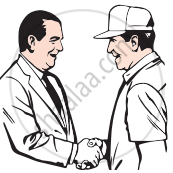
Guess what friendly words these two gentlemen exchange when shaking hands.
What does the poet mean when he says ‘good bye’?
Interpret each of the following expression used in the poem, in one or two line.
like a fixed portrait smile
Interpret each of the following expression used in the poem, in one or two line.
hands search my empty pockets
Why does the poet feel glad that he does not play any game?
Do you think the narrator is heroic? Why?
Why would the referee ask whether there was a doctor in the stands? What stands is he referring to?
The poet does not wish to exchange places with the athletes. How does he justify his view?
Read the given lines and answer the questions that follow in a sentence or two.
Well, ego it might be pleased enough But zealous athletes play so rough…
- What pleases the ego?
- Why are athletes often rough during play?
Underline the alliterated word in the following line.
They do not ever in their dealings…
Read the lines given below and answer the question that follow.
And I must think, do all I can,
That there was pleasure there…
- What did the poet notice about the twigs?
- What was the poet’s thought about then?
Does Nature affect a person’s thoughts and feelings? Explain.
The poet experiences sadness because ______.
Answer in a paragraph of about 100−150 words.
Do you think the poet wants to say that man is unhappy because he has lost his link with nature and forgotten how to enjoy nature, or because man is cruel to other men?
Work in groups of 4−6. Discuss how you would preserve the environment and protect Nature. One or two representatives may share their ideas with the class.
Write a letter to the Councillor of your Ward, explaining why a park is necessary in your locality.
Which law does Macavity break?
Where can you encounter Macavity?
Give an account of Macavity’s destructive mischief.
Explain the following line with reference to the context.
He always has an alibi, and one or two to spare
Which line is repeated in the poem? What is the effect created by this repetition?
What does ‘Everest’ in the title stand for?
In what way is every hillock similar to Everest?
Fill in the blank with appropriate word from the box and complete the statement suitably:
The business woman wished to ______all her riches to an orphanage, after her death.
What do the three words, ‘graves, worms and epitaphs’, refer to?
Are all deposed kings slain by the deposer?
Working with your partner, discuss the following adages and share your views with the class. You may need to give your ideas and justify your point of view. Remember to take turns while making your presentation/short speech.
War begets war
Working with your partner, discuss the following adages and share your views with the class. You may need to give your ideas and justify your point of view. Remember to take turns while making your presentation/short speech.
Uneasy lies the head that wears a crown
Read the poem once again carefully and identify the figure of speech that has been used in each of the following line from the poem:
“How can you say to me, I am a king?”
