Advertisements
Advertisements
प्रश्न
Underline the alliterated word in the following line.
They do not ever in their dealings…
Advertisements
उत्तर
They do not ever in their dealings…
APPEARS IN
संबंधित प्रश्न
Guess what friendly words these two gentlemen exchange when shaking hands.
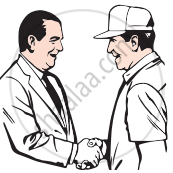
Pick out the expressions that indicate conflicting ideas.
Mention the qualities the child in the poem symbolises.
Interpret each of the following expression used in the poem, in one or two line.
like a fixed portrait smile
Interpret each of the following expression used in the poem, in one or two line.
hands search my empty pockets
Explain the things the poet has learnt when he grew into an adult.
Underline the alliterated word in the following line.
For this most modest physiques…
Why do accidents usually happen in the playground? Give your own examples and explain
Do you go for leisurely walks? If you are a city-dweller, what or who would you expect to see on your way?
Find words from the poem that convey the following ideas:
- connected together
- spread over the surface of the ground in a straggling manner
- make out or understand
- slender woody shoots growing from branches or stems of trees
Write a letter to the Councillor of your Ward, explaining why a park is necessary in your locality.
Why is the Flying Squad frustrated?
Which law does Macavity break?
What is Macavity expected to be doing after committing a crime?
Read the given lines and answer the question that follow.
Macavity’s a Mystery Cat: he’s called the Hidden Paw…
- Does the poet talk about a real cat?
- Why is he called the Hidden Paw?
Read the given lines and answer the question that follow.
And his footprints are not found in any file of Scotland Yard’s.
- What seems to be a challenge for the Scotland Yard?
- Why do they need his footprints?
Explain the following line with reference to the context.
There may be a scrap of paper in the hall or on the stair
But it’s useless to investigate…
Identify the literary devices used in the following lines:
- He sways his head from side to side, with movements like a snake.
- They say he cheats at cards.
What is the rhyme scheme used in the poem?
What does ‘Everest’ in the title stand for?
What does the ladder symbolize?
What does the executor mentioned in the poem do?
What does ‘flesh’ mean here?
Explain the following line with reference to the context in about 5 to 8 line:
“How can you say to me, I am a king?”
Read the poem once again carefully and identify the figure of speech that has been used in each of the following line from the poem:
“Scoffing his state and grinning at his pomp,…”
Pick out the alliteration from the following lines:
“And tell sad stories of the death of kings:”
Based on your reading of King Richard’s speech, answer the following questions in about 100 - 150 words each. You may add your own ideas if required to present and justify your point of view.
What are the causes for King Richard’s grief?
Based on your reading of King Richard’s speech, answer the following questions in about 100 - 150 words each. You may add your own ideas if required to present and justify your point of view.
Death has been cited in many ways in this monologue. Identify the poetic devices used in those references.
Based on your reading of King Richard’s speech, answer the following questions in about 100 - 150 words each. You may add your own ideas if required to present and justify your point of view.
Who does the future generations remember easily - the victor or the vanquished? Give reasons. Also, cite relevant references from King Richard’s speech.
