Advertisements
Advertisements
प्रश्न
Does Nature affect a person’s thoughts and feelings? Explain.
Advertisements
उत्तर
Yes, the beauty, harmony, peace, and nature’s pure joy enlivened the poet’s spirits. He couldn’t help comparing the happiness of nature with the self-destructive wars of human beings. He was sad remembering humans.
APPEARS IN
संबंधित प्रश्न
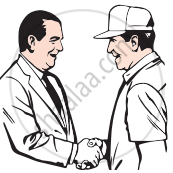
Guess what friendly words these two gentlemen exchange when shaking hands.
What do you associate with the title of the poem?
What happens to the poet when he visits someone for the third time?
Pick out the expressions that indicate conflicting ideas.
Explain the following lines with reference to the context.
Once upon a time, son They used to laugh with their eyes:
Explain the following lines with reference to the context.
I want to be what I used to be.
The poet does not wish to exchange position with the runners. Why?
Read the given line and answer the question that follow in a sentence or two
When snaps the knee and cracks the wrist….
Identify and explain the use of the literary device in this line.
Explain the following with reference to the context in about 50–60 word each.
I am just glad as glad can be That I am not them, that they are not me…
Would you like to exchange your place with someone else? Why/why not?
Read the following line and identify the figure of speech used in each extract.
To her fair works did Nature link
The human soul that through me ran.
Why does the poet think that the birds were happy?
The poet finds joy in various objects of Nature. Explain.
The poet experiences sadness because ______.
Listening Activity
Some phrases have been left out in the poem below. First, read the poem. Then, fill in the missing words on listening to the reading or the recording of it in full. You may listen again, if required
To Autumn
O Autumn, laden with fruit, and stained
With the blood of the grape, pass not, but sit
Beneath my ______, there thou may’st rest,
And tune thy jolly voice to my ______;
And all the daughters of the year shall dance!
Sing now the ______of fruits and flowers.
“The ______opens her beauties to
The sun, and love runs in her ______;
Blossoms hang round the brows of morning and
Flourish down the ______of modest eve,
Till clust’ring Summer breaks forth into singing,
And ______strew flowers round her head.
The spirits of the air live on the smells
Of fruit; and joy, with ______, roves round
The gardens, or sits singing in the trees.”
Thus sang the ______as he sat,
Then rose, girded himself, and o’er the bleak
Hills fled from our sight; but left his ______.
William Blake
What makes the fakir stare in wonder?
Mention any two qualities of Macavity.
Read the given lines and answer the question that follow.
For he’s a fiend in feline shape, a monster of depravity
- How is the cat described in this line?
- Explain the phrase ‘monster of depravity’.
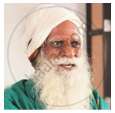
Identify the following personalities and their fields of achievement.
| Name | Field | |
 |
||
 |
||
 |
||
 |
||
 |
||
 |
||
 |
||
 |
- Mention a remarkable achievement of any of these personalities.
- What quality do you admire the most in each of these achievers?
- What are the qualities that you may share with them?
- Name a few more popular personalities who have made our nation proud.
- ______.
- ______.
- ______.
- ______.
Who are the ‘deserving ones’?
Read the given line and answer the question that follow.
We are proud of the position we hold; humble as we are
- What is the speaker proud of?
- How is the speaker both humble and proud?
- Pick out the alliteration in these lines.
Work with a partner and take this short quiz to find out how well-informed you are about history.
- Name a few wars and battles you have read about.
- What is the difference between a war and a battle?
- Why do rulers wage wars and battles?
- Is the outcome of a war always fair?
- Do you think rulers understand the true meaning of life – in defeat or in victory?
- Can you name a few kings and leaders who have fallen from glory to disgrace?
Fill in the blank with appropriate word from the box and complete the statement suitably:
The business woman wished to ______all her riches to an orphanage, after her death.
Who is Bolingbroke? Is he a friend or foe?
What are the various functions and objects given up by a defeated king?
Working with your partner, discuss the following adages and share your views with the class. You may need to give your ideas and justify your point of view. Remember to take turns while making your presentation/short speech.
War begets war
Based on your reading of King Richard’s speech, answer the following questions in about 100 - 150 words each. You may add your own ideas if required to present and justify your point of view.
What are the causes for King Richard’s grief?
