Advertisements
Advertisements
प्रश्न
Read the following line and identify the figure of speech used in each extract.
What Man has made of Man?
Advertisements
उत्तर
What Man has made of Man- Alliteration man, made, man
APPEARS IN
संबंधित प्रश्न
Guess what friendly words these two gentlemen exchange when shaking hands.
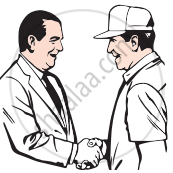
What is the relationship between the narrator and the listener?
Interpret each of the following expression used in the poem, in one or two line.
like a fixed portrait smile
Interpret each of the following expression used in the poem, in one or two line.
to unlearn all these muting things
The poet does not wish to exchange position with the runners. Why?
How does the poet establish the victory of common sense over ego?
The poet does not wish to exchange places with the athletes. How does he justify his view?
Read the given lines and answer the questions that follow in a sentence or two.
With all my heart I do admire
Athletes who sweat for fun or hire
- Whom does the poet admire?
- For what reasons do the athletes sweat?
Read the given line and answer the question that follow in a sentence or two
When snaps the knee and cracks the wrist….
Identify and explain the use of the literary device in this line.
Read the lines given below and answer the question that follow.
And ‘tis my faith that every flower
Enjoys the air it breathes…
- What is the poet’s faith?
- What trait of Nature do we see here?
Read the following line and identify the figure of speech used in each extract.
To her fair works did Nature link
The human soul that through me ran.
The poet finds joy in various objects of Nature. Explain.
The poem is set in a ______.
When humanity fails to live in harmony with Nature, its effects are felt around the world. Why and how?
People admire some of these animal qualities. What are they? Have you noticed some of them in yourself or in others? Share your views with the class.
Describe the appearance and qualities of Macavity.
Explain the following line with reference to the context.
He always has an alibi, and one or two to spare
What does ‘Everest’ in the title stand for?
What does ‘hillock’ refer to in the line ‘Every hillock has a summit to boast!’?
Discuss the following topic in groups of five and choose a representative to sum up the view and share them with the class.
‘Success is not final, failure is not fatal.’ It is the courage and perseverance that counts.
Fill in the blank with appropriate word from the box and complete the statement suitably:
Alexander the Great, wished to conquer many lands and ______the entire world.
How does the king establish that he and his subjects are equal in the end?
Explain the following line with reference to the context in about 5 to 8 line:
“Our lands, our lives, and all are Bolingbroke’s,
And nothing can we call our own but death;”
Read the poem once again carefully and identify the figure of speech that has been used in each of the following line from the poem:
“How can you say to me, I am a king?”
Read the poem once again carefully and identify the figure of speech that has been used in each of the following line from the poem:
“Scoffing his state and grinning at his pomp,…”
Pick out the alliteration from the following lines:
“Our lands, our lives, and all, are Bolingbroke’s,…”
Pick out the alliteration from the following lines:
“And tell sad stories of the death of kings:”
Based on your reading of King Richard’s speech, answer the following questions in about 100 - 150 words each. You may add your own ideas if required to present and justify your point of view.
How are eternal truths and wisdom brought to the reader here?
