Advertisements
Advertisements
प्रश्न
Mention the qualities the child in the poem symbolises.
Advertisements
उत्तर
A child is guileless. He /she is innocent. He multiplies his joy and halves his sorrow by sharing them with friends. A child does not have lasting anger and is quick to forgive and forget wrongs done to him. His friendship is genuine and laughter natural and spontaneous.
APPEARS IN
संबंधित प्रश्न
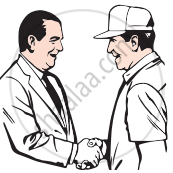
Guess what friendly words these two gentlemen exchange when shaking hands.
What is the relationship between the narrator and the listener?
What pleasantries does the poet use to fake cordiality?
Interpret each of the following expression used in the poem, in one or two line.
laugh with their eyes
Explain the following lines with reference to the context.
Once upon a time, son They used to laugh with their eyes:
Explain the following line with reference to the context.
I have learned to wear my faces Like dresses …
Why does the poet feel glad that he does not play any game?
Read the poem again and complete the summary using the words given in the box.
In the poem ‘Confessions of a Born Spectator,’ Ogden Nash talks about how people choose different sports in their lives or decide to become athletes. While admiring the talents of athletes and sportsmen, the poet (i)______he is glad that he is neither a sportsman nor an athlete. Children have different (ii)______and wish to play various games. Each child has in mind something in particular, but the narrator is (iii)______he is not one of the players. Though the narrator (iv) ______the talents of all athletes, he derives satisfaction from watching them, but does not wish to (v) ______places with them. He also sometimes regrets that (vi)______athletes play rough games without caring for the feelings of their sporting rivals. He feels that good sense and caution win over ego. The narrator wholeheartedly offers (vii) ______the modest (viii) ______of athletes. Ultimately the narrator is (ix)______that he himself is not an athlete.
|
thanksgiving exchange glad confesses physiques zealous satisfied aims admires |
The poet does not wish to exchange places with the athletes. How does he justify his view?
Everybody is special and everybody is a hero. Each one has a story to tell. In the light of this observation, present your views.
Read the lines given below and answer the question that follow.
And I must think, do all I can,
That there was pleasure there…
- What did the poet notice about the twigs?
- What was the poet’s thought about then?
Work in groups of 4−6. Discuss how you would preserve the environment and protect Nature. One or two representatives may share their ideas with the class.
Where can you encounter Macavity?
Read the given lines and answer the question that follow.
‘It must have been Macavity!’ but he’s a mile away.
- What is Macavity blamed for?
- Where is he?
Give four instances where the poet has used alliteration in the poem.
Pick out all the pairs of rhyming words used in the poem.
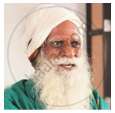
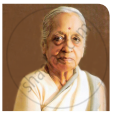
Identify the following personalities and their fields of achievement.
| Name | Field | |
 |
||
 |
||
 |
||
 |
||
 |
||
 |
||
 |
||
 |
- Mention a remarkable achievement of any of these personalities.
- What quality do you admire the most in each of these achievers?
- What are the qualities that you may share with them?
- Name a few more popular personalities who have made our nation proud.
- ______.
- ______.
- ______.
- ______.
Which line is repeated in the poem? What is the effect created by this repetition?
Which quality does the speaker wish to nourish? What is his mission?
What does ‘hillock’ refer to in the line ‘Every hillock has a summit to boast!’?
Why does the speaker say ‘Everest is not the only peak’?
Read the given line and answer the question that follow.
Honour is a property, common to all: In dignity and pride no one need to be poor.
- Who are considered rich?
- What is their asset?
Fill in the blank with appropriate word from the box and complete the statement suitably:
The spectators died laughing at the ______of the clown.
Fill in the blank with appropriate word from the box and complete the statement suitably:
The business woman wished to ______all her riches to an orphanage, after her death.
How does the king establish that he and his subjects are equal in the end?
Explain the following line with reference to the context in about 5 to 8 line:
“Our lands, our lives, and all are Bolingbroke’s,
And nothing can we call our own but death;”
Explain the following line with reference to the context in about 5 to 8 line:
“How can you say to me, I am a king?”
Working with your partner, discuss the following adages and share your views with the class. You may need to give your ideas and justify your point of view. Remember to take turns while making your presentation/short speech.
Uneasy lies the head that wears a crown
Read the poem once again carefully and identify the figure of speech that has been used in each of the following line from the poem:
“Bores through his castle wall, and farewell king!”
Based on your reading of King Richard’s speech, answer the following questions in about 100 - 150 words each. You may add your own ideas if required to present and justify your point of view.
Death has been cited in many ways in this monologue. Identify the poetic devices used in those references.
