Advertisements
Advertisements
प्रश्न
What does the poet long for?
Advertisements
उत्तर
The poet longs for the innocence of childhood days when he laughed with his heart.
APPEARS IN
संबंधित प्रश्न
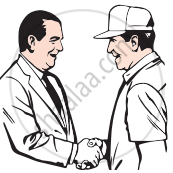
Guess what friendly words these two gentlemen exchange when shaking hands.
What happens to the poet when he visits someone for the third time?
Fill in the blanks choosing the words from the box given and complete the summary of the poem:
The poet Okara in this narrative monologue painfully condemns the (a)______ displayed by adults, both in their words and actions. Here, a father laments to his son about the negative changes that creep into the attitude and behaviour of humans, when they grow into (b)______. He says that people used to be (c)______ when they laugh and the honesty would be reflected in their eyes. But, people of modern times laugh (d)______. Their handshakes used to be warm and happy conveying a sense of togetherness, but nowadays the handshakes have become a mere (e)______. He warns his son that people are not trust-worthy and have become so selfish that they are concerned only about their own (f)______benefits. People utter words of welcome and exchange (g)______, but those words come only from the tip of their tongues and not from the depth of their hearts. Humans have learnt the art of changing their (h)______ expressions according to situations merely to ensure social acceptance. They wear(i)______ and exhibit multiple faces. The narrator admits that he has also changed into a hypocrite. However, he tells his son that though he (j)______ his expressions, he does all these against his will. He says he wants to become a (k)______ again and laugh genuinely. He wants to (l)______ the unreal things and (m)______how to laugh as he had done once upon a time. When he laughs before the (n)______, he sees no expression. His teeth are bare like that of the (o)______of a snake. So, he asks his son to show him how to laugh the way he used to laugh when he was a kid like him.
| relearn | adults | facial |
| personal | fangs | child |
| fakes | superficially | duplicity |
| genuine | unlearn | falsity |
| masks | mirror | pleasantries |
Interpret each of the following expression used in the poem, in one or two line.
hands search my empty pockets
Read the line given below and answer the question that follow.
‘But now they only laugh with their teeth, While their ice-block-cold eyes…’
- Who are ‘they’?
- Explain: ice-block-cold eyes
- Identify the figure of speech used here.
This poem is nothing but a criticism of modern life. Justify this statement.
Are the athletes conscious of the feelings of others? Why do you say so?
The poet does not wish to exchange places with the athletes. How does he justify his view?
Read the given lines and answer the questions that follow in a sentence or two.
With all my heart I do admire
Athletes who sweat for fun or hire
- Whom does the poet admire?
- For what reasons do the athletes sweat?
Read the poem and answer the following in a short paragraph of 8–10 sentences each.
When officialdom demands Is there a doctor in the stands?
- Why are doctors called from stands by the sponsors?
- Why does the poet make such an observation?
Read the given line and answer the question that follow in a sentence or two
When snaps the knee and cracks the wrist….
Identify and explain the use of the literary device in this line.
Would you like to exchange your place with someone else? Why/why not?
Explain the following line with reference to the context in about four to five sentence each.
The birds around me hopp’d and play’d,
Their thoughts I cannot measure.
Read the following line and identify the figure of speech used in each extract.
To her fair works did Nature link
The human soul that through me ran.
The poet experiences sadness because ______.
Answer in a paragraph of about 100−150 words.
Do you think the poet wants to say that man is unhappy because he has lost his link with nature and forgotten how to enjoy nature, or because man is cruel to other men?
What scene in nature gives you pleasure? Talk for a minute describing a natural scene that gave you a lot of joy. What did you see, hear, smell or feel, that gave you joy?
When humanity fails to live in harmony with Nature, its effects are felt around the world. Why and how?
Describe Macavity’s appearance.
What is Macavity expected to be doing after committing a crime?
Mention any two qualities of Macavity.
Explain the following line with reference to the context.
He always has an alibi, and one or two to spare
What does ‘Everest’ in the title stand for?
What does the ladder symbolize?
Discuss the following topics in groups of five and choose a representative to sum up the views and share them with the class.
To succeed in life, one must have a single-minded devotion to duty.
Work with a partner and take this short quiz to find out how well-informed you are about history.
- Name a few wars and battles you have read about.
- What is the difference between a war and a battle?
- Why do rulers wage wars and battles?
- Is the outcome of a war always fair?
- Do you think rulers understand the true meaning of life – in defeat or in victory?
- Can you name a few kings and leaders who have fallen from glory to disgrace?
Complete the passage given below, with suitable words from the box:
Lima, a (a)______and (b)______woman, kept (c)______at her colleagues and went on taxing them with hard labour. Though they were (d) ______to her, she being their head, they were offended and filled with (e)______. It so happened, that Lima was (f)______from her high position due to a serious blunder she had committed. Lima, having lost all her (g)______and glory, realized how arrogant she had been. She gave up her pride and with (h)______sought an apology from everyone. She thus turned over a new leaf and bid (i)______to them.
| farewell | ceremonious | deposed |
| reverence | vain | pomp |
| conceited | sorrow | scoffing |
Are all deposed kings slain by the deposer?
What are the various functions and objects given up by a defeated king?
Read the poem once again carefully and identify the figure of speech that has been used in each of the following line from the poem:
“Let’s talk of graves, of worms, and epitaphs;
Make dust our paper, and with rainy eyes Write sorrow on the bosom of the earth’’.
