हिंदी
तमिलनाडु बोर्ड ऑफ सेकेंडरी एज्युकेशनएचएससी विज्ञान कक्षा ११

Which path should we follow in life?

Advertisements
Advertisements

प्रश्न

Which path should we follow in life?

टिप्पणी लिखिए
Advertisements

उत्तर

We should follow the path of dignity and honor. We should never stoop before others for any ‘gains’.

shaalaa.com
Poem (Class 11th)
  क्या इस प्रश्न या उत्तर में कोई त्रुटि है?
अध्याय 5.2: Everest is not the Only Peak - Exercises [पृष्ठ १५८]

APPEARS IN

सामाचीर कलवी English Class 11 TN Board
अध्याय 5.2 Everest is not the Only Peak
Exercises | Q A. 4. | पृष्ठ १५८

संबंधित प्रश्न

Guess what friendly words these two gentlemen exchange when shaking hands.
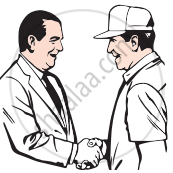

Explain the following lines with reference to the context.

Once upon a time, son They used to laugh with their eyes:


Explain the following line with reference to the context.

I have learned to wear my faces Like dresses …


‘Face is the index of the mind.’ Does this adage concur with the views of the poet?


The poet is satisfied just watching the heroic deeds of others. What could be the reason?


Why would the referee ask whether there was a doctor in the stands? What stands is he referring to?


Read the poem and complete the table with suitable rhyming words

e.g. enter center
  hockey
admire  
  romp
  deeds
score  
please  
  wrist
demands  
  stadium

You are the School Pupil Leader. Mention some qualities that can be drawn from the field of sports to improve your leadership skills.


If you go to a village, what scenes would you observe?


Explain the following line with reference to the context in about four to five sentence each.

The birds around me hopp’d and play’d,

Their thoughts I cannot measure.


Read the poem once again. Identify the rhyme scheme and pick out the rhyming pairs of words.


How do people bring grief and sorrow to one another?


The poem speaks of ______.


When humanity fails to live in harmony with Nature, its effects are felt around the world. Why and how?


Read the poem once again and complete the summary using the words given in the box.

‘Macavity – The Mystery Cat’ is a humorous poem, where the poet T.S. Eliot describes the mysterious (a) _______of a shrewd vile cat. He commits a crime at every possible opportunity. He is an elusive master (b)______who leaves no evidence after he commits a crime. Even the Scotland Yard, the London (c) ______ agency is unable to arrest him. The Flying Squad is (d) ______ because every time they rush to the crime spot to seize Macavity, he is not there. He breaks the human law as well as the law of (e) ______. He baffles even a (f) ______ with his powers of levitation. Macavity appears tall and thin with (g)______ eyes. He is always preoccupied with some serious (h) ______. His coat is dusty and his (i)______are unkempt. Macavity is a (j) ______in the guise of a cat. He appears to be outwardly (k) ______ but his actions disprove it. Macavity loots the (l)______, ransacks the jewel-case, and breaks the (m)______glass but wonder of wonders he is not to be found anywhere there. He is always a mile away from the scene of crime, happily relaxing or doing difficult (n) ______ sums. He is clever at making up an (o) ______every time he plots a crime. All the notorious cats are nothing but the (p) ______Macavity, the Napoleon of Crime.

larder whiskers
respectable criminal
devil thought
sunken division
agents detective
alibi desperate
fakir qualities
gravity greenhouse

Describe the appearance and qualities of Macavity.


Read the given lines and answer the question that follow.

Macavity’s a Mystery Cat: he’s called the Hidden Paw…

  1. Does the poet talk about a real cat?
  2. Why is he called the Hidden Paw?

Read the given lines and answer the question that follow.

He’s the bafflement of Scotland

Yard, the Flying Squad’s despair:

For when they reach the scene of crime

— Macavity’s not there!..

  1. What is ‘Scotland Yard’?
  2. Why does the flying squad feel disappointed?

What does ‘Everest’ in the title stand for?


What does the ladder symbolize?


Read the given line and answer the question that follow.

He, who does not stoop, is a king we adore. We bow before competence and merit;

  1. Who is adored as a king?
  2. What is the figure of speech used in the first line?

Creative Activity

  • Write eight words you associate with success.
  • Use the words to write eight lines that mean success to you or how success makes you feel.
  • Arrange your lines into a poem.
  • Share your poem with the class and post a copy on the notice board.

The historical background:

The poem is an extract from William Shakespeare’s play King Richard the Second. The play is based on true events that occurred towards the end of the 14th century.

Richard II was crowned the King of England in the year 1367. He continued to be the British Monarch until 1399, when he was deposed by his cousin, Henry of Bolingbroke, who crowned himself King Henry the Fourth in the same year. Shakespeare’s play is a dramatic rendition of the last two years of King Richard II’s life. In this brief span of time, he was ousted from his royal position and sent to prison, where he died in captivity.

The following extract is set in the Coast of Wales. King Richard and some of his followers awaited the arrival of the Welsh army [after facing defeat at the hands of his cousin, Bolingbroke], of about 10000 warriors. But to their shock and surprise, they received the message that the army was not coming to their rescue. His followers tried to boost their King’s courage against the news, only in vain. When Richard came face to face with the reality of his terrible fate, he spoke the following verse, famously known as the “Hollow Crown” speech in theatrical circles. In it, King Richard is reminded of the power of Death that overshadows everything else, including the power of rulers, and renders them as powerless as any commoner at a moment’s notice.


Read the poem once again carefully and identify the figure of speech that has been used in each of the following line from the poem:

“Scoffing his state and grinning at his pomp,…”


Pick out the alliteration from the following lines:

“And tell sad stories of the death of kings:”


Pick out the alliteration from the following lines:

“Comes at the last, and with a little pin…”


Based on your reading of King Richard’s speech, answer the following questions in about 100 - 150 words each. You may add your own ideas if required to present and justify your point of view.

What are the causes for King Richard’s grief?


Based on your reading of King Richard’s speech, answer the following questions in about 100 - 150 words each. You may add your own ideas if required to present and justify your point of view.

Death has been cited in many ways in this monologue. Identify the poetic devices used in those references.


Share
Notifications

Englishहिंदीमराठी


      Forgot password?
Use app×