Advertisements
Advertisements
Question
Which path should we follow in life?
Advertisements
Solution
We should follow the path of dignity and honor. We should never stoop before others for any ‘gains’.
APPEARS IN
RELATED QUESTIONS
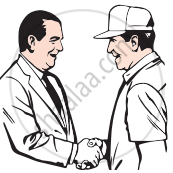
Guess what friendly words these two gentlemen exchange when shaking hands.
What do you associate with the title of the poem?
What is the relationship between the narrator and the listener?
What does the poet long for?
Interpret each of the following expression used in the poem, in one or two line.
laugh with their eyes
Interpret each of the following expression used in the poem, in one or two line.
like a fixed portrait smile
Interpret each of the following expression used in the poem, in one or two line.
hands search my empty pockets
Explain the following line with reference to the context.
There will be no thrice.
‘Face is the index of the mind.’ Does this adage concur with the views of the poet?
Read the poem again and complete the summary using the words given in the box.
In the poem ‘Confessions of a Born Spectator,’ Ogden Nash talks about how people choose different sports in their lives or decide to become athletes. While admiring the talents of athletes and sportsmen, the poet (i)______he is glad that he is neither a sportsman nor an athlete. Children have different (ii)______and wish to play various games. Each child has in mind something in particular, but the narrator is (iii)______he is not one of the players. Though the narrator (iv) ______the talents of all athletes, he derives satisfaction from watching them, but does not wish to (v) ______places with them. He also sometimes regrets that (vi)______athletes play rough games without caring for the feelings of their sporting rivals. He feels that good sense and caution win over ego. The narrator wholeheartedly offers (vii) ______the modest (viii) ______of athletes. Ultimately the narrator is (ix)______that he himself is not an athlete.
|
thanksgiving exchange glad confesses physiques zealous satisfied aims admires |
Read the given lines and answer the questions that follow in a sentence or two.
Well, ego it might be pleased enough But zealous athletes play so rough…
- What pleases the ego?
- Why are athletes often rough during play?
Explain the following with reference to the context in about 50–60 word each.
Athletes, I’ll drink to you, Or eat with you, Or anything except compete with you…
How does the poet feel while enjoying the beauty of Nature?
The poem is set in a ______.
A French proverb goes thus: ‘The dog may be wonderful prose, but only the cat is poetry.’ You may have observed that all animals possess a number of unique qualities. Fill in the columns with words and phrases associated with each of the following animals.
| DOG | CAT | WOLF | ELEPHANT |
What makes the fakir stare in wonder?
Describe Macavity’s appearance.
What is Macavity expected to be doing after committing a crime?
Give an account of Macavity’s destructive mischief.
Explain the following line with reference to the context.
And when you think he’s half asleep, he’s always wide awake
Which quality does the speaker wish to nourish? What is his mission?
Why does the speaker say ‘Everest is not the only peak’?
Read the given line and answer the question that follow.
We are proud of the position we hold; humble as we are
- What is the speaker proud of?
- How is the speaker both humble and proud?
- Pick out the alliteration in these lines.
The historical background:
The poem is an extract from William Shakespeare’s play King Richard the Second. The play is based on true events that occurred towards the end of the 14th century.
Richard II was crowned the King of England in the year 1367. He continued to be the British Monarch until 1399, when he was deposed by his cousin, Henry of Bolingbroke, who crowned himself King Henry the Fourth in the same year. Shakespeare’s play is a dramatic rendition of the last two years of King Richard II’s life. In this brief span of time, he was ousted from his royal position and sent to prison, where he died in captivity.
The following extract is set in the Coast of Wales. King Richard and some of his followers awaited the arrival of the Welsh army [after facing defeat at the hands of his cousin, Bolingbroke], of about 10000 warriors. But to their shock and surprise, they received the message that the army was not coming to their rescue. His followers tried to boost their King’s courage against the news, only in vain. When Richard came face to face with the reality of his terrible fate, he spoke the following verse, famously known as the “Hollow Crown” speech in theatrical circles. In it, King Richard is reminded of the power of Death that overshadows everything else, including the power of rulers, and renders them as powerless as any commoner at a moment’s notice.
What do the three words, ‘graves, worms and epitaphs’, refer to?
Are all deposed kings slain by the deposer?
Based on your reading of King Richard’s speech, answer the following questions in about 100 - 150 words each. You may add your own ideas if required to present and justify your point of view.
How are eternal truths and wisdom brought to the reader here?
