Advertisements
Advertisements
Question
Read the given lines and answer the questions that follow in a sentence or two.
With all my heart I do admire
Athletes who sweat for fun or hire
- Whom does the poet admire?
- For what reasons do the athletes sweat?
Advertisements
Solution
- The poet admires athletes who play games.
- The athletes play and sweat for fun or money.
APPEARS IN
RELATED QUESTIONS
Guess what friendly words these two gentlemen exchange when shaking hands.
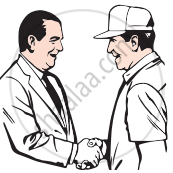
Read the line given below and answer the question that follow.
‘Most of all, I want to relearn How to laugh, for my laugh in the mirror Shows only my teeth like a snake’s bare fangs!’
- Why does the poet want to relearn how to laugh?
- Whom does the poet want to relearn from?
- Mention the figure of speech used here.
Read the poem again and complete the summary using the words given in the box.
In the poem ‘Confessions of a Born Spectator,’ Ogden Nash talks about how people choose different sports in their lives or decide to become athletes. While admiring the talents of athletes and sportsmen, the poet (i)______he is glad that he is neither a sportsman nor an athlete. Children have different (ii)______and wish to play various games. Each child has in mind something in particular, but the narrator is (iii)______he is not one of the players. Though the narrator (iv) ______the talents of all athletes, he derives satisfaction from watching them, but does not wish to (v) ______places with them. He also sometimes regrets that (vi)______athletes play rough games without caring for the feelings of their sporting rivals. He feels that good sense and caution win over ego. The narrator wholeheartedly offers (vii) ______the modest (viii) ______of athletes. Ultimately the narrator is (ix)______that he himself is not an athlete.
|
thanksgiving exchange glad confesses physiques zealous satisfied aims admires |
According to the poet, what contributes most to the injuries sustained by the athletes?
Explain the following with reference to the context in about 50–60 word each.
They do not ever in their dealings Consider one another’s feelings…
Underline the alliterated word in the following line.
For this most modest physiques…
Find out the rhyme scheme of the given stanza.
One infant grows up and becomes a jockey
Another plays basketball or hockey
This one the prize ring hates to enter
That one becomes a tackle or center…
Everybody is special and everybody is a hero. Each one has a story to tell. In the light of this observation, present your views.
Would you like to exchange your place with someone else? Why/why not?
If you go to a village, what scenes would you observe?
Explain the following line with reference to the context in about four to five sentence each.
Have I not reason to lament
What Man has made of Man?
Listening Activity
Some phrases have been left out in the poem below. First, read the poem. Then, fill in the missing words on listening to the reading or the recording of it in full. You may listen again, if required
To Autumn
O Autumn, laden with fruit, and stained
With the blood of the grape, pass not, but sit
Beneath my ______, there thou may’st rest,
And tune thy jolly voice to my ______;
And all the daughters of the year shall dance!
Sing now the ______of fruits and flowers.
“The ______opens her beauties to
The sun, and love runs in her ______;
Blossoms hang round the brows of morning and
Flourish down the ______of modest eve,
Till clust’ring Summer breaks forth into singing,
And ______strew flowers round her head.
The spirits of the air live on the smells
Of fruit; and joy, with ______, roves round
The gardens, or sits singing in the trees.”
Thus sang the ______as he sat,
Then rose, girded himself, and o’er the bleak
Hills fled from our sight; but left his ______.
William Blake
‘Nature can nurture’. Describe how this process happens.
Write a letter to the Councillor of your Ward, explaining why a park is necessary in your locality.
People admire some of these animal qualities. What are they? Have you noticed some of them in yourself or in others? Share your views with the class.
Describe Macavity’s appearance.
Read the given lines and answer the question that follow.
He’s the bafflement of Scotland
Yard, the Flying Squad’s despair:
For when they reach the scene of crime
— Macavity’s not there!..
- What is ‘Scotland Yard’?
- Why does the flying squad feel disappointed?
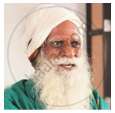
Identify the following personalities and their fields of achievement.
| Name | Field | |
 |
||
 |
||
 |
||
 |
||
 |
||
 |
||
 |
||
 |
- Mention a remarkable achievement of any of these personalities.
- What quality do you admire the most in each of these achievers?
- What are the qualities that you may share with them?
- Name a few more popular personalities who have made our nation proud.
- ______.
- ______.
- ______.
- ______.
Read the given line and answer the question that follow.
He, who does not stoop, is a king we adore. We bow before competence and merit;
- Who is adored as a king?
- What is the figure of speech used in the first line?
Creative Activity
- Write eight words you associate with success.
- Use the words to write eight lines that mean success to you or how success makes you feel.
- Arrange your lines into a poem.
- Share your poem with the class and post a copy on the notice board.
Discuss the following topic in groups of five and choose a representative to sum up the view and share them with the class.
‘Success is not final, failure is not fatal.’ It is the courage and perseverance that counts.
Fill in the blanks using the words given in the box to complete the summary of the poem:
King Richard the Second, had surrendered to his (a)______cousin, Bollingbroke. He experienced deep distress at the horror of his circumstances. In that desperate situation, he speaks of (b)______, (c)______, (d)______and other things connected with death. He spoke of how people leave nothing behind and can call nothing their own, except for the small patch of (e)______, where they will be buried. King Richard yielded to dejection and talked of all the different ways in which defeated kings suffer how some had been deposed, (f)______in war, (g)______by their wives and so forth. He attributed this loss of lives to (h)______, who he personified as the jester who watches over the shoulder of every ruler, who mocks kings by allowing them to think their human flesh, was like (i)______brass. However, Death penetrates through the castle walls, silently and unnoticed like a sharp (j)______, thus bidding (k)______to him and all his pride forever. Finally, Richard appealed to his soldiers not to mock his mere flesh and blood by showing (l) ______and respect to him. He added that he too needed bread to live, felt want, tasted (m)______and needed (n)______. He concluded thus, urging his men not to call him a (o)______as he was only human, just like the rest of them.
| barren-earth | friends | graves | slain |
| rebellious | poisoned | worms | grief |
| impregnable | epitaphs | death | farewell |
| reverence | king | pin |
Who is Bolingbroke? Is he a friend or foe?
What hides within the crown and laughs at the king’s grandeur?
Explain the following line with reference to the context in about 5 to 8 line:
“Comes at the last, and with a little pin
Bores through his castle wall, and farewell king!”
Pick out the alliteration from the following lines:
“Our lands, our lives, and all, are Bolingbroke’s,…”
Based on your reading of King Richard’s speech, answer the following questions in about 100 - 150 words each. You may add your own ideas if required to present and justify your point of view.
Who does the future generations remember easily - the victor or the vanquished? Give reasons. Also, cite relevant references from King Richard’s speech.
