Advertisements
Advertisements
Question
The poem speaks of ______.
Options
Man’s plan to shape destiny
Man seeking pleasure and riches
Man indulging in wars and acts of destruction
Man’s fear of Nature
Advertisements
Solution
The poem speaks of Man indulging in wars and acts of destruction.
APPEARS IN
RELATED QUESTIONS
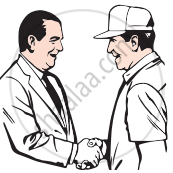
Guess what friendly words these two gentlemen exchange when shaking hands.
What is the relationship between the narrator and the listener?
How does the poet compare his face with dresses?
What does he desire to unlearn and relearn?
Read the line given below and answer the question that follow.
‘Most of all, I want to relearn How to laugh, for my laugh in the mirror Shows only my teeth like a snake’s bare fangs!’
- Why does the poet want to relearn how to laugh?
- Whom does the poet want to relearn from?
- Mention the figure of speech used here.
Explain the things the poet has learnt when he grew into an adult.
Do you think the narrator is heroic? Why?
Underline the alliterated word in the following line.
They do not ever in their dealings…
Would you like to exchange your place with someone else? Why/why not?
You are the School Pupil Leader. Mention some qualities that can be drawn from the field of sports to improve your leadership skills.
Read the poem once again. Identify the rhyme scheme and pick out the rhyming pairs of words.
Why does the poet think that the birds were happy?
Answer in a paragraph of about 100−150 words.
Do you think the poet wants to say that man is unhappy because he has lost his link with nature and forgotten how to enjoy nature, or because man is cruel to other men?
When humanity fails to live in harmony with Nature, its effects are felt around the world. Why and how?
What is Macavity’s nickname?
Where can you encounter Macavity?
Give an account of Macavity’s destructive mischief.
Read the given lines and answer the question that follow.
‘It must have been Macavity!’ but he’s a mile away.
- What is Macavity blamed for?
- Where is he?
Explain the following line with reference to the context.
And his footprints are not found in any file of Scotland Yard’s
Explain the following line with reference to the context.
He always has an alibi, and one or two to spare
Pick out all the pairs of rhyming words used in the poem.
What does the ladder symbolize?
Read the given line and answer the question that follow.
He, who does not stoop, is a king we adore. We bow before competence and merit;
- Who is adored as a king?
- What is the figure of speech used in the first line?
The poem does not focus on the destination but the journey towards it. Discuss
The historical background:
The poem is an extract from William Shakespeare’s play King Richard the Second. The play is based on true events that occurred towards the end of the 14th century.
Richard II was crowned the King of England in the year 1367. He continued to be the British Monarch until 1399, when he was deposed by his cousin, Henry of Bolingbroke, who crowned himself King Henry the Fourth in the same year. Shakespeare’s play is a dramatic rendition of the last two years of King Richard II’s life. In this brief span of time, he was ousted from his royal position and sent to prison, where he died in captivity.
The following extract is set in the Coast of Wales. King Richard and some of his followers awaited the arrival of the Welsh army [after facing defeat at the hands of his cousin, Bolingbroke], of about 10000 warriors. But to their shock and surprise, they received the message that the army was not coming to their rescue. His followers tried to boost their King’s courage against the news, only in vain. When Richard came face to face with the reality of his terrible fate, he spoke the following verse, famously known as the “Hollow Crown” speech in theatrical circles. In it, King Richard is reminded of the power of Death that overshadows everything else, including the power of rulers, and renders them as powerless as any commoner at a moment’s notice.
What does the crown of rulers stand for?
Working with your partner, discuss the following adages and share your views with the class. You may need to give your ideas and justify your point of view. Remember to take turns while making your presentation/short speech.
War begets war
Read the poem once again carefully and identify the figure of speech that has been used in each of the following line from the poem:
“Keeps Death his court, and there the antic sits,…”
Pick out the alliteration from the following lines:
“Our lands, our lives, and all, are Bolingbroke’s,…”
