English
Tamil Nadu Board of Secondary EducationHSC Science Class 11

Explain the following line with reference to the context. I have learned to wear my faces Like dresses … - English

Advertisements
Advertisements

Question

Explain the following line with reference to the context.

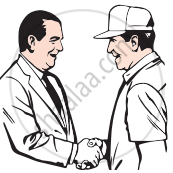
I have learned to wear my faces Like dresses …

Answer in Brief
Advertisements

Solution

  • Reference: These lines are from the poem “Once Upon a Time” written by Gabriel Okara.
  • Context: The poet says these words while admitting how he himself started putting on appearances to conform to the changed attitude of people
    in modem times.
  • Explanation: The poet registers his displeasure over the negative changes that have influenced the behaviour of adults. The adults have mastered the art
shaalaa.com
Poem (Class 11th)
  Is there an error in this question or solution?
Chapter 1.2: Once Upon a Time - Exercises [Page 24]

APPEARS IN

Samacheer Kalvi English Class 11 TN Board
Chapter 1.2 Once Upon a Time
Exercises | Q 3. C iii. | Page 24

RELATED QUESTIONS

What happens to the poet when he visits someone for the third time?


Pick out the expressions that indicate conflicting ideas.


What does he desire to unlearn and relearn?


Mention the qualities the child in the poem symbolises.


Fill in the blanks choosing the words from the box given and complete the summary of the poem:

The poet Okara in this narrative monologue painfully condemns the (a)______ displayed by adults, both in their words and actions. Here, a father laments to his son about the negative changes that creep into the attitude and behaviour of humans, when they grow into (b)______. He says that people used to be (c)______ when they laugh and the honesty would be reflected in their eyes. But, people of modern times laugh (d)______. Their handshakes used to be warm and happy conveying a sense of togetherness, but nowadays the handshakes have become a mere (e)______. He warns his son that people are not trust-worthy and have become so selfish that they are concerned only about their own (f)______benefits. People utter words of welcome and exchange (g)______, but those words come only from the tip of their tongues and not from the depth of their hearts. Humans have learnt the art of changing their (h)______ expressions according to situations merely to ensure social acceptance. They wear(i)______ and exhibit multiple faces. The narrator admits that he has also changed into a hypocrite. However, he tells his son that though he (j)______ his expressions, he does all these against his will. He says he wants to become a (k)______ again and laugh genuinely. He wants to (l)______ the unreal things and (m)______how to laugh as he had done once upon a time. When he laughs before the (n)______, he sees no expression. His teeth are bare like that of the (o)______of a snake. So, he asks his son to show him how to laugh the way he used to laugh when he was a kid like him.

relearn adults facial
personal fangs child
fakes superficially duplicity
genuine unlearn falsity
masks mirror pleasantries

Explain the following lines with reference to the context.

I want to be what I used to be.


‘Face is the index of the mind.’ Does this adage concur with the views of the poet?


The poet is satisfied just watching the heroic deeds of others. What could be the reason?


The poet does not wish to exchange position with the runners. Why?


Why does the poet prefer to buy tickets worth their weight in radium? Bring out the significance of the metal referred to here.


Read the given lines and answer the questions that follow in a sentence or two.

With all my heart I do admire

Athletes who sweat for fun or hire

  1. Whom does the poet admire?
  2. For what reasons do the athletes sweat?

Read the given line and answer the question that follow in a sentence or two

When snaps the knee and cracks the wrist….

Identify and explain the use of the literary device in this line.


Underline the alliterated word in the following line.

They do not ever in their dealings…


You are the School Pupil Leader. Mention some qualities that can be drawn from the field of sports to improve your leadership skills.


Complete the summary of the poem by filling in the blanks with the words given below.

The poet, in a relaxed state of mind, is sitting in a (1) ______. He reflects on how his mood brings (2) ______thoughts, which are inevitably followed by (3)______ones. He feels connected to all of nature, and senses an inherent joy in all (4)______. He has faith in the fact that all the primroses and periwinkles around him (5)______ the air they breathe. He feels that every bird in the grove moves with (6)______. As the twigs catch the breezy air, they do so with the same pleasure (7)______ all life on earth. This joy of nature seems to be heaven-sent. Nature’s holy plan is to offer joy and peace to all forms of life on earth. The poet’s pleasant train of thought slowly leads to the sad reflection of how mankind alone has wrought sorrow and (8)______ upon itself. He firmly believes that man is meant to spend his days blissfully taking part in the vitality and joy surrounding him in (9)______. He therefore concludes rhetorically, emphasizing that he has good reason to (10)______ the distress, man unnecessarily brings upon himself.

creations abundance savour
pleasant suffering grove
lament pervading sorrowful
ecstasy    

Why does the poet think that the birds were happy?


The poem is set in a ______.


When humanity fails to live in harmony with Nature, its effects are felt around the world. Why and how?


People admire some of these animal qualities. What are they? Have you noticed some of them in yourself or in others? Share your views with the class.


What makes the fakir stare in wonder?


Read the poem once again and complete the summary using the words given in the box.

‘Macavity – The Mystery Cat’ is a humorous poem, where the poet T.S. Eliot describes the mysterious (a) _______of a shrewd vile cat. He commits a crime at every possible opportunity. He is an elusive master (b)______who leaves no evidence after he commits a crime. Even the Scotland Yard, the London (c) ______ agency is unable to arrest him. The Flying Squad is (d) ______ because every time they rush to the crime spot to seize Macavity, he is not there. He breaks the human law as well as the law of (e) ______. He baffles even a (f) ______ with his powers of levitation. Macavity appears tall and thin with (g)______ eyes. He is always preoccupied with some serious (h) ______. His coat is dusty and his (i)______are unkempt. Macavity is a (j) ______in the guise of a cat. He appears to be outwardly (k) ______ but his actions disprove it. Macavity loots the (l)______, ransacks the jewel-case, and breaks the (m)______glass but wonder of wonders he is not to be found anywhere there. He is always a mile away from the scene of crime, happily relaxing or doing difficult (n) ______ sums. He is clever at making up an (o) ______every time he plots a crime. All the notorious cats are nothing but the (p) ______Macavity, the Napoleon of Crime.

larder whiskers
respectable criminal
devil thought
sunken division
agents detective
alibi desperate
fakir qualities
gravity greenhouse

What are the mysterious ways in which Macavity acts?


Which line is repeated in the poem? What is the effect created by this repetition?


What does the ladder symbolize?


Read the given line and answer the question that follow.

Our nature it is that whatever we try We do with devotion deep and true.

  1. Who does ‘we’ refer to?
  2. How should we carry out our duties?

Discuss the following topics in groups of five and choose a representative to sum up the views and share them with the class.

To succeed in life, one must have a single-minded devotion to duty.


Fill in the blank with appropriate word from the box and complete the statement suitably:

Alexander the Great, wished to conquer many lands and ______the entire world.


What do the three words, ‘graves, worms and epitaphs’, refer to?


What does the crown of rulers stand for?


Pick out the alliteration from the following lines:

“And tell sad stories of the death of kings:”


Share
Notifications

Englishहिंदीमराठी


      Forgot password?
Use app×