Advertisements
Advertisements
प्रश्न
Explain the following line with reference to the context.
I have learned to wear my faces Like dresses …
Advertisements
उत्तर
- Reference: These lines are from the poem “Once Upon a Time” written by Gabriel Okara.
- Context: The poet says these words while admitting how he himself started putting on appearances to conform to the changed attitude of people
in modem times. - Explanation: The poet registers his displeasure over the negative changes that have influenced the behaviour of adults. The adults have mastered the art
APPEARS IN
संबंधित प्रश्न
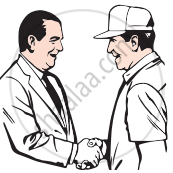
Guess what friendly words these two gentlemen exchange when shaking hands.
What happens to the poet when he visits someone for the third time?
What pleasantries does the poet use to fake cordiality?
What does the poet long for?
Interpret each of the following expression used in the poem, in one or two line.
shake hands without hearts
Do you think the narrator is heroic? Why?
The poet is satisfied just watching the heroic deeds of others. What could be the reason?
Are the athletes conscious of the feelings of others? Why do you say so?
Why would the referee ask whether there was a doctor in the stands? What stands is he referring to?
The poet does not wish to exchange places with the athletes. How does he justify his view?
Read the given lines and answer the questions that follow in a sentence or two.
With all my heart I do admire
Athletes who sweat for fun or hire
- Whom does the poet admire?
- For what reasons do the athletes sweat?
Read the poem and answer the following in a short paragraph of 8–10 sentences each.
When officialdom demands Is there a doctor in the stands?
- Why are doctors called from stands by the sponsors?
- Why does the poet make such an observation?
Explain the following with reference to the context in about 50–60 word each.
Athletes, I’ll drink to you, Or eat with you, Or anything except compete with you…
Underline the alliterated word in the following line.
For this most modest physiques…
Would you like to exchange your place with someone else? Why/why not?
Read the poem once again. Identify the rhyme scheme and pick out the rhyming pairs of words.
Does Nature affect a person’s thoughts and feelings? Explain.
The poem speaks of ______.
Why does the poet say Macavity is ‘outwardly’ respectable?
Read the given lines and answer the question that follow.
He’s the bafflement of Scotland
Yard, the Flying Squad’s despair:
For when they reach the scene of crime
— Macavity’s not there!..
- What is ‘Scotland Yard’?
- Why does the flying squad feel disappointed?
Explain the following line with reference to the context.
His powers of levitation would make a fakir stare
Which line is repeated in the poem? What is the effect created by this repetition?
Why does the speaker say ‘Everest is not the only peak’?
Read the given line and answer the question that follow.
We are proud of the position we hold; humble as we are
- What is the speaker proud of?
- How is the speaker both humble and proud?
- Pick out the alliteration in these lines.
Complete the passage given below, with suitable words from the box:
Lima, a (a)______and (b)______woman, kept (c)______at her colleagues and went on taxing them with hard labour. Though they were (d) ______to her, she being their head, they were offended and filled with (e)______. It so happened, that Lima was (f)______from her high position due to a serious blunder she had committed. Lima, having lost all her (g)______and glory, realized how arrogant she had been. She gave up her pride and with (h)______sought an apology from everyone. She thus turned over a new leaf and bid (i)______to them.
| farewell | ceremonious | deposed |
| reverence | vain | pomp |
| conceited | sorrow | scoffing |
Pick out the alliteration from the following lines:
“Our lands, our lives, and all, are Bolingbroke’s,…”
Based on your reading of King Richard’s speech, answer the following questions in about 100 - 150 words each. You may add your own ideas if required to present and justify your point of view.
How are eternal truths and wisdom brought to the reader here?
Based on your reading of King Richard’s speech, answer the following questions in about 100 - 150 words each. You may add your own ideas if required to present and justify your point of view.
Who does the future generations remember easily - the victor or the vanquished? Give reasons. Also, cite relevant references from King Richard’s speech.
