Advertisements
Advertisements
प्रश्न
Explain the following lines with reference to the context.
I want to be what I used to be.
Advertisements
उत्तर
- Reference: This line is from the poem “Once upon a time” written by Gabriel Okara.
- Context: The poet says these words while contrasting the present hypocrisy with his past genuine relationships.
- Explanation: During childhood, the poet, like any child, laughed with human warmth. He used to express his love through his eyes. Now, he is changing his faces like dresses to suit the occasion and to ensure social acceptance. So, he wants to be what he used to be in childhood.
APPEARS IN
संबंधित प्रश्न
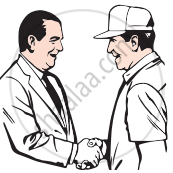
Guess what friendly words these two gentlemen exchange when shaking hands.
Pick out the expressions that indicate conflicting ideas.
Explain the following line with reference to the context.
I have learned to wear my faces Like dresses …
Why does the poet prefer to buy tickets worth their weight in radium? Bring out the significance of the metal referred to here.
Read the given lines and answer the questions that follow in a sentence or two.
With all my heart I do admire
Athletes who sweat for fun or hire
- Whom does the poet admire?
- For what reasons do the athletes sweat?
Read the given lines and answer the questions that follow in a sentence or two.
Well, ego it might be pleased enough But zealous athletes play so rough…
- What pleases the ego?
- Why are athletes often rough during play?
Read the lines given below and answer the question that follow.
If this belief from heaven be sent,
If such be Nature’s holy plan.
- What does ‘heaven’ refer to?
- Why does the poet call it ‘holy’?
Explain the following line with reference to the context in about four to five sentence each.
The birds around me hopp’d and play’d,
Their thoughts I cannot measure.
Read the following line and identify the figure of speech used in each extract.
To her fair works did Nature link
The human soul that through me ran.
How does the poet feel while enjoying the beauty of Nature?
What scene in nature gives you pleasure? Talk for a minute describing a natural scene that gave you a lot of joy. What did you see, hear, smell or feel, that gave you joy?
What makes the fakir stare in wonder?
Where can you encounter Macavity?
Give an account of Macavity’s destructive mischief.
Identify the literary devices used in the following lines:
- He sways his head from side to side, with movements like a snake.
- They say he cheats at cards.
Which quality does the speaker wish to nourish? What is his mission?
Read the given line and answer the question that follow.
Honour is a property, common to all: In dignity and pride no one need to be poor.
- Who are considered rich?
- What is their asset?
The poem does not focus on the destination but the journey towards it. Discuss
The historical background:
The poem is an extract from William Shakespeare’s play King Richard the Second. The play is based on true events that occurred towards the end of the 14th century.
Richard II was crowned the King of England in the year 1367. He continued to be the British Monarch until 1399, when he was deposed by his cousin, Henry of Bolingbroke, who crowned himself King Henry the Fourth in the same year. Shakespeare’s play is a dramatic rendition of the last two years of King Richard II’s life. In this brief span of time, he was ousted from his royal position and sent to prison, where he died in captivity.
The following extract is set in the Coast of Wales. King Richard and some of his followers awaited the arrival of the Welsh army [after facing defeat at the hands of his cousin, Bolingbroke], of about 10000 warriors. But to their shock and surprise, they received the message that the army was not coming to their rescue. His followers tried to boost their King’s courage against the news, only in vain. When Richard came face to face with the reality of his terrible fate, he spoke the following verse, famously known as the “Hollow Crown” speech in theatrical circles. In it, King Richard is reminded of the power of Death that overshadows everything else, including the power of rulers, and renders them as powerless as any commoner at a moment’s notice.
Fill in the blanks using the words given in the box to complete the summary of the poem:
King Richard the Second, had surrendered to his (a)______cousin, Bollingbroke. He experienced deep distress at the horror of his circumstances. In that desperate situation, he speaks of (b)______, (c)______, (d)______and other things connected with death. He spoke of how people leave nothing behind and can call nothing their own, except for the small patch of (e)______, where they will be buried. King Richard yielded to dejection and talked of all the different ways in which defeated kings suffer how some had been deposed, (f)______in war, (g)______by their wives and so forth. He attributed this loss of lives to (h)______, who he personified as the jester who watches over the shoulder of every ruler, who mocks kings by allowing them to think their human flesh, was like (i)______brass. However, Death penetrates through the castle walls, silently and unnoticed like a sharp (j)______, thus bidding (k)______to him and all his pride forever. Finally, Richard appealed to his soldiers not to mock his mere flesh and blood by showing (l) ______and respect to him. He added that he too needed bread to live, felt want, tasted (m)______and needed (n)______. He concluded thus, urging his men not to call him a (o)______as he was only human, just like the rest of them.
| barren-earth | friends | graves | slain |
| rebellious | poisoned | worms | grief |
| impregnable | epitaphs | death | farewell |
| reverence | king | pin |
Fill in the blank with appropriate word from the box and complete the statement suitably:
The business woman wished to ______all her riches to an orphanage, after her death.
What are the various functions and objects given up by a defeated king?
Bring out King Richard’s feelings when he was defeated.
Explain the following line with reference to the context in about 5 to 8 line:
All murdered – for within the hollow crown
That rounds the mortal temples of a king Keeps Death his court, …”
Explain the following line with reference to the context in about 5 to 8 line:
“Comes at the last, and with a little pin
Bores through his castle wall, and farewell king!”
Working with your partner, discuss the following adages and share your views with the class. You may need to give your ideas and justify your point of view. Remember to take turns while making your presentation/short speech.
Uneasy lies the head that wears a crown
Pick out the alliteration from the following lines:
“And tell sad stories of the death of kings:”
Based on your reading of King Richard’s speech, answer the following questions in about 100 - 150 words each. You may add your own ideas if required to present and justify your point of view.
What are the causes for King Richard’s grief?
Based on your reading of King Richard’s speech, answer the following questions in about 100 - 150 words each. You may add your own ideas if required to present and justify your point of view.
How are eternal truths and wisdom brought to the reader here?
