Advertisements
Advertisements
प्रश्न
Explain the following lines with reference to the context.
I want to be what I used to be.
Advertisements
उत्तर
- Reference: This line is from the poem “Once upon a time” written by Gabriel Okara.
- Context: The poet says these words while contrasting the present hypocrisy with his past genuine relationships.
- Explanation: During childhood, the poet, like any child, laughed with human warmth. He used to express his love through his eyes. Now, he is changing his faces like dresses to suit the occasion and to ensure social acceptance. So, he wants to be what he used to be in childhood.
APPEARS IN
संबंधित प्रश्न
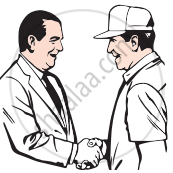
Guess what friendly words these two gentlemen exchange when shaking hands.
What happens to the poet when he visits someone for the third time?
How does the poet compare his face with dresses?
What pleasantries does the poet use to fake cordiality?
How is the poet’s laugh reflected in the mirror?
This poem is nothing but a criticism of modern life. Justify this statement.
‘Face is the index of the mind.’ Does this adage concur with the views of the poet?
The poet is satisfied just watching the heroic deeds of others. What could be the reason?
If you go to a village, what scenes would you observe?
Read the lines given below and answer the question that follow.
If this belief from heaven be sent,
If such be Nature’s holy plan.
- What does ‘heaven’ refer to?
- Why does the poet call it ‘holy’?
Explain the following line with reference to the context in about four to five sentence each.
The birds around me hopp’d and play’d,
Their thoughts I cannot measure.
Does Nature affect a person’s thoughts and feelings? Explain.
The poet finds joy in various objects of Nature. Explain.
The poem speaks of ______.
A French proverb goes thus: ‘The dog may be wonderful prose, but only the cat is poetry.’ You may have observed that all animals possess a number of unique qualities. Fill in the columns with words and phrases associated with each of the following animals.
| DOG | CAT | WOLF | ELEPHANT |
Read the poem once again and complete the summary using the words given in the box.
‘Macavity – The Mystery Cat’ is a humorous poem, where the poet T.S. Eliot describes the mysterious (a) _______of a shrewd vile cat. He commits a crime at every possible opportunity. He is an elusive master (b)______who leaves no evidence after he commits a crime. Even the Scotland Yard, the London (c) ______ agency is unable to arrest him. The Flying Squad is (d) ______ because every time they rush to the crime spot to seize Macavity, he is not there. He breaks the human law as well as the law of (e) ______. He baffles even a (f) ______ with his powers of levitation. Macavity appears tall and thin with (g)______ eyes. He is always preoccupied with some serious (h) ______. His coat is dusty and his (i)______are unkempt. Macavity is a (j) ______in the guise of a cat. He appears to be outwardly (k) ______ but his actions disprove it. Macavity loots the (l)______, ransacks the jewel-case, and breaks the (m)______glass but wonder of wonders he is not to be found anywhere there. He is always a mile away from the scene of crime, happily relaxing or doing difficult (n) ______ sums. He is clever at making up an (o) ______every time he plots a crime. All the notorious cats are nothing but the (p) ______Macavity, the Napoleon of Crime.
| larder | whiskers |
| respectable | criminal |
| devil | thought |
| sunken | division |
| agents | detective |
| alibi | desperate |
| fakir | qualities |
| gravity | greenhouse |
Read the given lines and answer the question that follow.
He’s the bafflement of Scotland
Yard, the Flying Squad’s despair:
For when they reach the scene of crime
— Macavity’s not there!..
- What is ‘Scotland Yard’?
- Why does the flying squad feel disappointed?
Read the given lines and answer the question that follow.
For he’s a fiend in feline shape, a monster of depravity
- How is the cat described in this line?
- Explain the phrase ‘monster of depravity’.
Explain the following line with reference to the context.
His powers of levitation would make a fakir stare
Give four instances where the poet has used alliteration in the poem.
Pick out all the pairs of rhyming words used in the poem.
Which line is repeated in the poem? What is the effect created by this repetition?
Read the given line and answer the question that follow.
He, who does not stoop, is a king we adore. We bow before competence and merit;
- Who is adored as a king?
- What is the figure of speech used in the first line?
Work with a partner and take this short quiz to find out how well-informed you are about history.
- Name a few wars and battles you have read about.
- What is the difference between a war and a battle?
- Why do rulers wage wars and battles?
- Is the outcome of a war always fair?
- Do you think rulers understand the true meaning of life – in defeat or in victory?
- Can you name a few kings and leaders who have fallen from glory to disgrace?
What do the three words, ‘graves, worms and epitaphs’, refer to?
Who is Bolingbroke? Is he a friend or foe?
Explain the following line with reference to the context in about 5 to 8 line:
“Our lands, our lives, and all are Bolingbroke’s,
And nothing can we call our own but death;”
Explain the following line with reference to the context in about 5 to 8 line:
All murdered – for within the hollow crown
That rounds the mortal temples of a king Keeps Death his court, …”
Explain the following line with reference to the context in about 5 to 8 line:
“How can you say to me, I am a king?”
