Advertisements
Advertisements
प्रश्न
A French proverb goes thus: ‘The dog may be wonderful prose, but only the cat is poetry.’ You may have observed that all animals possess a number of unique qualities. Fill in the columns with words and phrases associated with each of the following animals.
| DOG | CAT | WOLF | ELEPHANT |
Advertisements
उत्तर
| DOG | CAT | WOLF | ELEPHANT |
| Barks | meows | howls | trumpets |
| open fight | stealthy | groups | groups |
| aggressive | pretends to be gentle | rough | gentle |
| faithful | ungrateful | wild | civilized |
| fights for food | quickly steals food | predatory | graceful |
APPEARS IN
संबंधित प्रश्न
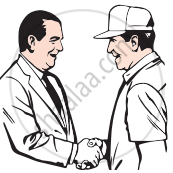
Guess what friendly words these two gentlemen exchange when shaking hands.
Pick out the expressions that indicate conflicting ideas.
Explain the things the poet has learnt when he grew into an adult.
The poet is satisfied just watching the heroic deeds of others. What could be the reason?
Why does the poet prefer to buy tickets worth their weight in radium? Bring out the significance of the metal referred to here.
Read the given lines and answer the questions that follow in a sentence or two.
Well, ego it might be pleased enough But zealous athletes play so rough…
- What pleases the ego?
- Why are athletes often rough during play?
Read the poem and answer the following in a short paragraph of 8–10 sentences each.
When officialdom demands Is there a doctor in the stands?
- Why are doctors called from stands by the sponsors?
- Why does the poet make such an observation?
Explain the following with reference to the context in about 50–60 word each.
Athletes, I’ll drink to you, Or eat with you, Or anything except compete with you…
Read the poem and complete the table with suitable rhyming words
| e.g. enter | center |
| hockey | |
| admire | |
| romp | |
| deeds | |
| score | |
| please | |
| wrist | |
| demands | |
| stadium |
Read the following line and identify the figure of speech used in each extract.
To her fair works did Nature link
The human soul that through me ran.
Read the following line and identify the figure of speech used in each extract.
What Man has made of Man?
Answer in a paragraph of about 100−150 words.
Do you think the poet wants to say that man is unhappy because he has lost his link with nature and forgotten how to enjoy nature, or because man is cruel to other men?
Describe the appearance and qualities of Macavity.
Read the given lines and answer the question that follow.
And his footprints are not found in any file of Scotland Yard’s.
- What seems to be a challenge for the Scotland Yard?
- Why do they need his footprints?
Explain the following line with reference to the context.
And when you think he’s half asleep, he’s always wide awake
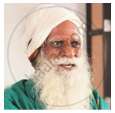
Identify the following personalities and their fields of achievement.
| Name | Field | |
 |
||
 |
||
 |
||
 |
||
 |
||
 |
||
 |
||
 |
- Mention a remarkable achievement of any of these personalities.
- What quality do you admire the most in each of these achievers?
- What are the qualities that you may share with them?
- Name a few more popular personalities who have made our nation proud.
- ______.
- ______.
- ______.
- ______.
Who are the ‘deserving ones’?
Why does the speaker say ‘Everest is not the only peak’?
Read the given line and answer the question that follow.
Our nature it is that whatever we try We do with devotion deep and true.
- Who does ‘we’ refer to?
- How should we carry out our duties?
Read the given line and answer the question that follow.
Defeat we repel, courage our fort;
- How do we react to defeat?
- Which is considered as our stronghold?
Discuss the following topic in groups of five and choose a representative to sum up the view and share them with the class.
Successful people neither brood over the past nor worry about the future.
The historical background:
The poem is an extract from William Shakespeare’s play King Richard the Second. The play is based on true events that occurred towards the end of the 14th century.
Richard II was crowned the King of England in the year 1367. He continued to be the British Monarch until 1399, when he was deposed by his cousin, Henry of Bolingbroke, who crowned himself King Henry the Fourth in the same year. Shakespeare’s play is a dramatic rendition of the last two years of King Richard II’s life. In this brief span of time, he was ousted from his royal position and sent to prison, where he died in captivity.
The following extract is set in the Coast of Wales. King Richard and some of his followers awaited the arrival of the Welsh army [after facing defeat at the hands of his cousin, Bolingbroke], of about 10000 warriors. But to their shock and surprise, they received the message that the army was not coming to their rescue. His followers tried to boost their King’s courage against the news, only in vain. When Richard came face to face with the reality of his terrible fate, he spoke the following verse, famously known as the “Hollow Crown” speech in theatrical circles. In it, King Richard is reminded of the power of Death that overshadows everything else, including the power of rulers, and renders them as powerless as any commoner at a moment’s notice.
Complete the passage given below, with suitable words from the box:
Lima, a (a)______and (b)______woman, kept (c)______at her colleagues and went on taxing them with hard labour. Though they were (d) ______to her, she being their head, they were offended and filled with (e)______. It so happened, that Lima was (f)______from her high position due to a serious blunder she had committed. Lima, having lost all her (g)______and glory, realized how arrogant she had been. She gave up her pride and with (h)______sought an apology from everyone. She thus turned over a new leaf and bid (i)______to them.
| farewell | ceremonious | deposed |
| reverence | vain | pomp |
| conceited | sorrow | scoffing |
What does the executor mentioned in the poem do?
Explain the following line with reference to the context in about 5 to 8 line:
“Our lands, our lives, and all are Bolingbroke’s,
And nothing can we call our own but death;”
Explain the following line with reference to the context in about 5 to 8 line:
All murdered – for within the hollow crown
That rounds the mortal temples of a king Keeps Death his court, …”
