Advertisements
Advertisements
प्रश्न
Read the line given below and answer the question that follow.
‘Most of all, I want to relearn How to laugh, for my laugh in the mirror Shows only my teeth like a snake’s bare fangs!’
- Why does the poet want to relearn how to laugh?
- Whom does the poet want to relearn from?
- Mention the figure of speech used here.
Advertisements
उत्तर
- The poet has forgotten to laugh naturally. He wants to relearn to laugh because his laugh in front of the mirror shows his teeth like a snake’s bare fangs.
- The poet wants to relearn from his little son.
- Simile is the figure of speech employed here in the last line.
APPEARS IN
संबंधित प्रश्न
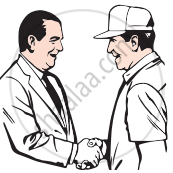
Guess what friendly words these two gentlemen exchange when shaking hands.
What is the relationship between the narrator and the listener?
What happens to the poet when he visits someone for the third time?
How does the poet compare his face with dresses?
Interpret each of the following expression used in the poem, in one or two line.
like a fixed portrait smile
Explain the following line with reference to the context.
There will be no thrice.
The poet is satisfied just watching the heroic deeds of others. What could be the reason?
The poet does not wish to exchange places with the athletes. How does he justify his view?
Underline the alliterated word in the following line.
They do not ever in their dealings…
Find out the rhyme scheme of the given stanza.
One infant grows up and becomes a jockey
Another plays basketball or hockey
This one the prize ring hates to enter
That one becomes a tackle or center…
Why do accidents usually happen in the playground? Give your own examples and explain
What sort of encouragement should an athlete in India be given? Give a few suggestions.
Complete the summary of the poem by filling in the blanks with the words given below.
The poet, in a relaxed state of mind, is sitting in a (1) ______. He reflects on how his mood brings (2) ______thoughts, which are inevitably followed by (3)______ones. He feels connected to all of nature, and senses an inherent joy in all (4)______. He has faith in the fact that all the primroses and periwinkles around him (5)______ the air they breathe. He feels that every bird in the grove moves with (6)______. As the twigs catch the breezy air, they do so with the same pleasure (7)______ all life on earth. This joy of nature seems to be heaven-sent. Nature’s holy plan is to offer joy and peace to all forms of life on earth. The poet’s pleasant train of thought slowly leads to the sad reflection of how mankind alone has wrought sorrow and (8)______ upon itself. He firmly believes that man is meant to spend his days blissfully taking part in the vitality and joy surrounding him in (9)______. He therefore concludes rhetorically, emphasizing that he has good reason to (10)______ the distress, man unnecessarily brings upon himself.
| creations | abundance | savour |
| pleasant | suffering | grove |
| lament | pervading | sorrowful |
| ecstasy |
Read the lines given below and answer the question that follow.
And ‘tis my faith that every flower
Enjoys the air it breathes…
- What is the poet’s faith?
- What trait of Nature do we see here?
The poem speaks of ______.
Write a letter to the Councillor of your Ward, explaining why a park is necessary in your locality.
What is Macavity’s nickname?
Read the given lines and answer the question that follow.
And his footprints are not found in any file of Scotland Yard’s.
- What seems to be a challenge for the Scotland Yard?
- Why do they need his footprints?
Read the given lines and answer the question that follow.
‘It must have been Macavity!’ but he’s a mile away.
- What is Macavity blamed for?
- Where is he?
Explain the following line with reference to the context.
There may be a scrap of paper in the hall or on the stair
But it’s useless to investigate…
Who are the ‘deserving ones’?
Read the given line and answer the question that follow.
Honour is a property, common to all: In dignity and pride no one need to be poor.
- Who are considered rich?
- What is their asset?
What do the three words, ‘graves, worms and epitaphs’, refer to?
What does ‘flesh’ mean here?
How does the king establish that he and his subjects are equal in the end?
Read the poem once again carefully and identify the figure of speech that has been used in each of the following line from the poem:
“Let’s talk of graves, of worms, and epitaphs;
Make dust our paper, and with rainy eyes Write sorrow on the bosom of the earth’’.
Based on your reading of King Richard’s speech, answer the following questions in about 100 - 150 words each. You may add your own ideas if required to present and justify your point of view.
Who does the future generations remember easily - the victor or the vanquished? Give reasons. Also, cite relevant references from King Richard’s speech.
