Advertisements
Advertisements
प्रश्न
Read the given lines and answer the question that follow.
And his footprints are not found in any file of Scotland Yard’s.
- What seems to be a challenge for the Scotland Yard?
- Why do they need his footprints?
Advertisements
उत्तर
- Scotland Yard police, known for its efficiency to nab criminals in record time, is unable to link any crime to Macavity. He has an alibi whenever a crime is committed. Arresting Macavity with clinching evidence for his involvement in a crime is a challenge for Scotland Yard.
- They need Macavity’s footprints to prove to the court of law that he was present at the scene of the crime.
APPEARS IN
संबंधित प्रश्न
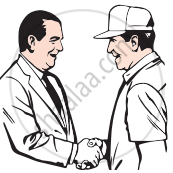
Guess what friendly words these two gentlemen exchange when shaking hands.
Interpret each of the following expression used in the poem, in one or two line.
to unlearn all these muting things
Read the line given below and answer the question that follow.
‘But now they only laugh with their teeth, While their ice-block-cold eyes…’
- Who are ‘they’?
- Explain: ice-block-cold eyes
- Identify the figure of speech used here.
Read the given lines and answer the questions that follow in a sentence or two.
With all my heart I do admire
Athletes who sweat for fun or hire
- Whom does the poet admire?
- For what reasons do the athletes sweat?
Explain the following with reference to the context in about 50–60 word each.
I am just glad as glad can be That I am not them, that they are not me…
Read the poem and complete the table with suitable rhyming words
| e.g. enter | center |
| hockey | |
| admire | |
| romp | |
| deeds | |
| score | |
| please | |
| wrist | |
| demands | |
| stadium |
Why do accidents usually happen in the playground? Give your own examples and explain
Does Nature affect a person’s thoughts and feelings? Explain.
Why does the poet think that the birds were happy?
The poet finds joy in various objects of Nature. Explain.
The poem speaks of ______.
Answer in a paragraph of about 100−150 words.
Do you think the poet wants to say that man is unhappy because he has lost his link with nature and forgotten how to enjoy nature, or because man is cruel to other men?
A French proverb goes thus: ‘The dog may be wonderful prose, but only the cat is poetry.’ You may have observed that all animals possess a number of unique qualities. Fill in the columns with words and phrases associated with each of the following animals.
| DOG | CAT | WOLF | ELEPHANT |
Why is the Flying Squad frustrated?
What is Macavity expected to be doing after committing a crime?
Read the given lines and answer the question that follow.
Macavity’s a Mystery Cat: he’s called the Hidden Paw…
- Does the poet talk about a real cat?
- Why is he called the Hidden Paw?
Read the given lines and answer the question that follow.
‘It must have been Macavity!’ but he’s a mile away.
- What is Macavity blamed for?
- Where is he?
Read the given lines and answer the question that follow.
There never was a Cat of such deceitfulness and suavity.
- Which cat is being talked of here?
- How is he different from the rest?
Explain the following line with reference to the context.
And his footprints are not found in any file of Scotland Yard’s
Give four instances where the poet has used alliteration in the poem.
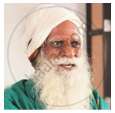
Identify the following personalities and their fields of achievement.
| Name | Field | |
 |
||
 |
||
 |
||
 |
||
 |
||
 |
||
 |
||
 |
- Mention a remarkable achievement of any of these personalities.
- What quality do you admire the most in each of these achievers?
- What are the qualities that you may share with them?
- Name a few more popular personalities who have made our nation proud.
- ______.
- ______.
- ______.
- ______.
Discuss the following topics in groups of five and choose a representative to sum up the views and share them with the class.
To succeed in life, one must have a single-minded devotion to duty.
Discuss the following topic in groups of five and choose a representative to sum up the view and share them with the class.
Successful people neither brood over the past nor worry about the future.
The historical background:
The poem is an extract from William Shakespeare’s play King Richard the Second. The play is based on true events that occurred towards the end of the 14th century.
Richard II was crowned the King of England in the year 1367. He continued to be the British Monarch until 1399, when he was deposed by his cousin, Henry of Bolingbroke, who crowned himself King Henry the Fourth in the same year. Shakespeare’s play is a dramatic rendition of the last two years of King Richard II’s life. In this brief span of time, he was ousted from his royal position and sent to prison, where he died in captivity.
The following extract is set in the Coast of Wales. King Richard and some of his followers awaited the arrival of the Welsh army [after facing defeat at the hands of his cousin, Bolingbroke], of about 10000 warriors. But to their shock and surprise, they received the message that the army was not coming to their rescue. His followers tried to boost their King’s courage against the news, only in vain. When Richard came face to face with the reality of his terrible fate, he spoke the following verse, famously known as the “Hollow Crown” speech in theatrical circles. In it, King Richard is reminded of the power of Death that overshadows everything else, including the power of rulers, and renders them as powerless as any commoner at a moment’s notice.
Fill in the blank with appropriate word from the box and complete the statement suitably:
Shravan never keeps his promises. His friends know that his words are ______.
How does the king establish that he and his subjects are equal in the end?
Read the poem once again carefully and identify the figure of speech that has been used in each of the following line from the poem:
“How can you say to me, I am a king?”
Read the poem once again carefully and identify the figure of speech that has been used in each of the following line from the poem:
“Scoffing his state and grinning at his pomp,…”
Based on your reading of King Richard’s speech, answer the following questions in about 100 - 150 words each. You may add your own ideas if required to present and justify your point of view.
Who does the future generations remember easily - the victor or the vanquished? Give reasons. Also, cite relevant references from King Richard’s speech.
