Advertisements
Advertisements
प्रश्न
How is the poet’s laugh reflected in the mirror?
Advertisements
उत्तर
The poet’s laugh in the mirror shows only his teeth, not his heart or human warmth. The teeth appear like a snake’s fangs. The false laughter could conceal enough poison to kill a person.
APPEARS IN
संबंधित प्रश्न
Guess what friendly words these two gentlemen exchange when shaking hands.
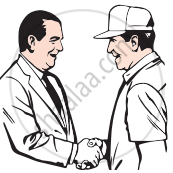
How does the poet compare his face with dresses?
Interpret each of the following expression used in the poem, in one or two line.
like a fixed portrait smile
Interpret each of the following expression used in the poem, in one or two line.
to unlearn all these muting things
Explain the things the poet has learnt when he grew into an adult.
‘Face is the index of the mind.’ Does this adage concur with the views of the poet?
The poet does not wish to exchange position with the runners. Why?
Find out the rhyme scheme of the given stanza.
One infant grows up and becomes a jockey
Another plays basketball or hockey
This one the prize ring hates to enter
That one becomes a tackle or center…
Why do accidents usually happen in the playground? Give your own examples and explain
Read the following line and identify the figure of speech used in each extract.
And ‘tis my faith that every flower
Enjoys the air it breathes.
The poem is set in a ______.
What scene in nature gives you pleasure? Talk for a minute describing a natural scene that gave you a lot of joy. What did you see, hear, smell or feel, that gave you joy?
When humanity fails to live in harmony with Nature, its effects are felt around the world. Why and how?
People admire some of these animal qualities. What are they? Have you noticed some of them in yourself or in others? Share your views with the class.
What makes the fakir stare in wonder?
Mention any two qualities of Macavity.
Describe the appearance and qualities of Macavity.
Give four instances where the poet has used alliteration in the poem.
Read the given line and answer the question that follow.
Honour is a property, common to all: In dignity and pride no one need to be poor.
- Who are considered rich?
- What is their asset?
In what way is every hillock similar to Everest?
Creative Activity
- Write eight words you associate with success.
- Use the words to write eight lines that mean success to you or how success makes you feel.
- Arrange your lines into a poem.
- Share your poem with the class and post a copy on the notice board.
Discuss the following topic in groups of five and choose a representative to sum up the view and share them with the class.
‘Success is not final, failure is not fatal.’ It is the courage and perseverance that counts.
Fill in the blank with appropriate word from the box and complete the statement suitably:
The spectators died laughing at the ______of the clown.
What do the three words, ‘graves, worms and epitaphs’, refer to?
How does the king establish that he and his subjects are equal in the end?
Explain the following line with reference to the context in about 5 to 8 line:
“How can you say to me, I am a king?”
Based on your reading of King Richard’s speech, answer the following questions in about 100 - 150 words each. You may add your own ideas if required to present and justify your point of view.
How are eternal truths and wisdom brought to the reader here?
Based on your reading of King Richard’s speech, answer the following questions in about 100 - 150 words each. You may add your own ideas if required to present and justify your point of view.
Death has been cited in many ways in this monologue. Identify the poetic devices used in those references.
