Advertisements
Advertisements
प्रश्न
Explain the following line with reference to the context in about four to five sentence each.
Have I not reason to lament
What Man has made of Man?
Advertisements
उत्तर
- Reference: These lines are from the poem “Lines Written in Early Spring” written by William Wordsworth.
- Context: William Wordsworth was inspired by a small woodland grove, a landscape of beauty. He came upon this spot when walking near Alford village. While sensing the blissful mood and happiness of birds, plants, creepers, and the murmuring brook, he juxtaposed what humans did to their kind in Napoleonic wars and amidst happy nature couldn’t help feeling sad. On that occasion, he said these words.
- Explanation: William Wordsworth derived extreme pleasure listening to the songs of birds and voiceless communication of joy between plants, twigs, and flowers. Though he could not fathom the meaning, he realized the blissful state of nature. But he remembered the depravity of man which was evident in Napoleonic wars. He was fed up with man’s capacity to destroy innocent lives and property. So, he lamented “what man has made of man”.
- Comment: The mixed feelings of happiness and sadness are well brought out.
APPEARS IN
संबंधित प्रश्न
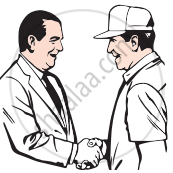
Guess what friendly words these two gentlemen exchange when shaking hands.
Read the line given below and answer the question that follow.
‘But now they only laugh with their teeth, While their ice-block-cold eyes…’
- Who are ‘they’?
- Explain: ice-block-cold eyes
- Identify the figure of speech used here.
Read the line given below and answer the question that follow.
‘Most of all, I want to relearn How to laugh, for my laugh in the mirror Shows only my teeth like a snake’s bare fangs!’
- Why does the poet want to relearn how to laugh?
- Whom does the poet want to relearn from?
- Mention the figure of speech used here.
Explain the things the poet has learnt when he grew into an adult.
Why does the poet feel glad that he does not play any game?
Are the athletes conscious of the feelings of others? Why do you say so?
Why does the poet prefer to buy tickets worth their weight in radium? Bring out the significance of the metal referred to here.
Read the poem and answer the following in a short paragraph of 8–10 sentences each.
When officialdom demands Is there a doctor in the stands?
- Why are doctors called from stands by the sponsors?
- Why does the poet make such an observation?
Explain the following with reference to the context in about 50–60 word each.
Athletes, I’ll drink to you, Or eat with you, Or anything except compete with you…
Underline the alliterated word in the following line.
They do not ever in their dealings…
What sort of encouragement should an athlete in India be given? Give a few suggestions.
The poet experiences sadness because ______.
Answer in a paragraph of about 100−150 words.
Do you think the poet wants to say that man is unhappy because he has lost his link with nature and forgotten how to enjoy nature, or because man is cruel to other men?
What scene in nature gives you pleasure? Talk for a minute describing a natural scene that gave you a lot of joy. What did you see, hear, smell or feel, that gave you joy?
Work in groups of 4−6. Discuss how you would preserve the environment and protect Nature. One or two representatives may share their ideas with the class.
What is Macavity’s nickname?
Read the poem once again and complete the summary using the words given in the box.
‘Macavity – The Mystery Cat’ is a humorous poem, where the poet T.S. Eliot describes the mysterious (a) _______of a shrewd vile cat. He commits a crime at every possible opportunity. He is an elusive master (b)______who leaves no evidence after he commits a crime. Even the Scotland Yard, the London (c) ______ agency is unable to arrest him. The Flying Squad is (d) ______ because every time they rush to the crime spot to seize Macavity, he is not there. He breaks the human law as well as the law of (e) ______. He baffles even a (f) ______ with his powers of levitation. Macavity appears tall and thin with (g)______ eyes. He is always preoccupied with some serious (h) ______. His coat is dusty and his (i)______are unkempt. Macavity is a (j) ______in the guise of a cat. He appears to be outwardly (k) ______ but his actions disprove it. Macavity loots the (l)______, ransacks the jewel-case, and breaks the (m)______glass but wonder of wonders he is not to be found anywhere there. He is always a mile away from the scene of crime, happily relaxing or doing difficult (n) ______ sums. He is clever at making up an (o) ______every time he plots a crime. All the notorious cats are nothing but the (p) ______Macavity, the Napoleon of Crime.
| larder | whiskers |
| respectable | criminal |
| devil | thought |
| sunken | division |
| agents | detective |
| alibi | desperate |
| fakir | qualities |
| gravity | greenhouse |
Give an account of Macavity’s destructive mischief.
Read the given lines and answer the question that follow.
Macavity’s a Mystery Cat: he’s called the Hidden Paw…
- Does the poet talk about a real cat?
- Why is he called the Hidden Paw?
Read the given lines and answer the question that follow.
He’s the bafflement of Scotland
Yard, the Flying Squad’s despair:
For when they reach the scene of crime
— Macavity’s not there!..
- What is ‘Scotland Yard’?
- Why does the flying squad feel disappointed?
Read the given lines and answer the question that follow.
And his footprints are not found in any file of Scotland Yard’s.
- What seems to be a challenge for the Scotland Yard?
- Why do they need his footprints?
Explain the following line with reference to the context.
And his footprints are not found in any file of Scotland Yard’s
Who are the ‘deserving ones’?
Which quality does the speaker wish to nourish? What is his mission?
Read the given line and answer the question that follow.
Our nature it is that whatever we try We do with devotion deep and true.
- Who does ‘we’ refer to?
- How should we carry out our duties?
Fill in the blank with appropriate word from the box and complete the statement suitably:
The fortress was ______and could not be conquered by the enemies.
What does the crown of rulers stand for?
How does the king establish that he and his subjects are equal in the end?
Read the poem once again carefully and identify the figure of speech that has been used in each of the following line from the poem:
“And yet not so – for what can we bequeath
Save our deposed bodies to the ground?”
