Advertisements
Advertisements
प्रश्न
Pick out the alliteration from the following lines:
“Our lands, our lives, and all, are Bolingbroke’s,…”
Advertisements
उत्तर
lands, fives
APPEARS IN
संबंधित प्रश्न
Guess what friendly words these two gentlemen exchange when shaking hands.
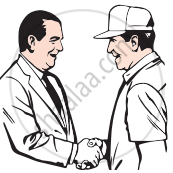
What is the relationship between the narrator and the listener?
Interpret each of the following expression used in the poem, in one or two line.
like a fixed portrait smile
Interpret each of the following expression used in the poem, in one or two line.
hands search my empty pockets
Explain the following lines with reference to the context.
Once upon a time, son They used to laugh with their eyes:
Why does the poet prefer to buy tickets worth their weight in radium? Bring out the significance of the metal referred to here.
How does the poet establish the victory of common sense over ego?
Underline the alliterated word in the following line.
They do not ever in their dealings…
Everybody is special and everybody is a hero. Each one has a story to tell. In the light of this observation, present your views.
Explain the following line with reference to the context in about four to five sentence each.
Have I not reason to lament
What Man has made of Man?
How do people bring grief and sorrow to one another?
People admire some of these animal qualities. What are they? Have you noticed some of them in yourself or in others? Share your views with the class.
Why is the Flying Squad frustrated?
Which two characters does the poet refer to as examples of wicked cats?
Read the poem once again and complete the summary using the words given in the box.
‘Macavity – The Mystery Cat’ is a humorous poem, where the poet T.S. Eliot describes the mysterious (a) _______of a shrewd vile cat. He commits a crime at every possible opportunity. He is an elusive master (b)______who leaves no evidence after he commits a crime. Even the Scotland Yard, the London (c) ______ agency is unable to arrest him. The Flying Squad is (d) ______ because every time they rush to the crime spot to seize Macavity, he is not there. He breaks the human law as well as the law of (e) ______. He baffles even a (f) ______ with his powers of levitation. Macavity appears tall and thin with (g)______ eyes. He is always preoccupied with some serious (h) ______. His coat is dusty and his (i)______are unkempt. Macavity is a (j) ______in the guise of a cat. He appears to be outwardly (k) ______ but his actions disprove it. Macavity loots the (l)______, ransacks the jewel-case, and breaks the (m)______glass but wonder of wonders he is not to be found anywhere there. He is always a mile away from the scene of crime, happily relaxing or doing difficult (n) ______ sums. He is clever at making up an (o) ______every time he plots a crime. All the notorious cats are nothing but the (p) ______Macavity, the Napoleon of Crime.
| larder | whiskers |
| respectable | criminal |
| devil | thought |
| sunken | division |
| agents | detective |
| alibi | desperate |
| fakir | qualities |
| gravity | greenhouse |
Describe the appearance and qualities of Macavity.
Explain the following line with reference to the context.
And his footprints are not found in any file of Scotland Yard’s
Explain the following line with reference to the context.
There may be a scrap of paper in the hall or on the stair
But it’s useless to investigate…
What does ‘Everest’ in the title stand for?
The poem does not focus on the destination but the journey towards it. Discuss
Discuss the following topic in groups of five and choose a representative to sum up the view and share them with the class.
Successful people neither brood over the past nor worry about the future.
Work with a partner and take this short quiz to find out how well-informed you are about history.
- Name a few wars and battles you have read about.
- What is the difference between a war and a battle?
- Why do rulers wage wars and battles?
- Is the outcome of a war always fair?
- Do you think rulers understand the true meaning of life – in defeat or in victory?
- Can you name a few kings and leaders who have fallen from glory to disgrace?
Complete the passage given below, with suitable words from the box:
Lima, a (a)______and (b)______woman, kept (c)______at her colleagues and went on taxing them with hard labour. Though they were (d) ______to her, she being their head, they were offended and filled with (e)______. It so happened, that Lima was (f)______from her high position due to a serious blunder she had committed. Lima, having lost all her (g)______and glory, realized how arrogant she had been. She gave up her pride and with (h)______sought an apology from everyone. She thus turned over a new leaf and bid (i)______to them.
| farewell | ceremonious | deposed |
| reverence | vain | pomp |
| conceited | sorrow | scoffing |
What do the three words, ‘graves, worms and epitaphs’, refer to?
What does the executor mentioned in the poem do?
What are the various functions and objects given up by a defeated king?
How does the king establish that he and his subjects are equal in the end?
Explain the following line with reference to the context in about 5 to 8 line:
“How can you say to me, I am a king?”
Read the poem once again carefully and identify the figure of speech that has been used in each of the following line from the poem:
“Bores through his castle wall, and farewell king!”
Pick out the alliteration from the following lines:
“Comes at the last, and with a little pin…”
