Advertisements
Advertisements
प्रश्न
Read the poem and answer the following in a short paragraph of 8–10 sentences each.
When officialdom demands Is there a doctor in the stands?
- Why are doctors called from stands by the sponsors?
- Why does the poet make such an observation?
Advertisements
उत्तर
- The doctors are called from the stands by the sponsors to attend to a badly hurt and bleeding athlete.
- The poet does not wish to swap place with either heroes or victims of brutal sports. So, he makes this remark. ,
APPEARS IN
संबंधित प्रश्न
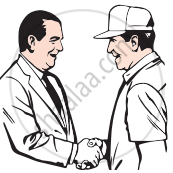
Guess what friendly words these two gentlemen exchange when shaking hands.
Interpret each of the following expression used in the poem, in one or two line.
like a fixed portrait smile
This poem is nothing but a criticism of modern life. Justify this statement.
Underline the alliterated word in the following line.
They do not ever in their dealings…
Do you go for leisurely walks? If you are a city-dweller, what or who would you expect to see on your way?
If you go to a village, what scenes would you observe?
Read the lines given below and answer the question that follow.
And ‘tis my faith that every flower
Enjoys the air it breathes…
- What is the poet’s faith?
- What trait of Nature do we see here?
Answer in a paragraph of about 100−150 words.
Do you think the poet wants to say that man is unhappy because he has lost his link with nature and forgotten how to enjoy nature, or because man is cruel to other men?
What scene in nature gives you pleasure? Talk for a minute describing a natural scene that gave you a lot of joy. What did you see, hear, smell or feel, that gave you joy?
Work in groups of 4−6. Discuss how you would preserve the environment and protect Nature. One or two representatives may share their ideas with the class.
Write a letter to the Councillor of your Ward, explaining why a park is necessary in your locality.
People admire some of these animal qualities. What are they? Have you noticed some of them in yourself or in others? Share your views with the class.
Mention any two qualities of Macavity.
Read the poem once again and complete the summary using the words given in the box.
‘Macavity – The Mystery Cat’ is a humorous poem, where the poet T.S. Eliot describes the mysterious (a) _______of a shrewd vile cat. He commits a crime at every possible opportunity. He is an elusive master (b)______who leaves no evidence after he commits a crime. Even the Scotland Yard, the London (c) ______ agency is unable to arrest him. The Flying Squad is (d) ______ because every time they rush to the crime spot to seize Macavity, he is not there. He breaks the human law as well as the law of (e) ______. He baffles even a (f) ______ with his powers of levitation. Macavity appears tall and thin with (g)______ eyes. He is always preoccupied with some serious (h) ______. His coat is dusty and his (i)______are unkempt. Macavity is a (j) ______in the guise of a cat. He appears to be outwardly (k) ______ but his actions disprove it. Macavity loots the (l)______, ransacks the jewel-case, and breaks the (m)______glass but wonder of wonders he is not to be found anywhere there. He is always a mile away from the scene of crime, happily relaxing or doing difficult (n) ______ sums. He is clever at making up an (o) ______every time he plots a crime. All the notorious cats are nothing but the (p) ______Macavity, the Napoleon of Crime.
| larder | whiskers |
| respectable | criminal |
| devil | thought |
| sunken | division |
| agents | detective |
| alibi | desperate |
| fakir | qualities |
| gravity | greenhouse |
Describe the appearance and qualities of Macavity.
Give four instances where the poet has used alliteration in the poem.
Which quality does the speaker wish to nourish? What is his mission?
Which path should we follow in life?
Read the given line and answer the question that follow.
Defeat we repel, courage our fort;
- How do we react to defeat?
- Which is considered as our stronghold?
Work with a partner and take this short quiz to find out how well-informed you are about history.
- Name a few wars and battles you have read about.
- What is the difference between a war and a battle?
- Why do rulers wage wars and battles?
- Is the outcome of a war always fair?
- Do you think rulers understand the true meaning of life – in defeat or in victory?
- Can you name a few kings and leaders who have fallen from glory to disgrace?
Fill in the blank with appropriate word from the box and complete the statement suitably:
The spectators died laughing at the ______of the clown.
Fill in the blank with appropriate word from the box and complete the statement suitably:
The fortress was ______and could not be conquered by the enemies.
Bring out King Richard’s feelings when he was defeated.
Explain the following line with reference to the context in about 5 to 8 line:
All murdered – for within the hollow crown
That rounds the mortal temples of a king Keeps Death his court, …”
Explain the following line with reference to the context in about 5 to 8 line:
“How can you say to me, I am a king?”
Read the poem once again carefully and identify the figure of speech that has been used in each of the following line from the poem:
“And yet not so – for what can we bequeath
Save our deposed bodies to the ground?”
Based on your reading of King Richard’s speech, answer the following questions in about 100 - 150 words each. You may add your own ideas if required to present and justify your point of view.
Who does the future generations remember easily - the victor or the vanquished? Give reasons. Also, cite relevant references from King Richard’s speech.
