Advertisements
Advertisements
Question
Pick out the alliteration from the following lines:
“Our lands, our lives, and all, are Bolingbroke’s,…”
Advertisements
Solution
lands, fives
APPEARS IN
RELATED QUESTIONS
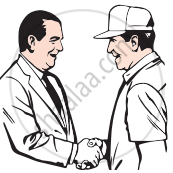
Guess what friendly words these two gentlemen exchange when shaking hands.
Interpret each of the following expression used in the poem, in one or two line.
to unlearn all these muting things
This poem is nothing but a criticism of modern life. Justify this statement.
Are the athletes conscious of the feelings of others? Why do you say so?
Find out the rhyme scheme of the given stanza.
One infant grows up and becomes a jockey
Another plays basketball or hockey
This one the prize ring hates to enter
That one becomes a tackle or center…
Would you like to exchange your place with someone else? Why/why not?
You are the School Pupil Leader. Mention some qualities that can be drawn from the field of sports to improve your leadership skills.
Explain the following line with reference to the context in about four to five sentence each.
The birds around me hopp’d and play’d,
Their thoughts I cannot measure.
Does Nature affect a person’s thoughts and feelings? Explain.
The poem is set in a ______.
Which two characters does the poet refer to as examples of wicked cats?
Read the given lines and answer the question that follow.
Macavity’s a Mystery Cat: he’s called the Hidden Paw…
- Does the poet talk about a real cat?
- Why is he called the Hidden Paw?
Read the given lines and answer the question that follow.
There never was a Cat of such deceitfulness and suavity.
- Which cat is being talked of here?
- How is he different from the rest?
Pick out all the pairs of rhyming words used in the poem.
Which line is repeated in the poem? What is the effect created by this repetition?
Which quality does the speaker wish to nourish? What is his mission?
Read the given line and answer the question that follow.
Our nature it is that whatever we try We do with devotion deep and true.
- Who does ‘we’ refer to?
- How should we carry out our duties?
Fill in the blank with appropriate word from the box and complete the statement suitably:
The business woman wished to ______all her riches to an orphanage, after her death.
Fill in the blank with appropriate word from the box and complete the statement suitably:
Alexander the Great, wished to conquer many lands and ______the entire world.
Complete the passage given below, with suitable words from the box:
Lima, a (a)______and (b)______woman, kept (c)______at her colleagues and went on taxing them with hard labour. Though they were (d) ______to her, she being their head, they were offended and filled with (e)______. It so happened, that Lima was (f)______from her high position due to a serious blunder she had committed. Lima, having lost all her (g)______and glory, realized how arrogant she had been. She gave up her pride and with (h)______sought an apology from everyone. She thus turned over a new leaf and bid (i)______to them.
| farewell | ceremonious | deposed |
| reverence | vain | pomp |
| conceited | sorrow | scoffing |
What does the executor mentioned in the poem do?
Are all deposed kings slain by the deposer?
What does the crown of rulers stand for?
Read the poem once again carefully and identify the figure of speech that has been used in each of the following line from the poem:
“And yet not so – for what can we bequeath
Save our deposed bodies to the ground?”
Read the poem once again carefully and identify the figure of speech that has been used in each of the following line from the poem:
“Scoffing his state and grinning at his pomp,…”
Read the poem once again carefully and identify the figure of speech that has been used in each of the following line from the poem:
“Bores through his castle wall, and farewell king!”
Pick out the alliteration from the following lines:
“Comes at the last, and with a little pin…”
Based on your reading of King Richard’s speech, answer the following questions in about 100 - 150 words each. You may add your own ideas if required to present and justify your point of view.
What are the causes for King Richard’s grief?
