Advertisements
Advertisements
Question
What does ‘Everest’ in the title stand for?
Advertisements
Solution
‘Everest’ means the greatest achievement in life or the highest point one can reach in life.
APPEARS IN
RELATED QUESTIONS
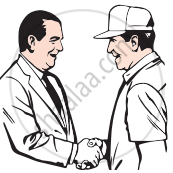
Guess what friendly words these two gentlemen exchange when shaking hands.
What do you associate with the title of the poem?
Interpret each of the following expression used in the poem, in one or two line.
laugh with their eyes
Explain the following line with reference to the context.
There will be no thrice.
This poem is nothing but a criticism of modern life. Justify this statement.
Why does the poet feel glad that he does not play any game?
The poet is satisfied just watching the heroic deeds of others. What could be the reason?
Read the given lines and answer the questions that follow in a sentence or two.
With all my heart I do admire
Athletes who sweat for fun or hire
- Whom does the poet admire?
- For what reasons do the athletes sweat?
Everybody is special and everybody is a hero. Each one has a story to tell. In the light of this observation, present your views.
Listening Activity
Some phrases have been left out in the poem below. First, read the poem. Then, fill in the missing words on listening to the reading or the recording of it in full. You may listen again, if required
To Autumn
O Autumn, laden with fruit, and stained
With the blood of the grape, pass not, but sit
Beneath my ______, there thou may’st rest,
And tune thy jolly voice to my ______;
And all the daughters of the year shall dance!
Sing now the ______of fruits and flowers.
“The ______opens her beauties to
The sun, and love runs in her ______;
Blossoms hang round the brows of morning and
Flourish down the ______of modest eve,
Till clust’ring Summer breaks forth into singing,
And ______strew flowers round her head.
The spirits of the air live on the smells
Of fruit; and joy, with ______, roves round
The gardens, or sits singing in the trees.”
Thus sang the ______as he sat,
Then rose, girded himself, and o’er the bleak
Hills fled from our sight; but left his ______.
William Blake
When humanity fails to live in harmony with Nature, its effects are felt around the world. Why and how?
A French proverb goes thus: ‘The dog may be wonderful prose, but only the cat is poetry.’ You may have observed that all animals possess a number of unique qualities. Fill in the columns with words and phrases associated with each of the following animals.
| DOG | CAT | WOLF | ELEPHANT |
Where can you encounter Macavity?
Who does the Secret Service suspect when a loss is reported?
Why is Macavity called the ‘Napoleon of Crime’?
Read the given lines and answer the question that follow.
He sways his head from side to
side, with movements like a snake;
And when you think he’s half asleep,
he’s always wide awake…
- Explain the comparison made here.
- What does he pretend to do?
Explain the following line with reference to the context.
And when you think he’s half asleep, he’s always wide awake
Explain the following line with reference to the context.
He always has an alibi, and one or two to spare
What is the rhyme scheme used in the poem?
Who are the ‘deserving ones’?
Read the given line and answer the question that follow.
Our nature it is that whatever we try We do with devotion deep and true.
- Who does ‘we’ refer to?
- How should we carry out our duties?
Read the given line and answer the question that follow.
He, who does not stoop, is a king we adore. We bow before competence and merit;
- Who is adored as a king?
- What is the figure of speech used in the first line?
In what way is every hillock similar to Everest?
The poem does not focus on the destination but the journey towards it. Discuss
Who is Bolingbroke? Is he a friend or foe?
What are the various functions and objects given up by a defeated king?
Bring out King Richard’s feelings when he was defeated.
Explain the following line with reference to the context in about 5 to 8 line:
“Our lands, our lives, and all are Bolingbroke’s,
And nothing can we call our own but death;”
Read the poem once again carefully and identify the figure of speech that has been used in each of the following line from the poem:
“Scoffing his state and grinning at his pomp,…”
