Advertisements
Advertisements
Question
The poet does not wish to exchange places with the athletes. How does he justify his view?
Advertisements
Solution
In the very first stanza, the poet admits that right from his boyhood days, he was glad to watch others play all kinds of games including boxing. He was glad that he was not one of them. His limp and bashful spirit feeds on the heroism of other players. He watches with a palpitating heart when ‘A’ runs ninety yards to bag a medal. He watches with obvious alarm when ‘B’ knocks another boxer down cracking his vertebrae and spines. The players maim each other. His ego would never be pleased to swap places with such popular players. He listens to the mention of prudence/common sense and refrains from hurting himself or others by not participating in any game whatsoever. Thus he justifies his view to continue as a spectator.
APPEARS IN
RELATED QUESTIONS
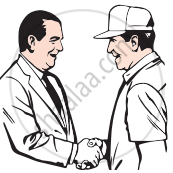
Guess what friendly words these two gentlemen exchange when shaking hands.
What do you associate with the title of the poem?
What pleasantries does the poet use to fake cordiality?
How is the poet’s laugh reflected in the mirror?
Interpret each of the following expression used in the poem, in one or two line.
laugh with their eyes
Interpret each of the following expression used in the poem, in one or two line.
to unlearn all these muting things
Explain the following line with reference to the context.
I have learned to wear my faces Like dresses …
Explain the following lines with reference to the context.
I want to be what I used to be.
Explain the things the poet has learnt when he grew into an adult.
Not everybody loves to play and participate in games, sports and other extra-curricular activities. Some of us wish to be mere spectators. List out the activities in which you like to be either a performer or a spectator. Share your views with the class.
| Activities | ||
| performer/player | spectator/audience | |
| e.g. | cricket | magician |
| a. | ||
| b. | ||
| c. | ||
| d. | ||
| e. | ||
Do you think the narrator is heroic? Why?
The poet is satisfied just watching the heroic deeds of others. What could be the reason?
Why does the poet prefer to buy tickets worth their weight in radium? Bring out the significance of the metal referred to here.
Read the given line and answer the question that follow in a sentence or two
When snaps the knee and cracks the wrist….
Identify and explain the use of the literary device in this line.
Why do accidents usually happen in the playground? Give your own examples and explain
What sort of encouragement should an athlete in India be given? Give a few suggestions.
Why does the poet think that the birds were happy?
Work in groups of 4−6. Discuss how you would preserve the environment and protect Nature. One or two representatives may share their ideas with the class.
Which two characters does the poet refer to as examples of wicked cats?
Read the given lines and answer the question that follow.
He sways his head from side to
side, with movements like a snake;
And when you think he’s half asleep,
he’s always wide awake…
- Explain the comparison made here.
- What does he pretend to do?
Explain the following line with reference to the context.
And when you think he’s half asleep, he’s always wide awake
Discuss the following topics in groups of five and choose a representative to sum up the views and share them with the class.
To succeed in life, one must have a single-minded devotion to duty.
The historical background:
The poem is an extract from William Shakespeare’s play King Richard the Second. The play is based on true events that occurred towards the end of the 14th century.
Richard II was crowned the King of England in the year 1367. He continued to be the British Monarch until 1399, when he was deposed by his cousin, Henry of Bolingbroke, who crowned himself King Henry the Fourth in the same year. Shakespeare’s play is a dramatic rendition of the last two years of King Richard II’s life. In this brief span of time, he was ousted from his royal position and sent to prison, where he died in captivity.
The following extract is set in the Coast of Wales. King Richard and some of his followers awaited the arrival of the Welsh army [after facing defeat at the hands of his cousin, Bolingbroke], of about 10000 warriors. But to their shock and surprise, they received the message that the army was not coming to their rescue. His followers tried to boost their King’s courage against the news, only in vain. When Richard came face to face with the reality of his terrible fate, he spoke the following verse, famously known as the “Hollow Crown” speech in theatrical circles. In it, King Richard is reminded of the power of Death that overshadows everything else, including the power of rulers, and renders them as powerless as any commoner at a moment’s notice.
Fill in the blanks using the words given in the box to complete the summary of the poem:
King Richard the Second, had surrendered to his (a)______cousin, Bollingbroke. He experienced deep distress at the horror of his circumstances. In that desperate situation, he speaks of (b)______, (c)______, (d)______and other things connected with death. He spoke of how people leave nothing behind and can call nothing their own, except for the small patch of (e)______, where they will be buried. King Richard yielded to dejection and talked of all the different ways in which defeated kings suffer how some had been deposed, (f)______in war, (g)______by their wives and so forth. He attributed this loss of lives to (h)______, who he personified as the jester who watches over the shoulder of every ruler, who mocks kings by allowing them to think their human flesh, was like (i)______brass. However, Death penetrates through the castle walls, silently and unnoticed like a sharp (j)______, thus bidding (k)______to him and all his pride forever. Finally, Richard appealed to his soldiers not to mock his mere flesh and blood by showing (l) ______and respect to him. He added that he too needed bread to live, felt want, tasted (m)______and needed (n)______. He concluded thus, urging his men not to call him a (o)______as he was only human, just like the rest of them.
| barren-earth | friends | graves | slain |
| rebellious | poisoned | worms | grief |
| impregnable | epitaphs | death | farewell |
| reverence | king | pin |
Fill in the blank with appropriate word from the box and complete the statement suitably:
The spectators died laughing at the ______of the clown.
What are the various functions and objects given up by a defeated king?
How does the king establish that he and his subjects are equal in the end?
Explain the following line with reference to the context in about 5 to 8 line:
“Our lands, our lives, and all are Bolingbroke’s,
And nothing can we call our own but death;”
Read the poem once again carefully and identify the figure of speech that has been used in each of the following line from the poem:
“Keeps Death his court, and there the antic sits,…”
Based on your reading of King Richard’s speech, answer the following questions in about 100 - 150 words each. You may add your own ideas if required to present and justify your point of view.
How are eternal truths and wisdom brought to the reader here?
