Advertisements
Advertisements
प्रश्न
‘Face is the index of the mind.’ Does this adage concur with the views of the poet?
Advertisements
उत्तर
Unlike the people of the past, people in modem times “laugh only with their teeth” while their ice-block cold eyes search for something. Now, people shake hands without hearts. There is no human warmth in social relations. While they shake hands, they look for. evidence to judge the financial status of a person. People say ‘feel at home and ‘come again’.
But if a person visits a third time he is not welcomed. They all have cocktail faces ready for all occasions. Their conforming smiles are like fixed portrait smiles. They wear a standard, deceitful, artificial smile for all occasions. They have faces like masks. The poet has learned from them how to use faces like dresses, home face, office face, street face, host face, etc. Their faces, like the teeth of the elephant, show only what is accepted. The ugly side of their personality is cleverly hidden behind their deceitful smiles and polite words. So, the poet’s views do not concur with the adage “Face is the index of the mind”.
APPEARS IN
संबंधित प्रश्न
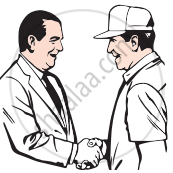
Guess what friendly words these two gentlemen exchange when shaking hands.
What do you associate with the title of the poem?
How is the poet’s laugh reflected in the mirror?
Interpret each of the following expression used in the poem, in one or two line.
shake hands without hearts
Read the line given below and answer the question that follow.
‘Most of all, I want to relearn How to laugh, for my laugh in the mirror Shows only my teeth like a snake’s bare fangs!’
- Why does the poet want to relearn how to laugh?
- Whom does the poet want to relearn from?
- Mention the figure of speech used here.
Explain the following line with reference to the context.
There will be no thrice.
Why does the poet feel glad that he does not play any game?
Why does the poet prefer to buy tickets worth their weight in radium? Bring out the significance of the metal referred to here.
Read the poem again and complete the summary using the words given in the box.
In the poem ‘Confessions of a Born Spectator,’ Ogden Nash talks about how people choose different sports in their lives or decide to become athletes. While admiring the talents of athletes and sportsmen, the poet (i)______he is glad that he is neither a sportsman nor an athlete. Children have different (ii)______and wish to play various games. Each child has in mind something in particular, but the narrator is (iii)______he is not one of the players. Though the narrator (iv) ______the talents of all athletes, he derives satisfaction from watching them, but does not wish to (v) ______places with them. He also sometimes regrets that (vi)______athletes play rough games without caring for the feelings of their sporting rivals. He feels that good sense and caution win over ego. The narrator wholeheartedly offers (vii) ______the modest (viii) ______of athletes. Ultimately the narrator is (ix)______that he himself is not an athlete.
|
thanksgiving exchange glad confesses physiques zealous satisfied aims admires |
How does the poet establish the victory of common sense over ego?
According to the poet, what contributes most to the injuries sustained by the athletes?
Explain the following with reference to the context in about 50–60 word each.
I am just glad as glad can be That I am not them, that they are not me…
Underline the alliterated word in the following line.
They do not ever in their dealings…
You are the School Pupil Leader. Mention some qualities that can be drawn from the field of sports to improve your leadership skills.
Read the lines given below and answer the question that follow.
And I must think, do all I can,
That there was pleasure there…
- What did the poet notice about the twigs?
- What was the poet’s thought about then?
How do people bring grief and sorrow to one another?
Why does the poet think that the birds were happy?
Answer in a paragraph of about 100−150 words.
Do you think the poet wants to say that man is unhappy because he has lost his link with nature and forgotten how to enjoy nature, or because man is cruel to other men?
What scene in nature gives you pleasure? Talk for a minute describing a natural scene that gave you a lot of joy. What did you see, hear, smell or feel, that gave you joy?
Write a letter to the Councillor of your Ward, explaining why a park is necessary in your locality.
Explain the following line with reference to the context.
He always has an alibi, and one or two to spare
Identify the literary devices used in the following lines:
- He sways his head from side to side, with movements like a snake.
- They say he cheats at cards.
Who are the ‘deserving ones’?
Fill in the blank with appropriate word from the box and complete the statement suitably:
The business woman wished to ______all her riches to an orphanage, after her death.
What does the executor mentioned in the poem do?
What does ‘flesh’ mean here?
Explain the following line with reference to the context in about 5 to 8 line:
All murdered – for within the hollow crown
That rounds the mortal temples of a king Keeps Death his court, …”
Working with your partner, discuss the following adages and share your views with the class. You may need to give your ideas and justify your point of view. Remember to take turns while making your presentation/short speech.
War begets war
Read the poem once again carefully and identify the figure of speech that has been used in each of the following line from the poem:
“And yet not so – for what can we bequeath
Save our deposed bodies to the ground?”
Read the poem once again carefully and identify the figure of speech that has been used in each of the following line from the poem:
“Keeps Death his court, and there the antic sits,…”
