Advertisements
Advertisements
प्रश्न
Find words from the poem that convey the following ideas:
- connected together
- spread over the surface of the ground in a straggling manner
- make out or understand
- slender woody shoots growing from branches or stems of trees
Advertisements
उत्तर
- blended
- tailed
- reason
- twigs
APPEARS IN
संबंधित प्रश्न
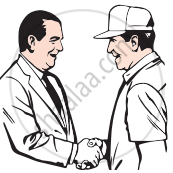
Guess what friendly words these two gentlemen exchange when shaking hands.
What do you associate with the title of the poem?
Interpret each of the following expression used in the poem, in one or two line.
shake hands without hearts
Explain the following line with reference to the context.
There will be no thrice.
Explain the following lines with reference to the context.
I want to be what I used to be.
Are the athletes conscious of the feelings of others? Why do you say so?
The poet does not wish to exchange places with the athletes. How does he justify his view?
Read the given lines and answer the questions that follow in a sentence or two.
With all my heart I do admire
Athletes who sweat for fun or hire
- Whom does the poet admire?
- For what reasons do the athletes sweat?
Explain the following with reference to the context in about 50–60 word each.
They do not ever in their dealings Consider one another’s feelings…
Find out the rhyme scheme of the given stanza.
One infant grows up and becomes a jockey
Another plays basketball or hockey
This one the prize ring hates to enter
That one becomes a tackle or center…
Why do accidents usually happen in the playground? Give your own examples and explain
You are the School Pupil Leader. Mention some qualities that can be drawn from the field of sports to improve your leadership skills.
Do you go for leisurely walks? If you are a city-dweller, what or who would you expect to see on your way?
Why does the poet think that the birds were happy?
The poet finds joy in various objects of Nature. Explain.
The poem is set in a ______.
Listening Activity
Some phrases have been left out in the poem below. First, read the poem. Then, fill in the missing words on listening to the reading or the recording of it in full. You may listen again, if required
To Autumn
O Autumn, laden with fruit, and stained
With the blood of the grape, pass not, but sit
Beneath my ______, there thou may’st rest,
And tune thy jolly voice to my ______;
And all the daughters of the year shall dance!
Sing now the ______of fruits and flowers.
“The ______opens her beauties to
The sun, and love runs in her ______;
Blossoms hang round the brows of morning and
Flourish down the ______of modest eve,
Till clust’ring Summer breaks forth into singing,
And ______strew flowers round her head.
The spirits of the air live on the smells
Of fruit; and joy, with ______, roves round
The gardens, or sits singing in the trees.”
Thus sang the ______as he sat,
Then rose, girded himself, and o’er the bleak
Hills fled from our sight; but left his ______.
William Blake
A French proverb goes thus: ‘The dog may be wonderful prose, but only the cat is poetry.’ You may have observed that all animals possess a number of unique qualities. Fill in the columns with words and phrases associated with each of the following animals.
| DOG | CAT | WOLF | ELEPHANT |
Which law does Macavity break?
Who are the ‘deserving ones’?
What does ‘hillock’ refer to in the line ‘Every hillock has a summit to boast!’?
What does the ladder symbolize?
Discuss the following topic in groups of five and choose a representative to sum up the view and share them with the class.
Successful people neither brood over the past nor worry about the future.
Fill in the blank with appropriate word from the box and complete the statement suitably:
The spectators died laughing at the ______of the clown.
What are the various functions and objects given up by a defeated king?
How does the king establish that he and his subjects are equal in the end?
Explain the following line with reference to the context in about 5 to 8 line:
“How can you say to me, I am a king?”
Read the poem once again carefully and identify the figure of speech that has been used in each of the following line from the poem:
“Scoffing his state and grinning at his pomp,…”
Based on your reading of King Richard’s speech, answer the following questions in about 100 - 150 words each. You may add your own ideas if required to present and justify your point of view.
How are eternal truths and wisdom brought to the reader here?
